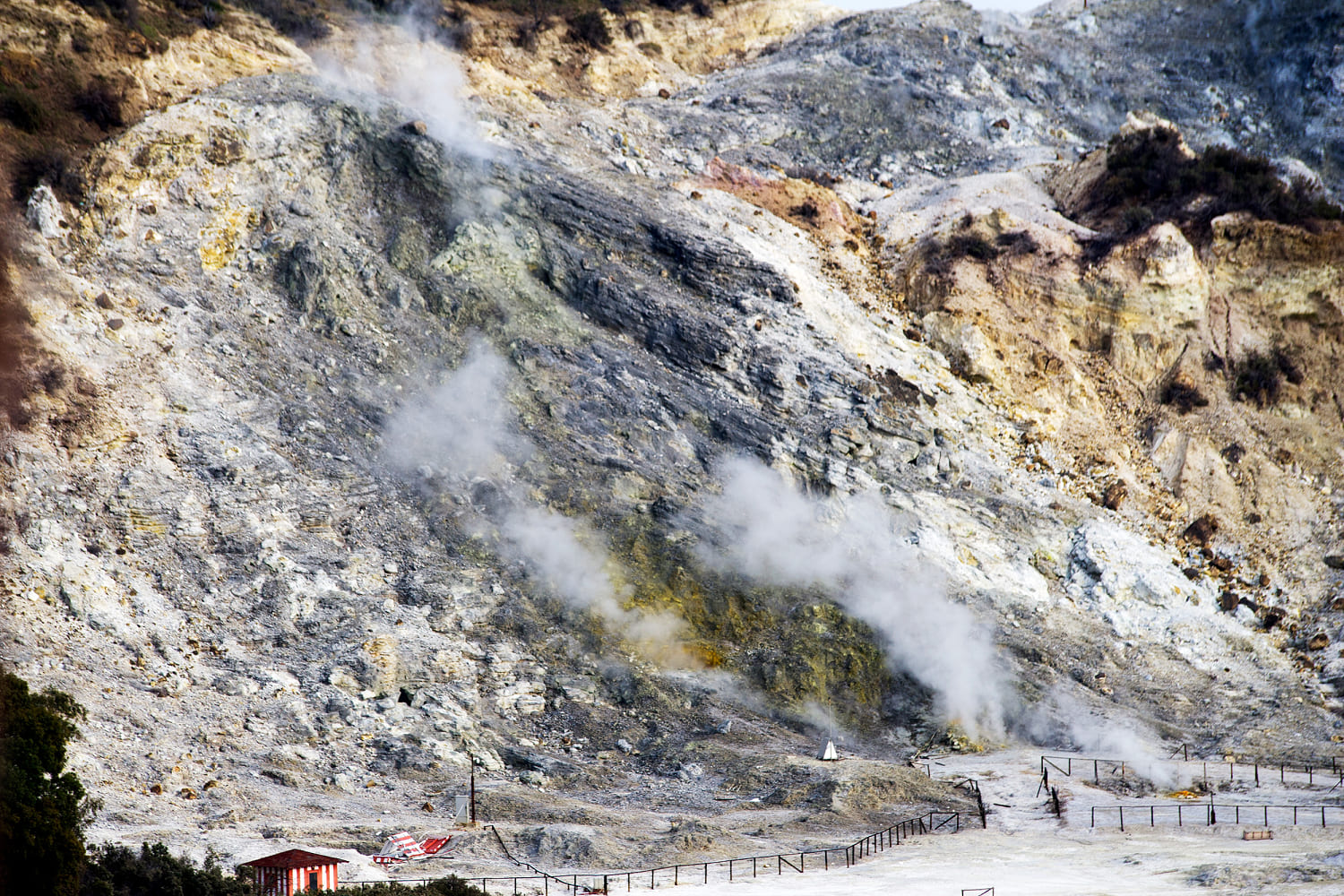
The last time Campi Flegrei erupted was in 1538, and one of the system’s biggest explosions occurred around 39,000 years ago.
In September, the former head of the Vesuvius observatory at Italy’s National Institute of Geophysics and Volcanology told Reuters that the earthquake swarms were causing ground uplift in the area, which could lead to structural damage in the port town of Pozzuoli, located roughly 20 miles outside of Naples.
Christopher Kilburn, a professor of volcanology and geophysical hazards at University College London, said the last period of seismic unrest at Campi Flegrei was in the 1980s. Kilburn said the ground in the town of Pozzuoli was lifted nearly 2 meters, or almost 6.5 feet, over two years.
Still, there was no big eruption.
Fast-forward to today, and Kilburn said there are some key differences with the seismic unrest that has been observed.
“The difference is that today, the uplift has been a bit more than 1 meter, but over 20 years, not two,” he said. “And so this whole uplift has lasted 10 times longer and it has been about 10 times slower.”
Still, Kilburn thinks the current activity at Campi Flegrei indicates that the structure of the volcano’s crust is changing. In a study published in June in the journal Communications Earth & Environment, Kilburn and his colleagues used a model to analyze the volcano’s behavior and found that the crust of Campi Flegrei is becoming weaker, making it more prone to rupturing.
But even if the crust reaches its breaking point, that wouldn’t necessarily have catastrophic consequences, Kilburn said.
“If there’s a rupture, there is no guarantee that magma is going to erupt,” he said. “And that’s why with the observatory there, the official releases cover anything from just an increase in seismicity through to a small eruption, because we can’t really tell where we are in that just yet.”
Calderas are often difficult to study because they are vast depressions over top of huge magmatic systems. Campi Flegrei, for instance, stretches 7 to 9 miles across. The Long Valley Caldera in California is about 10 miles wide. And one of the most famous calderas in the world, at Yellowstone National Park, measures 30 miles by 45 miles, according to the U.S. National Park Service.
Coincidentally, the Long Valley Caldera also saw an uptick in earthquake activity in the 1980s and has been seismically stirring for decades, but scientists have been less concerned overall about a major eruption there in the foreseeable future. That’s because there have been signs that the magma beneath it has been cooling.
Ettore Biondi, a research scientist in the division of geological and planetary sciences at the California Institute of Technology, has tried to understand what has been unfolding in recent decades at the Long Valley Caldera.
Biondi and his colleagues published a study last month in the journal Science Advances detailing a novel way of gathering acoustic sensing data with fiber-optic cables to capture snapshots of what is happening beneath the caldera’s surface.
An eruption cannot be ruled out completely, but the researchers found that a solid rock structure is actually covering the magma chamber at the Long Valley Caldera, which is likely preventing big eruptions from occurring.
“That doesn’t imply that you can’t have smaller eruptions, but from a supervolcanic eruption perspective, I think as of now we are on the safe side,” Biondi said.
He added that this method of gathering high-resolution underground images could be used at other volcano systems around the world, and particularly at ones that are not well understood. The results could help scientists better anticipate what is happening at volcanoes when they start to stir.
“For certain volcanoes, we know very well what’s going on,” Biondi said. “For other volcanoes, we have no idea.”
The inability to create reliable eruption forecasts owes largely to the fact that volcano systems are so varied. The way one volcano comes to life is not necessarily how others around the world signal an eruption is imminent.
“We have to spend a lot of time on the volcanic system, monitoring it to understand what’s normal at that volcano, and then be able to recognize when something becomes abnormal,” said Poland, of the U.S. Geological Survey.
Yellowstone, for instance, is hit by an average of around 2,000 earthquakes every year, and that seismic activity is not considered out of the ordinary, he said.
At places like Campi Flegrei and the Long Valley Caldera, scientists have been putting in the work to understand what all the rumblings and geological changes really mean.
“Volcanoes are sort of like people — they all have their own personality,” Poland said. “A big part of volcanology and monitoring active volcanoes is getting to understand the personality of the specific volcanoes that you’re interested in. And some volcanoes are noisier than others.”