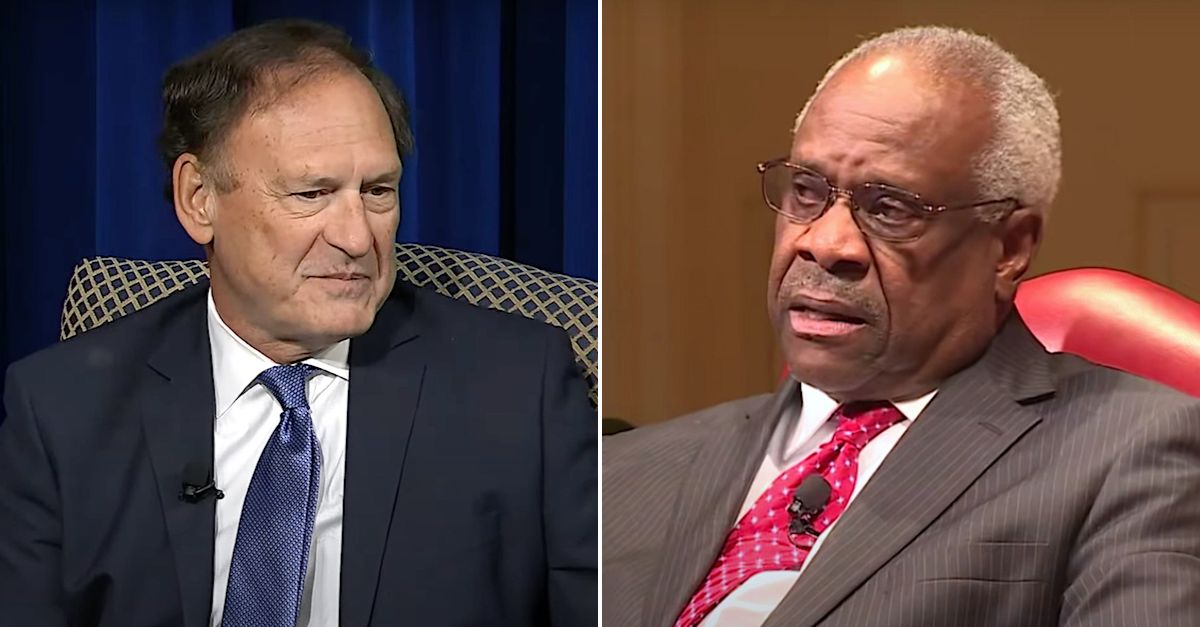
Left, Associate Justice of the Supreme Court Samuel Alito. (Image via YouTube screengrab/The Heritage Foundation.) Right, Associate Justice of the Supreme Court Clarence Thomas.
(Image via YouTube/Library of Congress.)
Supreme Court Justice Clarence Thomas penned and Justice Samuel Alito joined a dissent on Monday in a case about a Virginia Tech University policy for “bias intervention and response,” urging fellow justices to “resolve” once and for all the “high-stakes issue” of whether “bias-reporting schemes” tend to “objectively chill students’ speech.”
The dissent came at the end of an orders list, where SCOTUS granted Speech First, Inc.’s petition for a writ of certiorari but vacated the judgment below and “remanded to the United States Court of Appeals for the Fourth Circuit with instructions to dismiss those claims as moot,” since the university changed its policy before the petition was filed. Thomas and Alito joined together to say they would have granted the petition and heard the case, calling it a “high-stakes issue for our Nation’s system of higher education.”
Justice Thomas, noting that Speech First likened “bias reporting schemes” on campus to “a literal speech police,” said the petition “raises an important question affecting universities nationwide.”
“I have serious concerns that bias response policies, such as Virginia Tech’s, objectively chill students’ speech,” he wrote, especially in light of the U.S. Court of Appeals for the Fourth Circuit’s holding that the Virginia Tech “bias response” policy in question did not chill speech because the university lacked “authority to discipline or otherwise punish students and the implementation of the policy is not so heavyhanded that it deters students’ speech.”
For Justices Thomas and Alito, “it is at least a close question whether ‘students [may] self-censor, fearing the consequences of a report to [the bias response team] and thinking that speech is no longer worth the trouble.””
More Law&Crime coverage: Justice Clarence Thomas suggests SCOTUS will ‘soon have no choice’ but to rein in ability of ‘dominant digital platforms’ to moderate speech online
The dissent included examples of “bias incidents” reported by students and said that the “expansive policy has prompted students to report any and all perceived slights”:
For example, one report was submitted when “a student in a University residence hall overheard several male students privately talking crap about the women who were playing in a snowball fight, calling them not ‘athletic.’” Speech First, Inc. v. Sands, 2021 WL 4315459, *10 (WD Va., Sept. 22, 2021) (some internal quotation marks and alteration omitted). Another person submitted a report after someone “observed the words Saudi Arabia on the white board of [a] room”—despite acknowledging that “[i]t was unclear what the motive or complete message of the text originally was.” ecl. of C. Norris in No. 7:21–cv– 00203 (WD Va., Apr. 12, 2021), ECF Doc. 4–2, p. 123. Other universities with bias response policies have received similar reports. See, e.g., App. in No. 21–2061 (CA4), at 254 (explaining that Ohio State University received a report for “a chalk message stating ‘Build the Wall’”); id., at 252 (highlighting that Texas Tech University received a report for a student group tweeting “‘All lives don’t matter . . . #BlackLivesMatter’”).
Thomas wrote that he would have taken up the case because unless and until a circuit split is resolved “there will be a patchwork of First Amendment rights on college campuses,” where some students in America can challenge “bias reporting schemes” and others “have no recourse and are potentially pressured to avoid controversial speech to escape their universities’ scrutiny and condemnation.”
Justice Ketanji Brown Jackson dissented, noting that she would have denied the petition.
Read the dissent here.