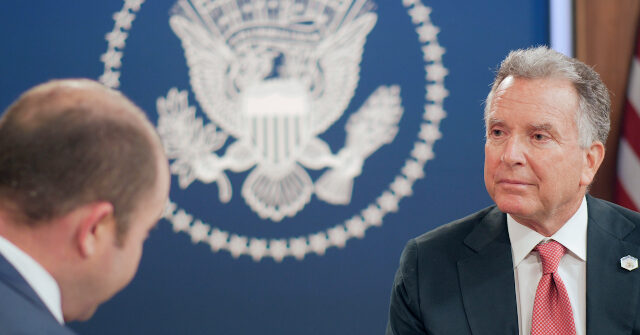

WASHINGTON — Senior adviser and assistant to the president Steve Witkoff told – News exclusively that the government of Iran has told him that the Iranians have agreed they do not want a nuclear weapon.
Witkoff, who made the explosive revelation in an exclusive long-form on-camera interview with – News on Thursday at the White House, is leading negotiations for President Donald Trump with the Islamic Republic of Iran. Witkoff is expected to meet with the Iranians, possibly as soon as this weekend, for a fourth round of talks in Oman, after two previous discussions in Iran and another in Rome. Witkoff will be meeting with them during a broader trip to the Middle East this upcoming week, where President Trump is expected to visit Saudi Arabia, the United Arab Emirates, and Qatar. Witkoff is joining Trump for those legs of the trip, but breaking off on his own to meet with the Iranians separately in Oman at the president’s direction.
“We’ve stated our position. The Iranians cannot have a bomb. They have stated back that they don’t want one,” Witkoff told – News. “So we’re going to, for the purposes of this discussion, take them at their word that that’s actually how they feel. If that’s how they feel, then their enrichment facilities have to be dismantled. They cannot have centrifuges. They have to downblend all of their fuel that they have there and send it to a faraway place—and they have to convert to a civil program if they want to run a civil program. Now, they have a civil reactor actually in the state of Iran—it’s called Bushehr. They have no enrichment capability at this place and if we take them at their word why not just turn all the rest of their facilities just like Bushehr? Bushehr they have no ability to enrich, they have no ability to have centrifuges there, they can only use that facility for civilian purposes—making of electricity and things of that sort of civilian purposes—and if that is what they choose to do, if they believe in that program, they ought to expand it if they want to. An enrichment program can never exist in the state of Iran ever again. That’s our red line. No enrichment. That means dismantlement, it means no weaponization, and it means that Natanz, Fordow, and Isfahan—those are their three enrichment facilities—have to be dismantled.”
Asked if an eventual deal with the Iranians would look like former President Barack Obama’s failed Joint Comprehensive Plan of Action (JCPOA) or if it would be a tougher deal, Witkoff said the Iranians are in a “more vulnerable” position than they were a decade ago during JCPOA negotiations and therefore any eventual deal will be much stronger.
“I think they’re a lot more vulnerable today but look, we’re not—the purpose here is to actually sit with them, talk with them, and talk them through why they should do it our way,” Witkoff said. “They may not accept that, but it makes no sense to me why they wouldn’t accept it. First of all, we’re never doing a JCPOA deal where sanctions come off and there’s no sunsetting of their obligations. That doesn’t make sense. That was a mismatched procedure in JCPOA. We believe that they cannot have enrichment, they cannot have centrifuges, they cannot have anything that allows them to build a weapon. We believe in all of that. That was not JCPOA. JCPOA had sunset provisions that burned off the obligations and burned off the sanctions relief at inappropriate times. It’s never going to happen in this deal.”
Witkoff added that he thinks it would be “unwise” for the Iranians to “test President Trump,” and believes “they have no choice” but to accept the U.S. terms for a denuclearization deal.
“Well, I’m a rational, sensible person,” Witkoff said. “So, I just believe they have no choice. Obviously, they can say no and they can test President Trump but I think that would be an unwise thing to do. I don’t mean that in a confrontational way to them if they end up watching this show. I mean it is a reality. They cannot have a bomb and they have said they do not want a bomb. They have attested to it. They have said they only want to operate in a civil way. There are multiple civil nuclear programs all over the world and they are operating without enrichment capability. They don’t need enrichment capability to operate a civil program.”
Witkoff also said that the U.S. will not accept a bad deal, and will walk away if it is not very strong.
“That’s correct,” Witkoff said when asked if the U.S. would not accept a bad deal. “And look, we didn’t think that the talks last week were going to be productive because we needed to get to certain understandings with them, and hopefully this Sunday they will be productive. Hopefully that means they will continue those talks. If they are not productive on Sunday, then they won’t continue and we’ll have to take a different route.”
While talks at this moment are focused exclusively on nuclear issues, Witkoff did say, when asked if there is a possibility of expanding the talks with Iran to include cultural and economic planks of a deal or vision with the West similar to human rights provisions contained in 1970s era deals with the Soviet Union like the Helsinki agreement, that he thinks that could happen in later phases of talks when the Iranians get there on nuclear talks. He also said that in later phases the U.S. intends to pressure the Iranians to stop funding and supplying weapons to groups like Hamas, Hezbollah, and the Houthis.
“We’re inviting Iran to be a member of the league of nations,” Witkoff said. “We think that they are an industrious people, a smart people historically, savvy, good merchants—all those sorts of things. I have plenty of friends who are of Iranian heritage and there are some interesting people—authors and doctors and lawyers and so forth. We’re saying to Iran: ‘You can be a better nation. We can do business with you. We can have strategic relationships with you. But you can’t be a provocateur.’ Now, our negotiations with them today is limited to nuclear. But do we think they need to stop enabling Hamas, Hezbollah, the Houthis, and pulling back from being a provocateur? We do believe that. That’s a secondary discussion. Do we think that they should not be supplying weapons to people we consider to be our enemies? We believe that. But again, we don’t want to confuse the nuclear discussion because that to us is the existential issue. That’s the issue that needs to be solved today and quickly.”
More from Witkoff’s exclusive interview with – News is forthcoming.