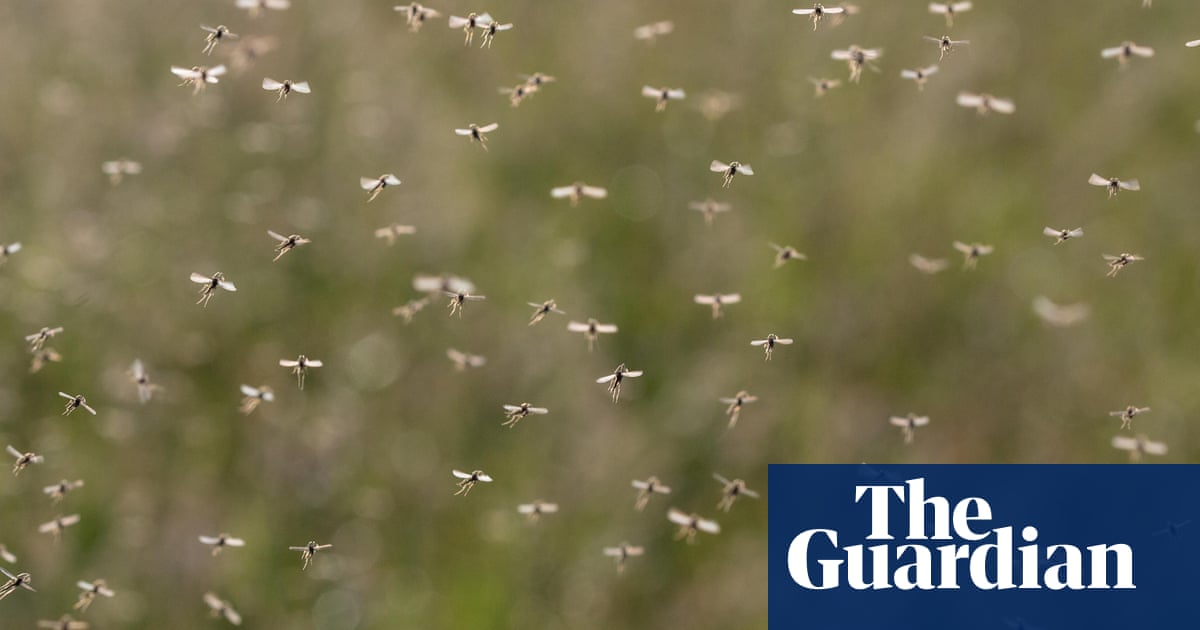

West Nile virus has been detected in genetic material of mosquitoes collected in Britain for the first time, the UK Health Security Agency has reported.
The agency assessed the risk to the general public as “very low” and said there was no evidence of transmission to humans or that the virus had become endemic.
The detection in mosquitoes collected in Nottinghamshire follows warnings that the geographical boundaries for serious vector-borne diseases, including West Nile virus, dengue and yellow fever, are moving steadily northwards due to climate change.
Dr Arran Folly, an arbovirologist at the Animal and Plant Health Agency (APHA) and lead of the surveillance programme that tested the mosquitoes, said: “The detection of West Nile virus in the UK is part of a wider changing landscape where, in the wake of climate change, mosquito-borne diseases are expanding to new areas.”
West Nile virus is usually found in birds and typically circulates through Aedes vexans mosquitoes, which prefer to bite birds but in rare cases can transmit the virus to humans or horses. Most human infections are asymptomatic, with approximately one in five people developing a fever, headache, body aches and other flu-like symptoms and a very small percentage developing severe neurological illnesses such as encephalitis or meningitis.
Aedes vexans mosquitoes are native to the UK and, while uncommon, their numbers can boom in summer in flooded river landscapes. Experts suggest the virus may have arrived on an infected bird.
For the disease to become endemic, climate is crucial, because the virus replicates far more rapidly when it is hot. At 15C it takes several months – longer than a mosquito’s average lifespan – for the virus to reach the infectious threshold. At 30C, the same process takes two to three weeks, meaning the virus can take root in a mosquito population.
The virus was detected through the Vector-Borne Radar (Real-time Arbovirus Detection and Response) programme by APHA in Aedes vexans mosquitoes collected by the UKHSA from wetlands on the River Idle near Gamston, Nottinghamshire, in July 2023.
The mosquitoes were pooled into groups of 10 for testing, and fragments of West Nile virus genetic material were identified in two of the pools. The other 198 pools were negative. This is the first evidence of West Nile virus detected in a mosquito in the UK.
West Nile virus is endemic in various regions around the globe, including southern Europe, Africa, the Middle East, North America and Australia. The geographic range of West Nile virus has expanded in recent years to more northern and western regions of mainland Europe as long, hot summers have become more frequent.
There have been no cases of locally acquired West Nile virus detected in humans or horses in the UK to date and there is no evidence to suggest ongoing circulation of the virus in birds or mosquitoes.
Disease surveillance and control activities are being enhanced in light of the findings and advice has been issued to healthcare professionals so that patients with encephalitis of unknown cause can be tested as a precaution.
Dr Meera Chand, the UKHSA deputy director for travel health, zoonoses, emerging infections, respiratory and tuberculosis, said: “While this is the first detection of West Nile virus in mosquitoes in the UK so far, it is not unexpected as the virus is already widespread in Europe. The risk to the general public is currently assessed as very low.”
Paul Hunter, a professor in medicine at the University of East Anglia, said: “The immediate risk is probably not great to human health. But as the summers get warmer and longer, the northern boundary of West Nile virus will shift north and we will likely start seeing endemic infections, initially in the south of the country.”