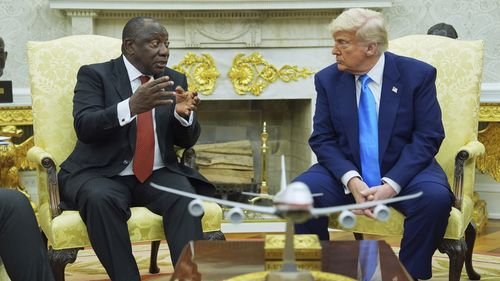
Trump ambushes South African president with farmer killing video
US President Donald Trump used a White House meeting to challenge South African President Cyril Ramaphosa. He accused South Africa of not addressing his unsubstantiated claim that there is a widespread and targeted killing of white farmers.

“People are leaving South Africa due to safety concerns,” Trump declared during the meeting, at one point lowering the lights in the Oval Office to play a contentious video of a communist politician singing an anti-apartheid song that references killing farmers. 

“Their land is being confiscated and in many cases they’re being killed.”
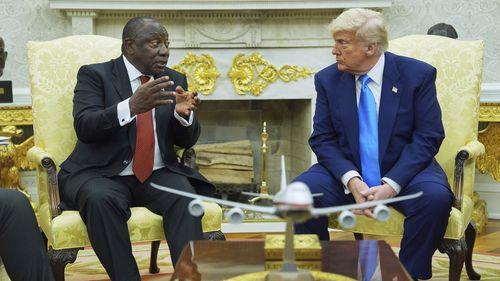
Trump Confronts South African President with Video on Farmer Killings
President Donald Trump meets South African President Cyril Ramaphosa in the Oval Office of the White House, Wednesday, May 21, 2025, in Washington.(AP Photo/Evan Vucci)

Ramaphosa refuted Trump’s assertions, aiming to correct misunderstandings and improve the relationship between South Africa and the US.

The bilateral relationship is at its lowest point since South Africa enforced its apartheid system of racial segregation, which ended in 1994.

“We are completely opposed to that,” Ramaphosa said of the behavior alleged by Trump in their exchange. 

According to experts in South Africa, there is no proof that white individuals are specifically targeted, though farmers of all ethnicities are subject to violent attacks in a nation plagued by high crime rates.

You May Also Like

Woolworths and Coles Trial Facial Recognition Cameras That Could Scan Shoppers on Entry - Internewscast Journal

Woolworths and Coles Trial Facial Recognition Cameras That Could Scan Shoppers on Entry

Coles and Woolworths are looking closely at facial recognition technology as Australia’s…
Woolworths and Coles Trial Facial Recognition Cameras That Could Scan Shoppers as They Enter Stores - Internewscast Journal

Woolworths and Coles Trial Facial Recognition Cameras That Could Scan Shoppers as They Enter Stores

Coles and Woolworths are assessing whether facial recognition technology could play a…