
Topline
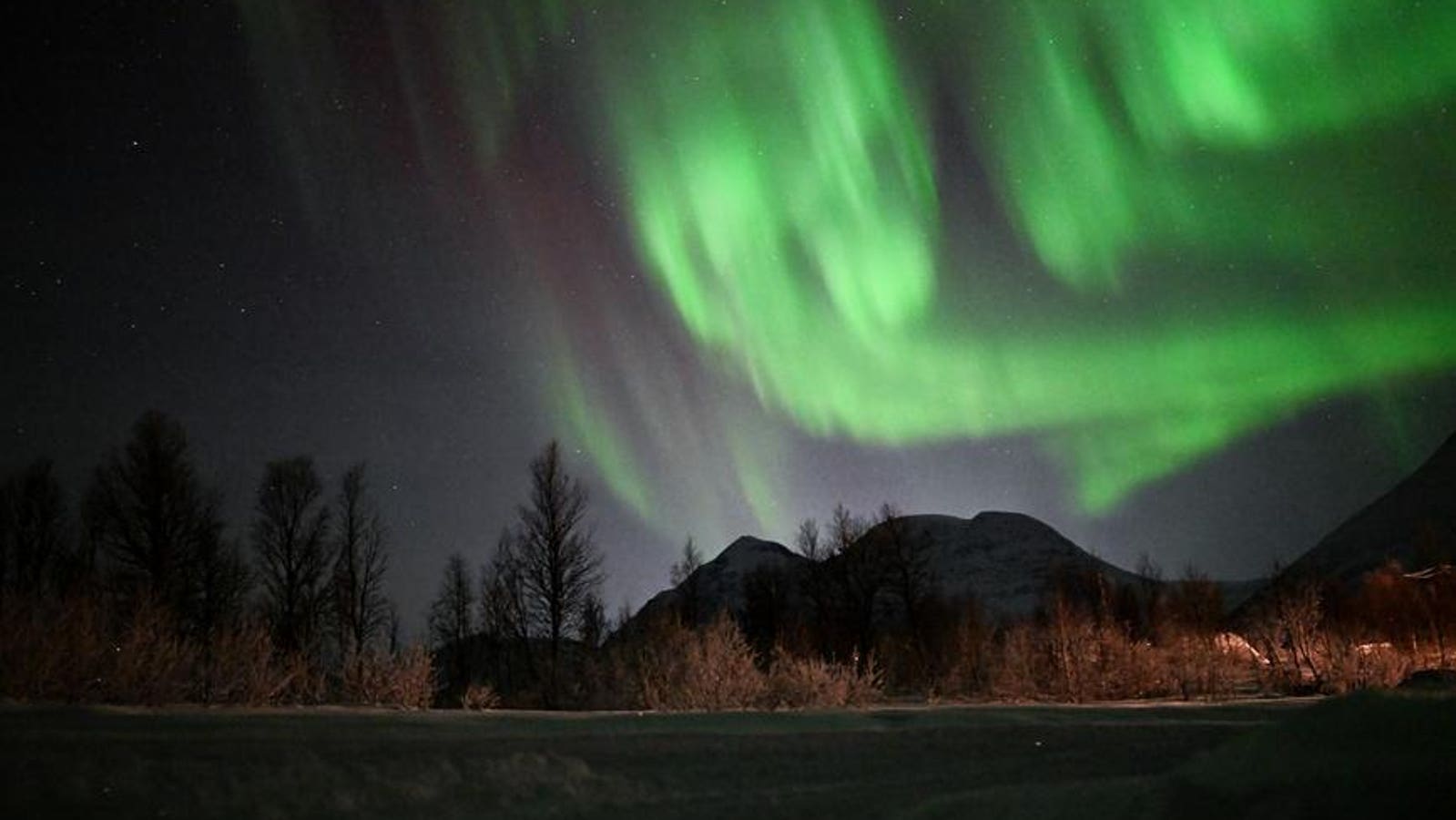
Several states in the northern U.S. may have the opportunity to see the northern lights Friday, but it’s possible the phenomenon could become visible in more areas, according to the National Oceanic and Atmospheric Administration.
Forecasters said auroral activity could increase through the night, potentially pulling the … More
AFP via Getty Images
Key Facts
Auroral activity is forecast with a Kp index of three on a scale of nine for Friday night, suggesting the northern lights will be more active away from the poles and be “quite pleasing to look at” in some areas.
The Kp index may increase to four on Friday, meaning there could be a chance to see the aurora borealis in parts of South Dakota and Maine, according to NOAA’s three-day forecast.
The northern lights will likely be calmer through the weekend, NOAA said, with a maximum Kp index of nearly two for Friday and Saturday, indicating the aurora borealis would likely only be visible in northern Canada and Alaska.
Where Will The Northern Lights Be Visible?
The northern lights have the highest chance of being visible across Canada and Alaska, while a view line marking a minimal opportunity sweeps just under the Canadian border. Parts of northeastern Washington, northern Idaho, Montana, North Dakota, Wisconsin, Minnesota and Upper Michigan have a lower likelihood of seeing aurora borealis. (See map below.)
Friday’s view line.
NOAA
What’s The Best Way To See The Northern Lights?
NOAA recommends traveling to a north-facing, high vantage point away from light pollution sometime between 10 p.m. and 2 a.m. local time.
What’s The Best Way To Photograph The Northern Lights?
Photography experts told National Geographic it’s best to use a wide-angle lens, an aperture or F-stop of four or less, a focus set to the furthest possible setting and a tripod to capture the northern lights. With a smartphone, NOAA suggests turning on night mode and disabling flash.
Key Background
The northern lights will likely be increasingly visible throughout the U.S. after a “solar maximum” was achieved on the sun’s surface in October 2024, according to NOAA and NASA. During the sun’s 11-year cycle of solar activity, a “solar maximum” and “solar minimum” are both reached at different points, indicating a corresponding rise or decline in solar events like coronal mass ejections and solar flares. Electrons from these events collide with oxygen and nitrogen in the Earth’s atmosphere, causing them to produce a swirling array of lights, according to NOAA. This peak in solar activity will persist into early 2026, according to NASA’s projections.
Further Reading