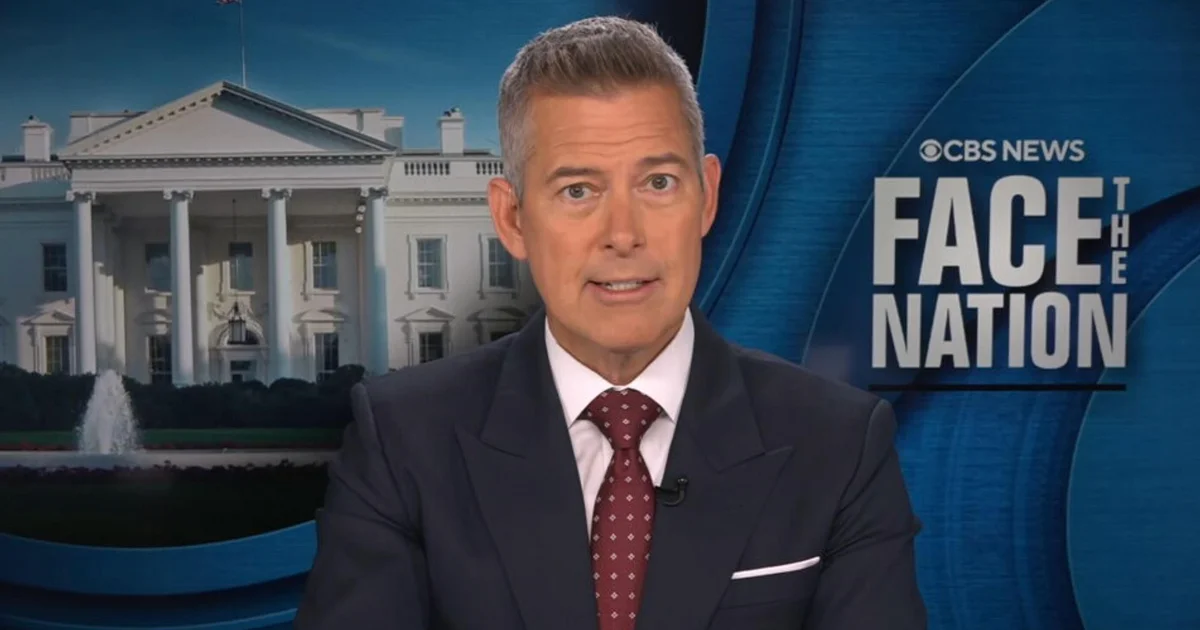
Washington — Transportation Secretary Sean Duffy said Sunday that the Federal Aviation Administration must move away from its aging telecommunications infrastructure after an outage caused by overloaded routers led to a rare nationwide ground stop Friday. Officials said the incident began during network maintenance and triggered a major telecommunication outage.
“We have to get off the old network, old telecom,” Duffy said on “Face the Nation with Margaret Brennan.” He added that the FAA had failed to modernize the system for decades because the work was difficult.
The ground stop forced the cancellation of thousands of flights and left travelers stranded at airports across the country as the weekend began. FAA telecommunications contractor L3Harris Technologies had been replacing outdated copper communication lines with fiber-optic connections at a remote facility. During the router switch, however, the equipment began sending excessive data across the network, overwhelming other routers and disrupting the system.
Duffy said investigators are examining why the installation in El Dorado, Arkansas, began broadcasting data and whether it was connected to a second problem at an Amarillo, Texas, facility where similar work had taken place weeks earlier. The FAA and L3Harris, which owns and operates the network, are investigating at the sites, while the FBI is providing assistance.
“We’re looking at that right now, and when we know what the root cause of this issue was — was it the install from L3Harris, was it the router — I’m going to tell you and the American people what we find,” Duffy said.
Duffy said the El Dorado telecommunications line relied on copper wiring that was no longer usable. The provider required the FAA to replace it with fiber, he said, and the agency installed new routers as part of the upgrade. That process was followed by the network flooding.
“So this is part of our maintenance that we do on this really old architecture of a telecom network,” Duffy said.
The transportation secretary said the upgrade itself was carried out properly, noting that similar work has been completed thousands of times without a comparable failure. Maintenance at major facilities is generally scheduled overnight, he explained, while work at remote locations may take place during the day because the historical risk has been considered minimal.
“Obviously, on Friday we saw no; it flooded our network, and we had to take the extraordinary step of issuing a ground stop,” Duffy said.
Duffy emphasized that modernization cannot be delayed. He said the FAA’s communications infrastructure should essentially be rebuilt from the ground up, noting that businesses and institutions worldwide have already transitioned from copper systems to digital and fiber-optic technology.
More than 70% of the FAA’s copper lines have reportedly been converted to fiber without incident, Duffy said. He cited the transition of nearly 470 radios, along with the rollout of electronic flight strips and upgraded tower systems.
YOU MAY ALSO READ: Is Jessie James Decker Nashville’s Most Hated WAG? Insiders Speak Out
Duffy said Friday that the FAA needs $50 billion from Congress to replace and modernize its telecommunications network. On Sunday, he repeated that request, while acknowledging that money provided to the agency through the One Big Beautiful Bill came with strict congressional spending requirements.
“They specifically said how I spend the money, and I’ve got it all spent, ready to be deployed by the end of the president’s tenure in office,” Duffy said. “But what I don’t have money for is a new telecom system. I don’t have money for new software. Those are critical pieces to the infrastructure, and it’s been historically underinvested in.”
Duffy said he is asking the public and Congress to support completing the FAA’s modernization effort. “For the first time, the FAA is taking your money, and we’re actually building with your money,” he said. “Let me continue. Let’s finish the job, let’s not see what happened on Friday — let’s not let it happen again.”
President Trump also called on Congress to approve additional funding.
“Much of our current air control system is 50 years old – RIDICULOUS!” he said in a post on Truth Social. “We have already started the work, but it should be done all at once, not in drips and drabs. Congress must approve.”
Rep. Jim Himes, a Connecticut Democrat who also appeared on “Face the Nation” Sunday, disputed the idea that the FAA’s problems primarily require more congressional funding.
Himes pointed to money already provided through the One Big Beautiful Bill. “How about if you spend that before we put more money in that bank account?
“This is not immediately a spending problem,” he said. “It is a prioritization problem.”
Duffy said the effects of Friday’s nationwide ground stop were continuing, though he expected air traffic to return to normal soon. “We have some delays in the airspace right now, but as we look to the end of the day and into tomorrow, we should be running at full capacity,” he said.
Because aircraft and flight crews were displaced during the shutdown, Duffy explained that airlines needed time to reorganize schedules and restore their operations.
“But we’re well on our way,” he said.


