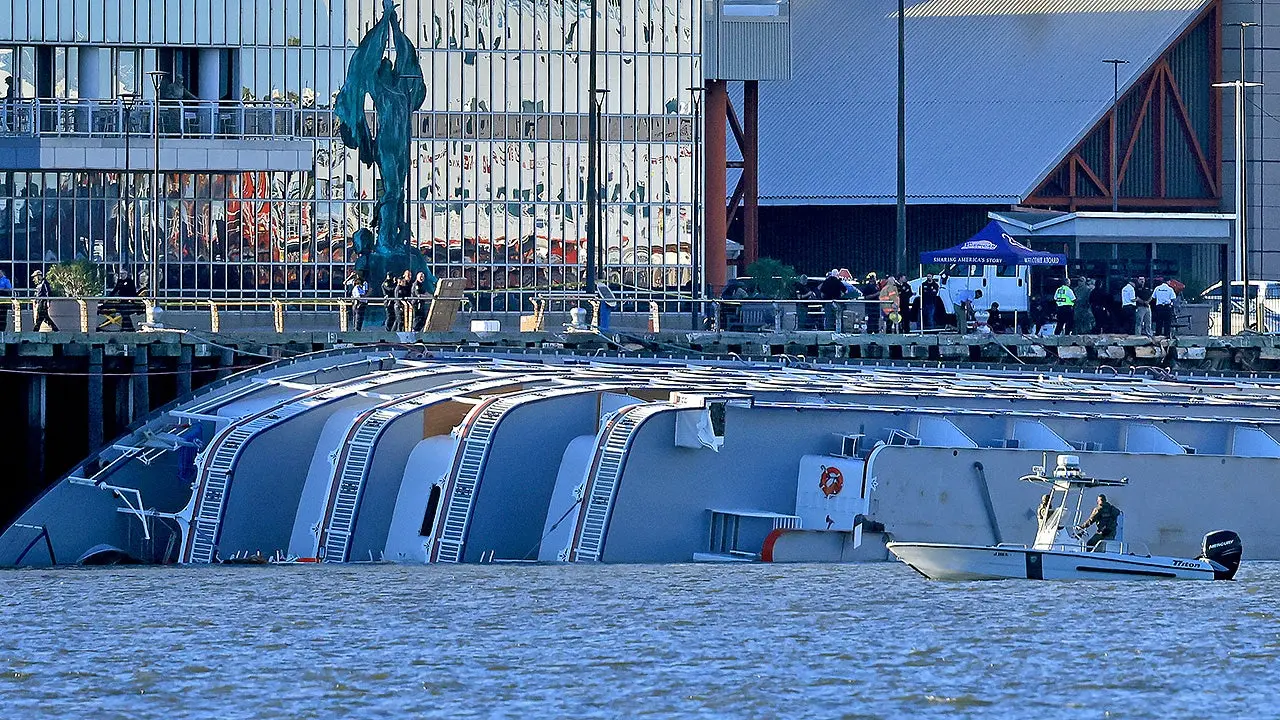

Federal investigators said Sunday that the tanker involved in Friday’s New Orleans riverboat crash experienced a steering failure roughly two minutes before the collision, prompting warning whistles, distress calls and emergency maneuvers.
The Atlantic Asphalt was traveling upriver near the Crescent City Connection Bridge at approximately 12:26 p.m. when its rudder stayed hard to starboard, directing the vessel toward the Mississippi River’s east bank, according to Bart Barnum, a senior marine accident investigator with the National Transportation Safety Board.
About two minutes later, the tanker hit American Cruise Lines’ docked American Heritage. Preliminary NTSB findings indicate the riverboat overturned approximately 22 minutes after the impact.

NTSB investigators examine the wreckage. (NTSB)
Investigators retrieved more than nine hours of information from the tanker’s voyage data recorder. The material includes bridge audio, rudder position, engine revolutions, the ship’s course and its speed.
The recording also captured what sounded like whistle signals, verbal warnings, radio requests for assistance, orders to lower anchors and urgent shiphandling commands, Barnum said.
Officials have referred to the malfunction as a “steering casualty,” while stressing that the phrase does not identify the precise cause.
“It could be many different things. That is something that we are investigating very closely,” Barnum said.

Tugboats surround the Atlantic Asphalt tanker in New Orleans after its Nov. 13, 2026, collision with the docked American Heritage river cruiser. (Kat Ramirez for News Outlet)
NTSB board member John DeLeeuw said the agency has obtained the tanker’s speed data but is still reviewing it before making the information public. Investigators saw video showing anchors in the water, though they are continuing to determine which anchors were released and how far they descended.
The latest details came as officials continued to describe a dramatic rescue that resulted in everyone aboard the American Heritage surviving. Port of New Orleans Harbor Police Chief Melanie Montroll said Saturday that about 100 people were pulled from the Mississippi River, while more than 80 others were evacuated before the vessel overturned.
“This is a miracle. It is a literal miracle on the Mississippi,” Louisiana Gov. Jeff Landry said Friday.
Eight people were still hospitalized Saturday, including two listed in serious condition. The remaining six were reported to be stable.
The NTSB said Sunday that the riverboat carried 190 people: 140 passengers and 50 crew members.
New Orleans Mayor Helena Moreno said the American Heritage’s captain suffered injuries but remained on the vessel until passengers and crew had been accounted for. He was the final person to leave the ship.
“Every moment of the critical time [Friday], he did not want to leave his ship,” Moreno said Saturday.
Coast Guard Capt. Melanie Burnham said Saturday that crews were preparing to remove approximately 16,000 gallons of fuel ahead of salvage operations. She warned that clearing the overturned riverboat could take weeks. DeLeeuw said Sunday that divers had already entered the water, while the Coast Guard and salvage contractors directed the recovery effort.

Map showing the Port of New Orleans collision. (Google Maps)
NTSB investigators began interviewing American Heritage crew members Sunday. Interviews with the Atlantic Asphalt crew were scheduled to start Monday and continue throughout the week, Barnum said.
The agency expects to issue a preliminary report in roughly 30 days. DeLeeuw said Sunday’s briefing was likely the investigation team’s final planned news conference at the scene, with additional updates to be published online.


