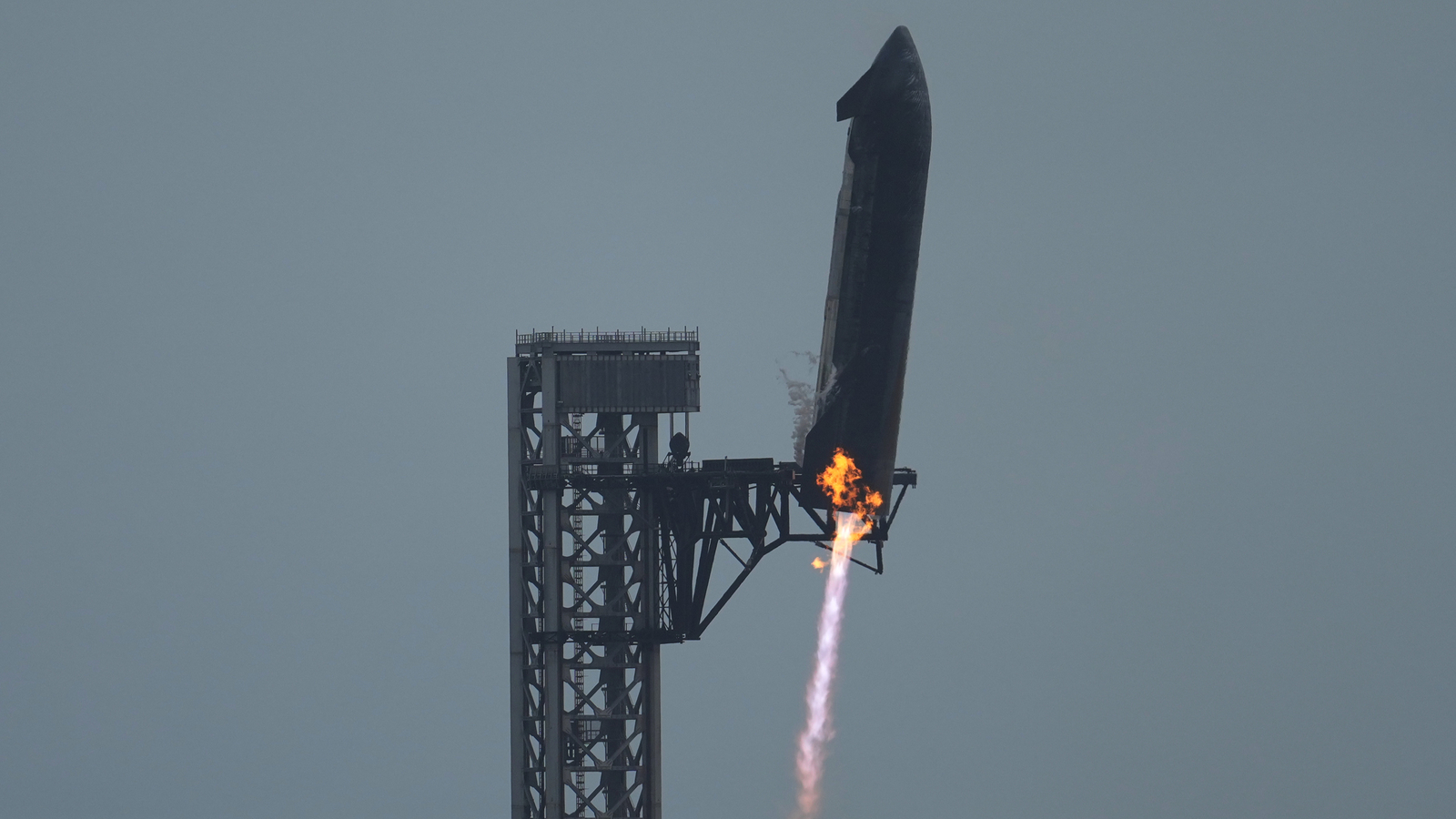

CAPE CANAVERAL, Fla. — SpaceX’s Starship returned safely to Earth Saturday, completing a dramatic landing in which giant mechanical arms caught the spacecraft at the same launch site from which it had lifted off 22 hours earlier.
It was the spectacular finale Elon Musk and his team had hoped to achieve — the first-ever midair capture of a Starship returning from space. The company did not manage the planned double recovery, however, after the first-stage booster exploded soon after Friday’s launch from Texas.
Debris remained in the Gulf of Mexico inside an area marked by buoys while the stainless-steel, bullet-shaped spacecraft descended upright at the launch tower.
The dramatic, science-fiction-like capture overshadowed the booster’s failed return. Cameras followed the spacecraft as it was held high above the ground by the tower’s mechanical arms.
“Can you believe it?” SpaceX commentator Dan Huot shouted, stretching out each word. “Look at her! Baby, she’s back!”
SpaceX officials said the successful capture demonstrated Starship’s potential for complete reusability, a capability the company considers essential for future missions to the moon and Mars. Although Friday’s booster recovery failed, SpaceX had already completed three successful booster catches, helping validate the approach.
NASA welcomed the achievement. The agency is investing billions of dollars in Starship to transport Artemis astronauts to the moon later this decade and support plans for a permanent lunar base. Musk’s ambitions extend much further: He hopes to send a fleet of Starships to Mars to establish a city there.
“It was almost magic,” NASA Administrator Jared Isaacman said on X. “Making more believers by the day … one step closer to (emojis of the moon and the U.S. flag).”
The world’s largest and most powerful rocket — a 407-foot (124-meter) behemoth — launched late Friday afternoon from SpaceX’s Starship facility near the U.S.-Mexico border. The upper-stage spacecraft separated cleanly from its booster before trouble developed, reached orbit and deployed 26 advanced Starlink satellites.
Starship continued circling Earth at an altitude of 165 miles (265 kilometers), transmitting live views of the spacecraft and planet through Starlink. It completed 14 orbits, a significant improvement over the previous mission’s one or two laps.
The flight was SpaceX’s 15th launch of a full-scale Starship since 2023 and only its second mission to reach orbit.
SpaceX said all major systems on the spacecraft, including its critical heat shield, appeared to perform as expected.
The booster encountered a different outcome. SpaceX’s Kate Tice said its engines shut down too early during the descent. When the guidance system detected that the booster was not properly aligned, it automatically directed the vehicle toward the water and triggered its destruction. Engineers are continuing to investigate what caused the problem.
SpaceX expects to begin launching Starships from NASA’s Kennedy Space Center in Florida within the next few months. The site will support NASA’s next Artemis mission, which will fly around Earth rather than travel to the moon while astronauts practice operations involving the lunar lander.
The four astronauts aboard Artemis III will attempt to dock their capsule with both Starship and Blue Origin’s Blue Moon. The two companies are expected to take turns transporting crews to the lunar surface. NASA is aiming for Artemis IV to launch as early as 2028, marking humanity’s first return to the moon since the Apollo era more than half a century ago.
Copyright © 2026 by The Associated Press. All Rights Reserved.
SEE ALSO: Family-Owned Factory Surprised as Old Part Becomes an Unexpected Hit


