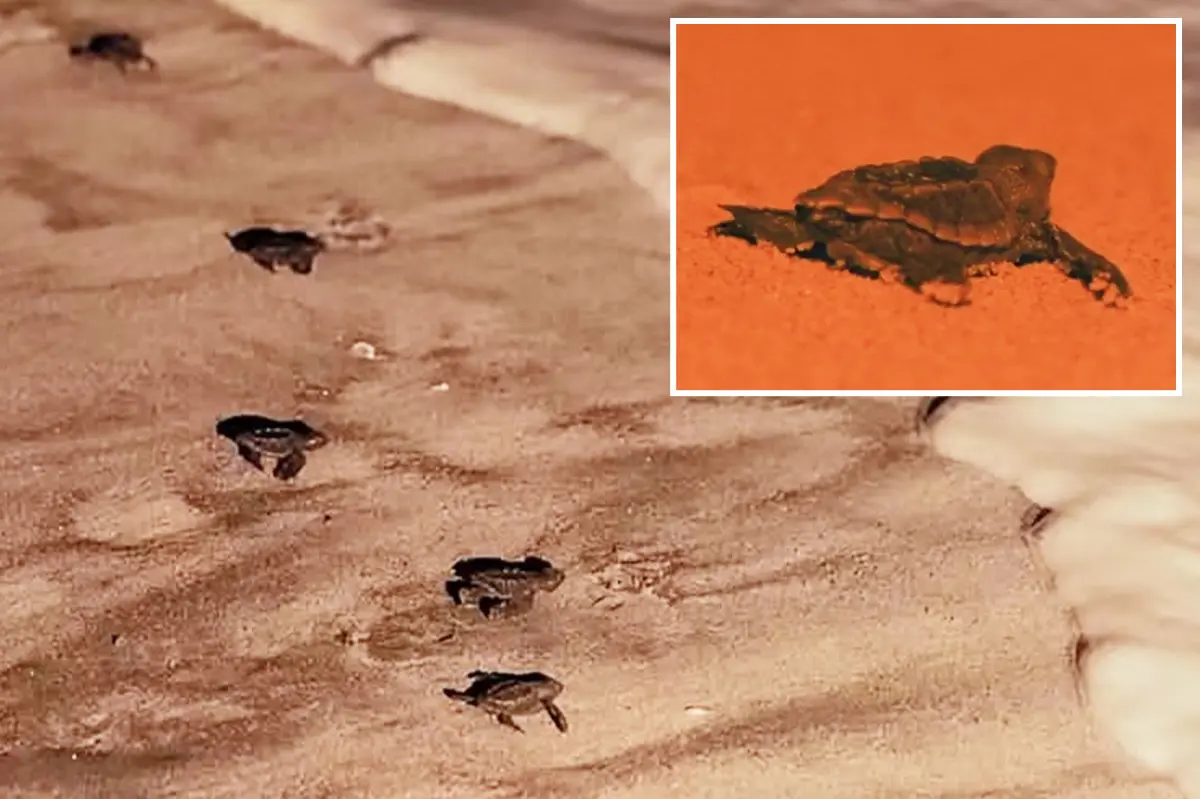

California’s newest beachgoers are tiny enough to fit in a handful, yet they have already made history.
Olive ridley sea turtle hatchlings have emerged from the first confirmed natural sea turtle nests on the U.S. West Coast, scrambling across the sand before disappearing into the Pacific Ocean.
“We’re pleased that some sea turtle eggs were viable and have not only already successfully hatched, but the hatchlings have also made their journey across the sand to the ocean,” said Dr. Lance Adams, director of veterinary services at the Aquarium of the Pacific.
The discovery dates to mid-September, when two nests were found in Seal Beach and Huntington Beach.
With tropical storms threatening to flood the nesting areas, federal officials and local partners, led by the U.S. Fish and Wildlife Service, coordinated the transfer of the eggs to the Aquarium of the Pacific.
Biologists collected the eggs on Sept. 25 and placed them in incubators beneath sand inside a secure room where temperature and humidity could be carefully controlled.
The decision proved timely. Both beaches later saw powerful surf and standing water near the nesting sites after Tropical Storm Rachel.
SEE ALSO: Prince Andrew’s Rumored New Beau Is a Posh ‘Turnip Toff’
Olive ridleys are one of the world’s smallest sea turtle species. They typically inhabit tropical waters in the Pacific, Atlantic and Indian oceans. Pacific breeding colonies in Mexico are listed as endangered, while other olive ridley populations are considered threatened.
Scientists do not yet know why the turtles selected Southern California for nesting. The unusual activity, however, could offer important insights into the species and shape future sea turtle conservation efforts along the West Coast.
“Whether the reason for the nests in Southern California was because of our weather patterns, or a simple anomaly, this is an important conservation story,” said Jeff Flocken, president and CEO of the Aquarium of the Pacific.
A third nest was found farther north in Ventura County on Nov. 1, suggesting that additional turtles may have nested elsewhere along the California coast.
The hatchlings that reached the ocean still face enormous challenges. They must swim continuously for days to reach deeper water while avoiding predators and finding food. Researchers estimate that only one in 1,000 olive ridley hatchlings survives to adulthood.
Anyone who sees turtle tracks, a nesting turtle or a sea turtle in distress should notify a local lifeguard or call the 24-hour West Coast Sea Turtle Stranding Hotline at 562-506-4315.
These protected animals must not be approached, disturbed or harassed.


