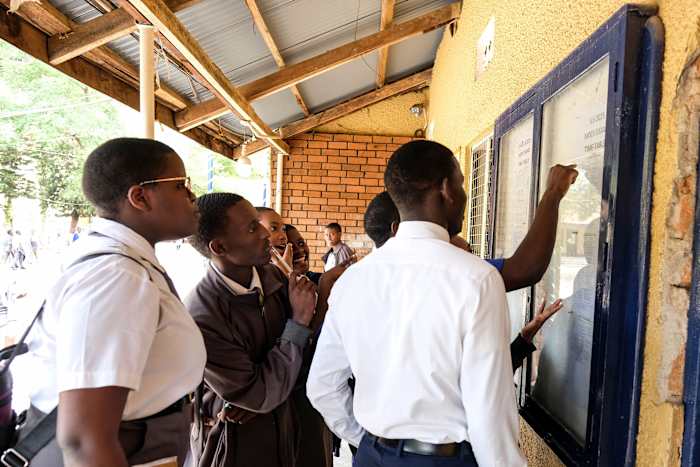


KAMPALA – At a Catholic private school, a distressed parent approached the teachers in the staff room, desperately pleading for her son to be admitted despite an outstanding tuition balance.
The institution’s policy demanded that parents pay at least 60% of the full tuition for their children to join the school. Unable to afford the amount, the mother was escorted out.
“She was pleading, ‘Please help me,’” recalled Beatrice Akite, a teacher at St. Kizito Secondary School in Uganda’s capital city, who witnessed the emotional scene. “It was very embarrassing. We had never seen something like that.”
Two weeks into second term, Akite recounted the woman’s desperate moment to highlight how distressed parents are being crushed by unpredictable fees they can’t pay, forcing their children to drop out of school. It’s leaving many in sub-Saharan Africa — which has the world’s highest dropout rates — to criticize the mission-driven Catholic Church for not doing enough to ease the financial pressure families face.
Legacy of Catholic education across Africa
The Catholic Church is the region’s largest nongovernmental investor in education. Catholic schools have long been a pillar of affordable but high-quality education, especially for poor families.
Their appeal remains strong even with competition from other nongovernmental investors now eying schools as enterprises for profit. The growing trend toward privatization is sparking concern that the Catholic Church may price out the people who need uplifting.
Akite hopes Catholic leaders support measures that would streamline fees across schools of comparable quality. Firm fee ceilings need to be set, she said.
Kampala’s St. Kizito Secondary School, where Akite teaches literature, was founded by priests of the Comboni missionary order, known for its dedication to serving poor communities. Its students come mostly from working-class families and tuition per term is roughly $300, a substantial sum in a country where GDP per capita was about $1,000 in 2023.
Yet that tuition is lower than at many other Catholic-run schools in Kampala, where many students report later in the term because they can’t raise school fees in time, Akite said.
Late starts, long lines, extension requests
One of the most expensive private schools in Kampala, the Catholic-run Uganda Martyrs’ Secondary School Namugongo, maintains a policy of “zero balance” when a child reports to school at the beginning of a three-month term. This means students must be fully paid by the time they report to school.
Tuition at the school was once as high as $800 but has since dropped to about $600 as enrollment swelled to nearly 5,000, said deputy headmaster James Batte. On a recent morning, there was a queue of parents waiting outside Batte’s office to request more time to clear tuition balances.
Daniel Birungi, an electrical engineer in Kampala whose son enrolled this year at St. Mary’s College Kisubi, a leading school for boys in Uganda, said the emerging risk for traditional Catholic schools is to cater only to the rich.
There is hot water in the bathrooms, he said, describing what he felt was a trend toward levels of luxury he never imagined as a student there in the 1990s. Now, students are prohibited from packing snacks and instead encouraged to buy what they need from school-owned canteens, he said.
That has “put us under a lot of pressure,” he said.
Tuition at St. Mary’s College Kisubi is roughly $800 per term, and Birungi doubts he will be able to regularly pay school fees on time. “You can go there and see the brother and negotiate,” he said, referring to the headmaster. “I am planning to go there and see him and ask for that consideration.”
The effects of a private education system
The World Bank reported in 2023 that 54% of adults in sub-Saharan Africa rank the issue of paying school fees higher than medical bills and other expenses. That’s partly because education is largely in private hands, with the most desirable schools controlled by profit-seeking owners.
Schools run by the Catholic Church are not usually registered as profit-making entities, but those who run those schools say they wouldn’t be competitive if they were run merely as charities. They say they face the same maintenance costs as others in the field and offer scholarships to exceptional students.
Regulating tuition is not easy, said Ronald Reagan Okello, a priest who oversees education at the Catholic Secretariat in Kampala. He urges parents to send their children to schools they can afford.
“As the Catholic Church, also we are competing with those who are in the private sector,” said Okello, the national executive secretary for education with the Ugandan bishops conference. “Now, as you are competing, the other ones are setting the bar high. They are giving you good services. But now putting the standard to that level, we are forced to raise the school fees to match the demands of the people who can afford.”
Across the region, the Catholic Church has built a reputation as a key provider of formal education in areas often underserved by the state. Its schools are cherished by families of all means for their values, discipline and academic success.
In Zimbabwe, the Catholic Church operates about 100 schools, ranging from dozens in impoverished areas where annual tuition is as low as $150 to elite boarding schools that can charge thousands of dollars.
But a legacy of inclusion is under pressure in the southern African nation due to fee increases at boarding schools and efforts by Catholic leaders to fully privatize some schools. Many boarding schools already charge tuition fees between $600 and $800, prohibitive for the working class in a country where most civil servants make less than a $300 per month.
Privatization will raise tuition fees even higher, warned Peter Muzawazi, a prominent educator in Zimbabwe.
Muzawazi, who attended Catholic schools, once was the headmaster of Marist Brothers, a top Catholic school for boys in Zimbabwe. That school in Nyanga is among those earmarked for privatization.
“I know in the Catholic Church there is a lot of space for reasonable fees for day scholars, but for boarders there is need to be watching because the possibility that they would be out of reach for the vulnerable is there,” he said.
The church needs to be actively engaged, he said. “How do we continue to guarantee education for the poor?”
Efforts to privatize church-founded schools have sparked debate in Zimbabwe, which for years has been in economic decline stemming in part from sanctions imposed by the U.S. and others. Authorities say privatizing these schools is necessary to maintain standards, even as critics warn Catholic leaders not to turn their backs on poor people.
“Schools have now turned into businesses,” Martin Chaburumunda, president of the Zimbabwe Rural Teachers’ Union, told The Manica Post, a state-run weekly. “Churches now appear only hungry for money as opposed to educating the communities they operate in.”
Rather than privatizing old mission schools, the church should invest in building new ones if it’s useful to experiment with different funding models, said Muzawazi, a lay Catholic who serves on the governing council of the Catholic University of Zimbabwe.
“The bright people who advance the cause of countries are not the rich ones,” he said. “We want every church and every nation to tap the potential of every person, regardless of economic status.”
___ Mutsaka reported from Harare, Zimbabwe.
___
Associated Press religion coverage receives support through the AP’s collaboration with The Conversation US, with funding from Lilly Endowment Inc. The AP is solely responsible for this content.
Copyright 2025 The Associated Press. All rights reserved. This material may not be published, broadcast, rewritten or redistributed without permission.


