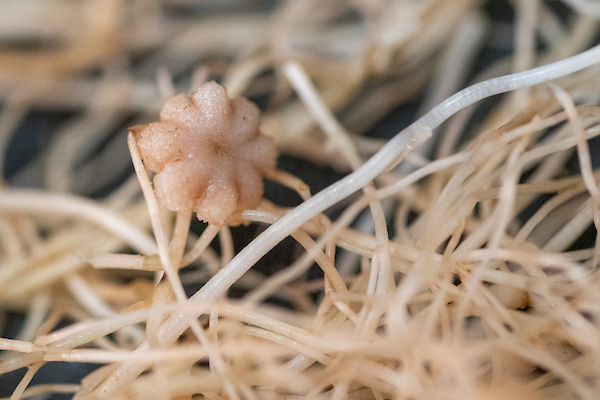


AUSTIN (KXAN) — One of the biggest problems with deep space exploration is food: You either have to bring it with you or grow it. Research out of Texas A&M may make space farming a little easier.
“If we could figure out how to establish a permanent presence on the moon, that’s going to help us explore further into the universe,” said Jess Atkin, a Ph.D. student at Texas A&M.
Atkin, recently retired from the U.S. Air Force, is focusing on turning moon dust, also called regolith, into soil that astronauts could use to grow crops.
Moon dust isn’t great for crops. It lacks key nutrients that plants rely on and is devoid of nitrogen.
“All plants need nitrogen. It’s one of the most limiting nutrients that plants have,” said Amelia Wolf, an assistant professor in Integrative Biology at the University of Texas in Austin.

Wolf said that Earth’s soil contains tiny microbes and little life forms that make farming possible. Plants rely on these microbes to bloom. Soil also differs around the world, with some soil better for crops than others.
“Different plants have different needs. Some plants really like to grow in kind of rich, fertile soil. Some plants, like desert plants, grow in very sandy soil,” Wolf said.
Moon dust isn’t great for any plants. That’s where Atkin’s work comes in. She is using a simulated regolith, made in a lab here on Earth, to test out how different fungi can bring life to dust and turn it into soil.
“We’ve seen that through generations, our fungi and bacteria are able to survive the harshness of the lunar regolith simulant. So we would only need to pack, you know, one small package (of the seeds coated with the fungi),” Atkin said.
Atkin is also focusing on the crop. “I chose chickpea because it’s able to form relationships with microorganisms, and it actually actively recruits these relationships.”

Chickpeas also can provide protein to astronauts. The downside is they take a while to grow and produce more seeds, but this also proves that plants can grow over a long term in the soil.
“Our hope is by the end of this to have it turned into a lunar soil,” Atkin said.
The work is still in the early stages. NASA has provided a $150-thousand NASA Future Investigators in NASA Earth and Space Science and Technology grant. The grant secures Atkin’s work for three years.
A recent internship with NASA will see some of her research into plant systems arrive on the moon as part of human’s return to the moon aboard Artemis III.