
WASHINGTON – Researchers have finally unraveled the enigma behind the demise of over 5 billion sea stars along the Pacific coast of North America, attributed to a decade-long epidemic.
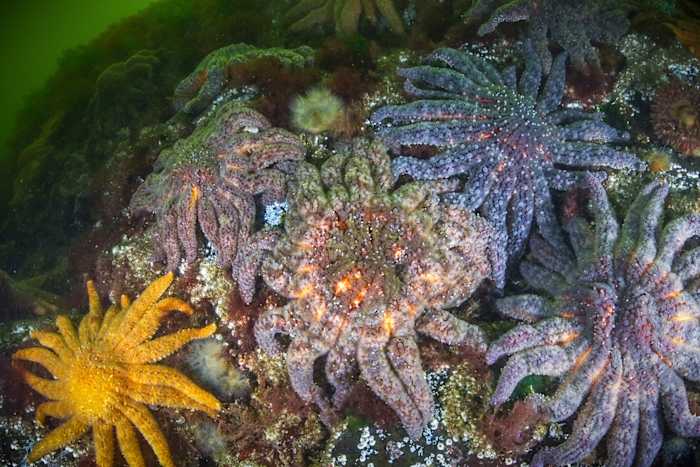
Sea stars, commonly called starfish, typically possess five arms, though certain species can have as many as 24 arms. They exhibit a wide range of colors, from vibrant orange to intricate patterns of orange, purple, brown, and green.
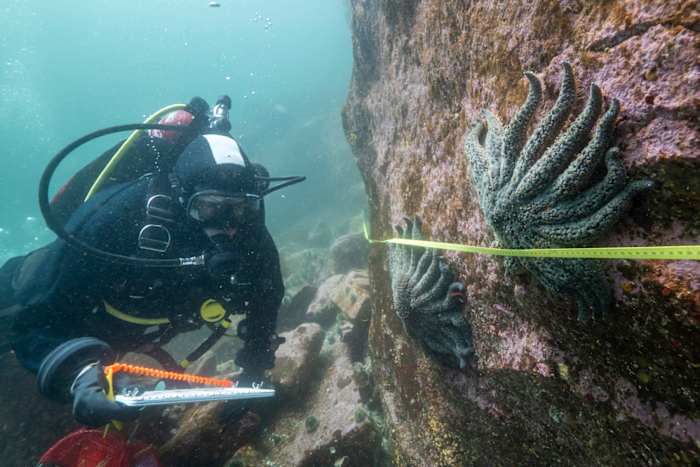
Commencing in 2013, an enigmatic sea star wasting disease instigated a mass die-off spanning from Mexico to Alaska. The epidemic, affecting more than 20 species, persists to this day. The sunflower sea star, in particular, was severely impacted, losing about 90% of its population within the outbreak’s first five years.
“It’s truly quite horrific,” stated Alyssa Gehman, a marine disease ecologist at the Hakai Institute in British Columbia, Canada, who contributed to identifying the cause.
“Healthy sea stars feature ‘puffy arms sticking straight out,'” she explained. However, the wasting disease leads to lesions, with arms eventually detaching.
The culprit? Bacteria that has also infected shellfish, according to a study published Monday in the journal Nature Ecology and Evolution.
The discoveries “resolve a long-standing question about a very serious disease in the ocean,” remarked Rebecca Vega Thurber, a marine microbiologist at the University of California, Santa Barbara, who was not part of the research.
It took more than a decade for researchers to identify the cause of the disease, with many false leads and twists and turns along the way.
Early research hinted the cause might be a virus, but it turned out the densovirus that scientists initially focused on was actually a normal resident inside healthy sea stars and not associated with disease, said Melanie Prentice of the Hakai Institute, co-author of the new study.
Other efforts missed the real killer because researchers studied tissue samples of dead sea stars that no longer contained the bodily fluid that surrounds the organs.
But the latest study includes detailed analysis of this fluid, called coelomic fluid, where the bacteria Vibrio pectenicida were found.
“It’s incredibly difficult to trace the source of so many environmental diseases, especially underwater,” said microbiologist Blake Ushijima of the University of North Carolina, Wilmington, who was not involved in the research. He said the detective work by this team was “really smart and significant.”
Now that scientists know the cause, they have a better shot at intervening to help sea stars.
Prentice said that scientists could potentially now test which of the remaining sea stars are still healthy — and consider whether to relocate them, or breed them in captivity to later transplant them to areas that have lost almost all their sunflower sea stars.
Scientists may also test if some populations have natural immunity, and if treatments like probiotics may help boost immunity to the disease.
Such recovery work is not only important for sea stars, but for entire Pacific ecosystems because healthy starfish gobble up excess sea urchins, researchers say.
Sunflower sea stars “look sort of innocent when you see them, but they eat almost everything that lives on the bottom of the ocean,” said Gehman. “They’re voracious eaters.”
With many fewer sea stars, the sea urchins that they usually munch on exploded in population – and in turn gobbled up around 95% of the kelp forest s in Northern California within a decade. These kelp forests provide food and habitat for a wide variety of animals including fish, sea otters and seals.
Researchers hope the new findings will allow them to restore sea star populations — and regrow the kelp forests that Thurber compares to “the rainforests of the ocean.”
___
The Associated Press Health and Science Department receives support from the Howard Hughes Medical Institute’s Department of Science Education and the Robert Wood Johnson Foundation. The AP is solely responsible for all content.
Copyright 2025 The Associated Press. All rights reserved. This material may not be published, broadcast, rewritten or redistributed without permission.