A mother-of-four who dismissed a small dry patch on her nose was shocked to be told it was skin cancer—because she had been ‘obsessed’ with wearing sun cream.
Amanda Anderson, 43, first noticed the blemish in January but assumed it was down to the cold Utah winter.
She visited her GP ‘just to be on the safe side’—but was given a cream to soothe the dryness.
But when the mark came back, bled and began to scab, Amanda’s instincts told her something wasn’t right.
She went to another medic and a biopsy revealed basal cell carcinoma—the most common type of skin cancer.
‘I wasn’t super concerned at the beginning,’ said Amanda, who lives in Layton and works for a suicide prevention charity.
‘It was just a little dry spot on the side of my nose. With it being the winter it’s common to have dry patches.’
Doctors scheduled her for Mohs surgery, a specialist technique where thin layers of skin are removed and examined under a microscope until no cancer cells remain.

Amanda Anderson, 43, first noticed the blemish in January but assumed it was dry skin, down to the cold Utah winter

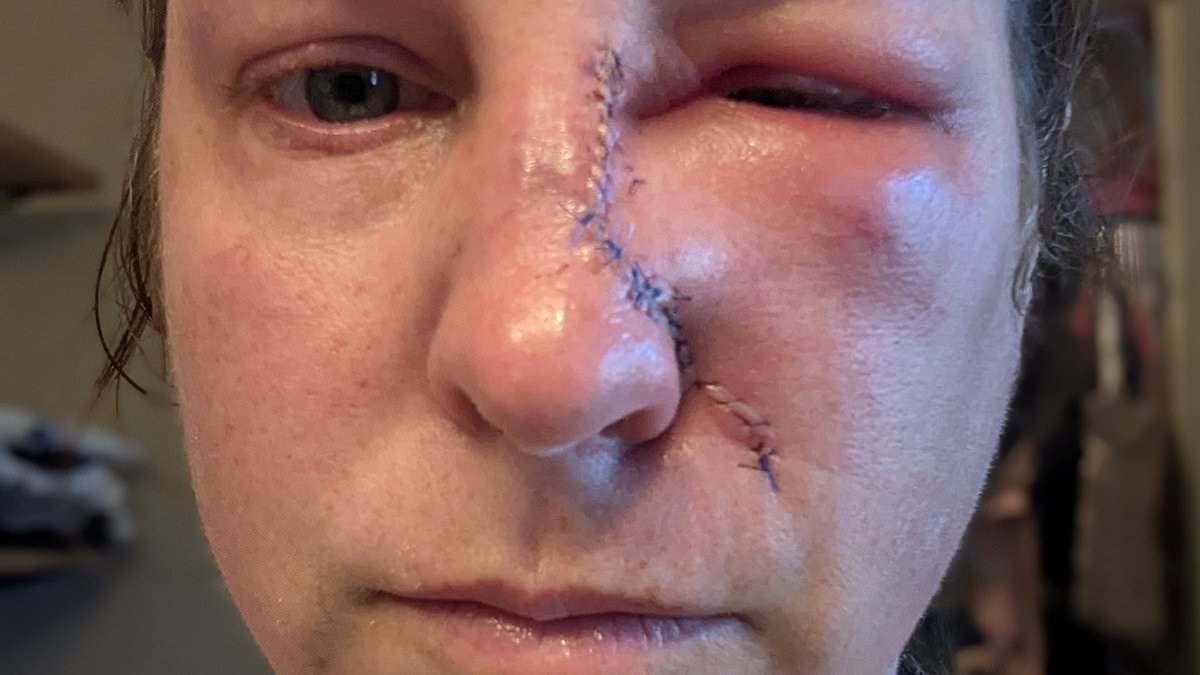
Doctors scheduled her for Mohs surgery, where thin layers of skin are removed. The procedure left a penny-sized hole in her nose, which was repaired by folding skin from above and below
Amanda needed three rounds before surgeons confirmed they had cleared it.
The procedure left a penny-sized hole in her nose, which was repaired by folding skin from above and below to cover the gap.
‘It’s hard to hear,’ Amanda said of her diagnosis. ‘It’s on my face and as a woman we do everything we can to make sure our faces look as good as possible.
‘I’m obsessed about sun cream and shade. So it was a bit of a gut punch.’
Amanda’s father, Kirk Romney, 66, has faced his own battles with skin cancer and endured more than 17 Mohs surgeries to remove tumours from his face, neck and shoulders.
But Amanda grew up in Arizona in the 1980s, when tanning was fashionable and sunscreen wasn’t widely used.
‘I’m very fair—I freckle, I don’t tan easily,’ she said.
‘There was a tanning salon across the street from school that wasn’t regulated. I lived in Arizona where it was year-round sun.’

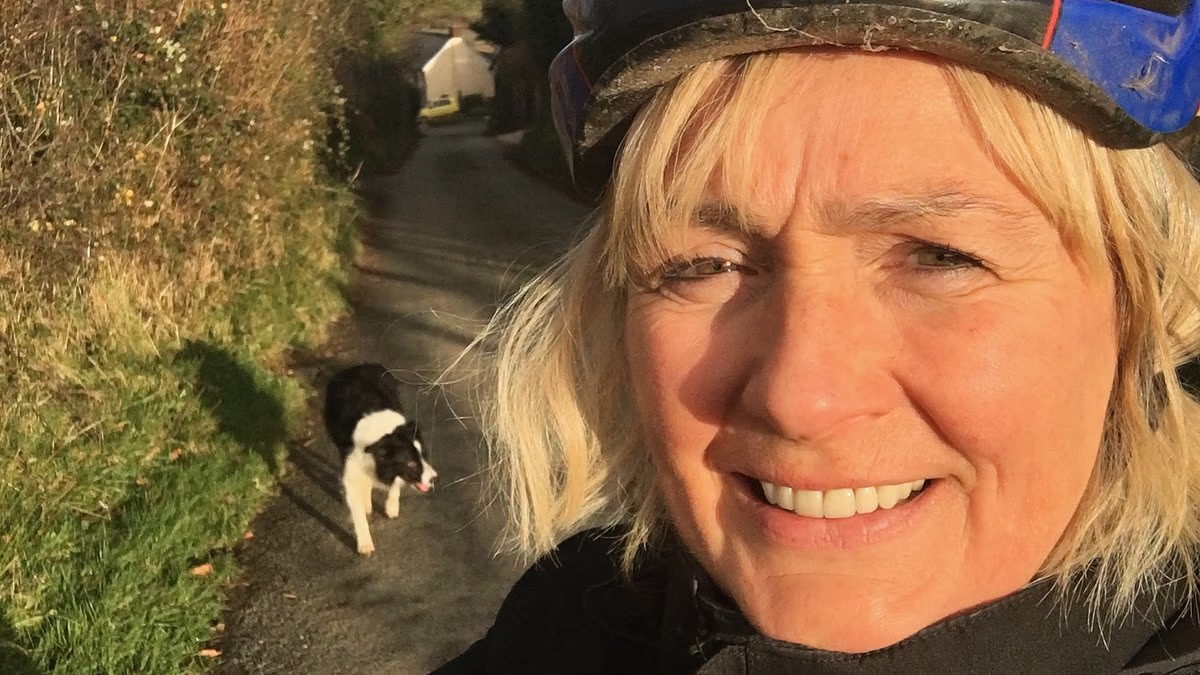
Amanda, today. She said of her diagnosis: ‘I’m obsessed about sun cream and shade. So it was a bit of a gut punch.
Now recovering, she is urging others to take skin protection seriously and to act quickly if they notice anything unusual.
‘The damage is done when you’re young,’ Amanda said. ‘I encourage my daughters to put sun cream on underneath their make-up.
‘I’m trying to build healthy habits in my kids. People don’t realise you can get sunburnt through the window of a car.
‘We have to take care of our skin like you would your teeth. Skin cancer is so preventable.’
Skin cancer is among the most common cancers in both the UK and the US.
In Britain, melanoma—the deadliest form—affects around 17,000 people a year, while here are an estimated 156,000 new non-melanoma skin cancer cases annually, including basal cell and squamous cell carcinoma.
In the US, around 9,500 people are diagnosed with skin cancer every single day. One in five Americans will develop it at some point in their lives.
Basal cell carcinoma, which Amanda had, is rarely fatal but can cause significant damage if left untreated.
It often appears on sun-exposed areas such as the nose, lips and ears—as the main trigger is UV exposure, from the sun.
Squamous cell carcinoma is also common and can spread if not removed early.
Melanoma, though accounting for just one per cent of cases, causes the vast majority of skin cancer deaths.
Around 104,000 new melanomas are expected in the US this year, leading to more than 8,000 deaths.
The good news is that survival is high when skin cancers are caught early.
In the UK, more than nine in ten people with melanoma survive at least ten years—one of the highest survival rates of any cancer.
But outcomes depend heavily on how early it is caught.
If the disease has spread to the lymph nodes, survival falls to around 75 per cent, and if it reaches other organs just 35 per cent of patients live five years.
Non-melanoma cancers like Amanda’s are even more treatable, with cure rates above 95 per cent if removed promptly.
Mohs surgery—considered the gold standard for high-risk or facial skin cancers—offers cure rates of up to 99 per cent.
Experts urge people to be vigilant and check their skin regularly.
For moles, dermatologists recommend the ABCDE rule: look out for Asymmetry, irregular Borders, Colour variation, large Diameter, and any Evolving change.
Other red flags include sores that don’t heal, patches that bleed or scab, and new lumps or bumps that look different to the rest.
Amanda says her experience shows that anyone can be affected, no matter how careful they are.
‘I had a gut feeling that it was going to need to be removed,’ she said. ‘I’m just glad I listened to my instincts.’
She will now have check-ups every six months but doesn’t need further treatment. Her advice is simple: don’t ignore changes to your skin.
‘Skin cancer is so preventable,’ Amanda said. ‘If you notice something unusual, don’t wait. Get it checked.’