
In recent years, Canada’s laws regarding assisted suicide have been quickly evolving, with a group of medical professionals now advocating for the euthanasia of disabled newborns.
The demand for euthanasia is so high that doctors who provide it cannot keep up, according to a new report by The Atlantic.
Assisted dying, legalized in 2016, now accounts for about one out of 20 deaths in Canada, far surpassing countries where it’s been legal for longer.
As assisted dying has increasingly integrated into Canada’s healthcare framework, the Quebec College of Physicians proposed the legalization of euthanizing severely ill newborns.
As The Atlantic noted, the practice is legal in the Netherlands – the first country to adopt it since Nazi Germany did it in 1939.
In 2022, Louis Roy, representing the Quebec College of Physicians, brought forth the idea of euthanizing infants up to a year old who are born with serious deformities or critical medical conditions, arguing that if their life expectancy and level of suffering are severe, it may be justified to prevent their suffering.
Although parents currently have the ability to cease treatment for infants with severe medical issues, this proposal would lead to a more immediate end of life, prompting debates around the issue of consent.

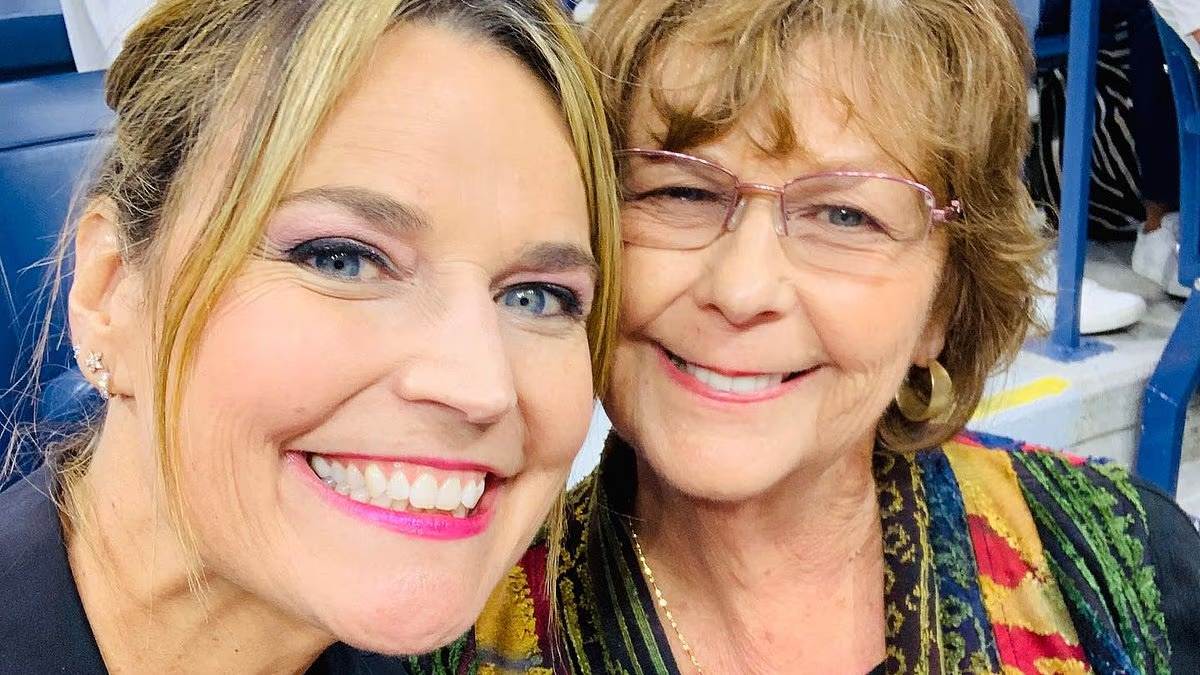
Vancouver doctor Ellen Wieber, who used to be an abortion provider, has euthanized more than 430 patients in nine years

Canada allows doctors to administer lethal injections and for MAiD candidates to receive fatal drugs they can take at home, like in this photo

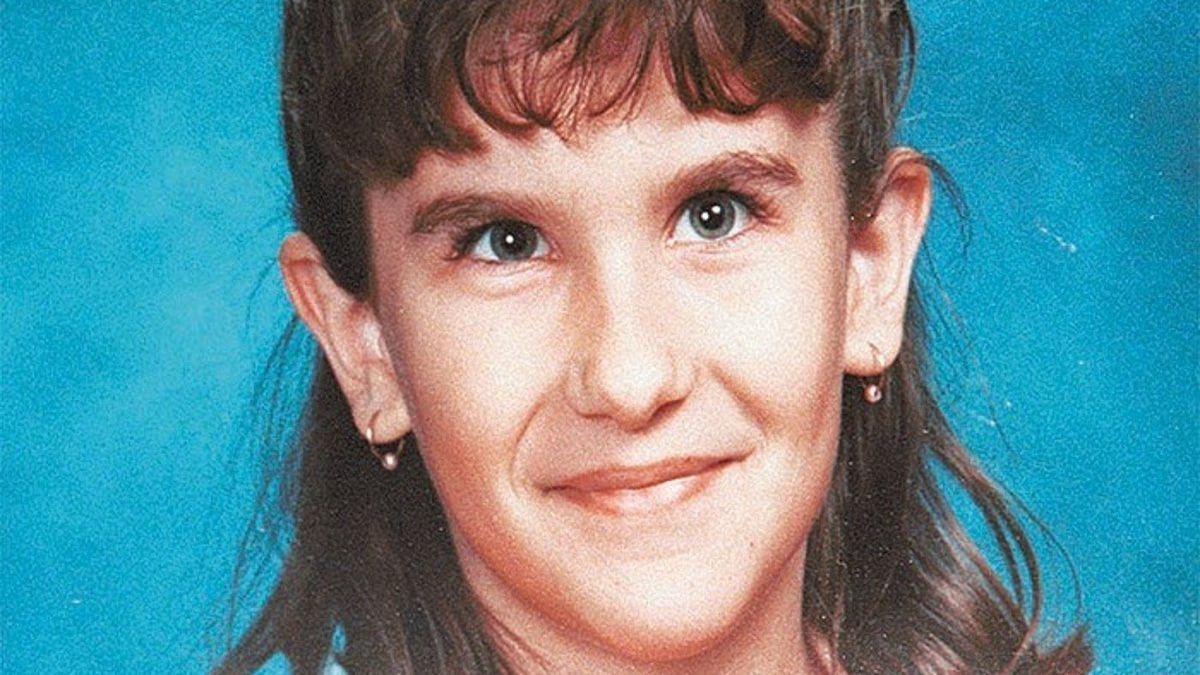
The Quebec College of Physicians suggested legalizing euthanasia for infants born with ‘severe malformations’
Currently, patients don’t need to be terminally ill to qualify for Medical Assistance in Dying, or MAID, as it’s called in Canada.
In two years, the mentally ill will qualify for MAID, and parliament has recommended granting access to minors.
Just one doctor – Vancouver’s Ellen Wieber, who used to be an abortion provider – has euthanized more than 430 patients in nine years.
Vancouver-based doctor Stefanie Green mentioned she prefers to refer to her assisted death procedures as ‘deliveries’ rather than ‘provisions,’ the standard term used by Canadian doctors for euthanasia.
As a former maternity doctor, she used to welcome lives into the world, and now sees her job as ‘delivering life out.’
Some doctors conveyed to The Atlantic feeling uneasy about providing Medical Assistance in Dying (MAID) to patients who aren’t terminally ill, yet they are bound to honor the patient’s autonomy as emphasized by Canadian law.
Toronto-based cancer psychiatrist Madeline Li shared the story of a man in his early 30s who went to the emergency room in pain and was diagnosed with a cancer that had a 65 percent chance of a cure.
But the young man declined any kind of treatment and demanded MAID.
While MAID is advertised as allowing patients to die peaceful and dignified deaths, one doctor told The Atlantic that not all who choose assisted suicide have a loving send off.

In 2022, Louis Roy from the Quebec College of Physicians raised the notion of euthanasia for babies up to a year old ‘who are born with severe deformations, very grave and severe medical syndromes’

Donna Duncan, 61, was ‘fast tracked’ for euthanasia after she ‘starved herself’ – because she was ‘depressed’ following car accident complications, according to her family
Toronto physician Sandy Buchman told of a patient who was ‘all alone’ lying on a mattress on the floor of an otherwise empty rental apartment.
Canada’s legal criteria require a medical reasons for euthanasia – a fatal diagnosis or unmanageable pain – but a 2024 report by Ontario’s chief coroner found that some patients were euthanized based on other factors including an ‘unmet social need.’
The report came after an Associated Press investigation found doctors and nurses were privately struggling with euthanasia requests from vulnerable people whose suffering might be addressed by money, social connections or adequate housing.
Providers expressed deep discomfort with ending the lives of vulnerable people whose deaths were avoidable, even if they met the criteria in Canada’s euthanasia system.
In the case of a man identified as Mr A, Ontario’s expert committee questioned whether authorities tried hard enough to relieve his pain before he was euthanized.
Mr A was an unemployed man in his 40s with bowel disease and a history of substance abuse and mental illness.
He was described as ‘socially vulnerable and isolated.’ Some committee members were alarmed that a psychiatrist suggested euthanasia during a mental health assessment.
Mr A was eventually picked up and driven to the location where he was killed by the health professional who euthanized him – a transgression of professional boundaries, according to some committee members.

Canada’s road to allowing euthanasia began in 2015, when its top court declared that outlawing assisted suicide deprived people of their dignity and autonomy. Justin Trudeau, pictured, was prime minister at the time
They said that might have ‘created pressure and gave rise to a perception of hastening a person towards death.’
Another case detailed Ms B, a woman in her 50s suffering from multiple chemical sensitivity syndrome, with a history of mental illness including suicidality and post-traumatic stress disorder.
She was socially isolated and asked to die largely because she could not get proper housing, according to the report.
Canada’s road to allowing euthanasia began in 2015, when its top court declared that outlawing assisted suicide deprived people of their dignity and autonomy. It gave national leaders a year to draft legislation.
The resulting 2016 law legalized both euthanasia and assisted suicide for people aged 18 and over, provided they met certain conditions.
They had to have a serious, advanced condition, disease, or disability that was causing suffering and their death was looming.
The law was later amended to allow people who are not terminally ill to choose death, significantly broadening the number of eligible people.
Critics say that change removed a key safeguard aimed at protecting people with potentially decades of life left.
Today, any adult with a serious illness, disease, or disability can seek help in dying.
Euthanasia is legal in seven countries – Belgium, Canada, Colombia, Luxembourg, Netherlands, New Zealand and Spain – plus several states in Australia.

Nearly two thirds of Canada’s recipients of assisted suicides are sufferers of cancer
Other jurisdictions, including a growing number of US states, allow doctor-assisted suicide – in which patients take the drug themselves, typically crushing up and drinking a lethal dose of pills prescribed by a physician.
Daily Mail has reached out to the Quebec College of Physicians for comment on this story.