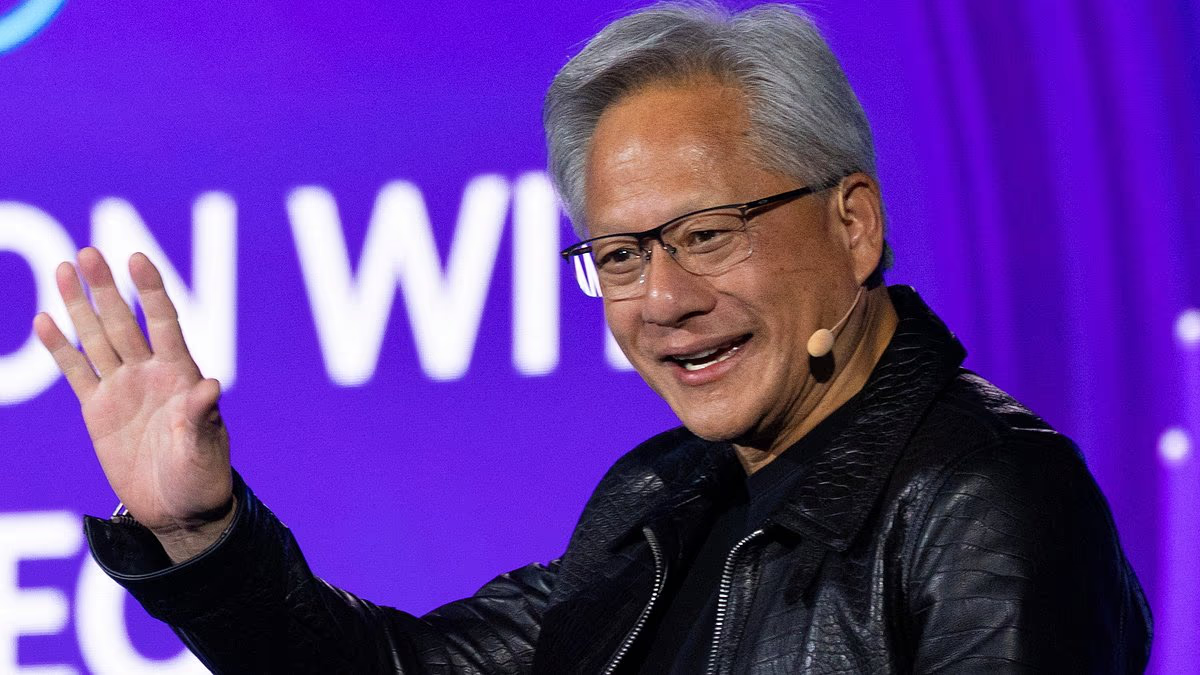
Jensen Huang’s removal over alleged extramarital affairs does not make him a victim. It makes him a cautionary tale for Nvidia’s board and investors.
The language of the ‘Stand with Jensen’ petition is extraordinary, borrowing the tone of an underdog campaign and a protest against social injustice.
This is not a noble moral cause. It is the technology industry closing ranks around one of its own. Huang now looks less like an untouchable tech visionary than a global embarrassment in an expensive leather jacket.
The campaign is also an unwelcome complication for Colette Kress, the interim chief executive, as she prepares to unveil Nvidia’s financial results today. Even an impressive performance may do little to quiet the frenzy surrounding Huang.
At the heart of the Nvidia scandal is a failure of corporate oversight, compounded by an unchecked cult of personality.
Bringing Huang straight back after such a serious lapse in judgment would deepen that governance crisis and leave investors facing a potentially explosive risk.

Jensen Huang was removed as chief executive of chip giant Nvidia following reports of two extramarital affairs
Huang has let down investors, employees, the artificial intelligence sector and, most painfully, his family.
Donald Trump appears unconcerned, saying he ‘would not mind’ seeing Huang return. Elon Musk has also backed him, writing on X that supply-chain agreements were secured on ‘a handshake with Jensen, not a written contract. Without Jensen, at least some of those critical deals will be lost’.
That is hardly a case for reinstatement. It is an argument for stronger corporate procedures. Important commercial agreements should involve more than a handshake.
Perhaps some technology executives oppose Huang’s permanent departure for the same reason Elizabeth I was famously reluctant to execute her cousin Mary, Queen of Scots: removing one of their own could establish an uncomfortable precedent.
Neet solutions
Alan Milburn’s recommendations on young people not in education, employment or training are due today. He is an intelligent and thoughtful figure whose instincts reflect a humane, pragmatic strand of Labour politics that is increasingly hard to find.
Milburn understands that the employment costs and bureaucracy imposed on businesses by his own party’s policies threaten to undermine his ambition to help one million Neets. Benefit reform and employability schemes will achieve little if employers are not creating jobs.
He is expected to propose a ‘tax break’ for companies hiring staff aged between 21 and 24. The plan would raise the point at which employers begin paying National Insurance Contributions from £5,000 to £10,000 a year, at an estimated cost of about £1billion.
That would be a positive step, but it is modest beside the estimated £125billion annual cost of Neets to the economy.
Governments of different political colours have made hiring young workers too costly and uncertain, with Rachel Reeves’s 2024 Budget carrying much of the blame. Last month, Chancellor John Healey announced a Young Entrepreneurs Allowance in his Budget.
The scheme recalls Margaret Thatcher’s Enterprise Allowance Scheme. Though heavily criticised when it was introduced, it supported future business figures including Superdry founder Julian Dunkerton and Creation Records founder Alan McGee.
Artist Tracey Emin also benefited from the scheme early in her career. Young entrepreneurs who build successful companies can create jobs for themselves and, in time, for other people.
But new businesses are far less likely to thrive when they are buried under regulation, paperwork and rising costs.
The most effective way to prevent Neets from being left behind is to build an economy that rewards enterprise and growth. That may be a difficult message for Labour’s left wing to accept.
Neter principle
Most people have now heard about the one million Neets. Far fewer will know about the 2.9 million Neters.
The term describes people from the age of 50 up to state pension age who are not working, studying, undertaking training or retired.
Many are too young or financially unable to retire, yet find themselves screened out by recruitment systems increasingly shaped by artificial intelligence.
The loss of their skills and experience is a profound waste. Perhaps Milburn, now 68, should make this group his next priority.
There is, however, evidence that age need not be a barrier. Anne Boden, the entrepreneur who founded Starling Bank, is launching another bank at 66. It is never too late to start again.
DIY INVESTING PLATFORMS

AJ Bell
AJ Bell
Simple investing with ready-made portfolio options

Hargreaves Lansdown
Hargreaves Lansdown
Free fund dealing plus investment inspiration

interactive investor
interactive investor
Flat-fee investing available from £4.99 a month

Freetrade
Freetrade
Isa investing is free on the basic plan

Trading 212
Trading 212
Commission-free share dealing with no account fee
Affiliate links: If you take out a product This is Money may earn a commission. These offers are selected by our editorial team because we believe they are worth considering. This does not influence our editorial independence.
Compare the best investing account for you


