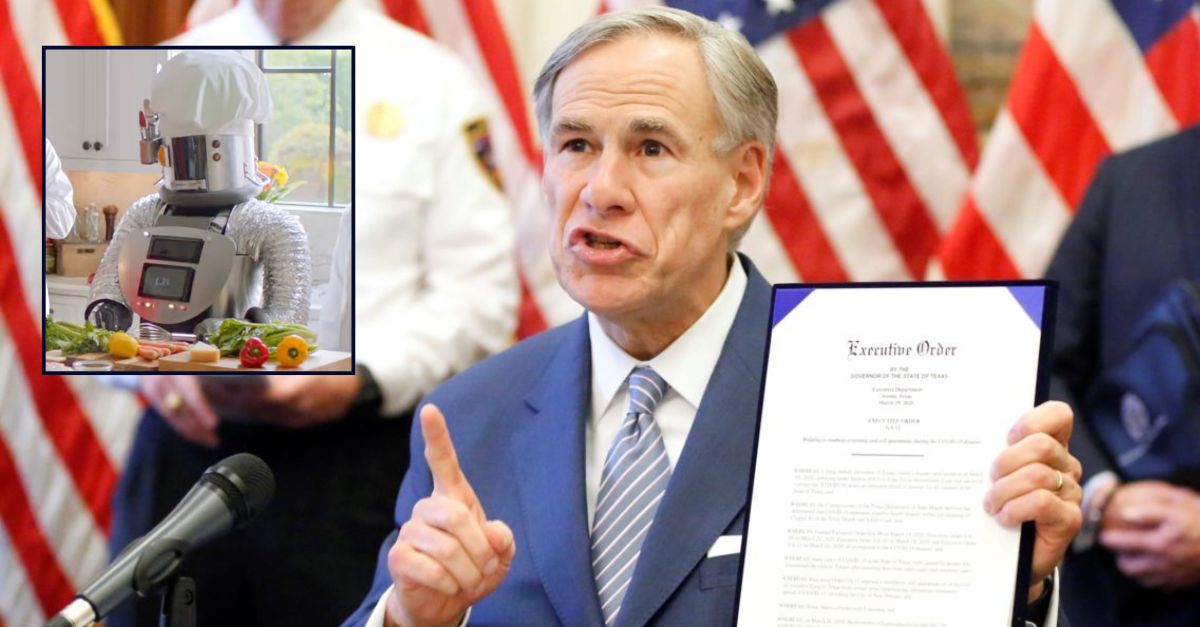

Main: Texas Gov. Greg Abbott displaying an executive order during a press briefing at the Texas State Capitol on March 29, 2020 (Tom Fox/The Dallas Morning News via AP). Inset: Automated chef from a 2019 H-E-B commercial (YouTube).
In the legal contest over the constitutionality of Texas’ newly redrawn U.S. House district map, Gov. Greg Abbott has found an unusual ally in his efforts to further sway the state’s congressional delegation to the right—a figurative robot chef.
In a 15-page motion submitted on Monday to the U.S. District Court for the Western District of Texas, the state aims to dismiss a report from one of the plaintiffs’ experts. This report claims that the map Texas introduced earlier this year “is a significant outlier that heavily relies on race in forming certain Hispanic and Black CVAP [Citizen Voting Age Population] majority districts.”
The plaintiffs, who initiated the lawsuit in 2021 and have amended it several times post the passage of the new U.S. House district map by the state legislature, argue that the new districts “actively discriminate against Black voters and other voters of color” by weakening the electoral power of minority residents. Their complaint seeks an injunction due to the alleged “racially discriminatory intent” behind the redistricting maps.
The report by Dr. Matt Barreto, a tenured political science professor at UCLA, provides an analysis of the map based on computer-generated redistricting plans and “involves producing simulations using a robot,” as detailed in the filing. However, the state is requesting the court to prevent the plaintiffs from utilizing the report, citing their “refusal to provide crucial data needed to replicate and verify his methodology.”
In arguing to have the report tossed, attorneys for the state of Texas likened the plaintiffs’ analysis to a robot preparing a meal.
Conducting a computer redistricting simulation analysis requires various types of information essential for reproducing and verifying its results. Firstly, there is the input code, which directs the robot on how to handle data—the instructions or recipe, so to speak. Secondly, there are the data inputs that are processed by the code—akin to the ingredients the robot chef uses to create the described dish. Thirdly, there are the outputs generated from running the data through the input code—the completed dish. Lastly, there are reports the robot can generate to confirm adherence to the recipe—whether the robot processed all data correctly as the input code anticipated, measured ingredients accurately, combined them at the right moment, and cooked them at the proper temperature for the correct duration.
The motion returns to the theme several times throughout the filing, claiming that Barreto’s refusal to provide the state with reports demonstrating that “the robot successfully ran data through his input code” is akin to the professor having “refused to produce the dish he says he cooked.” Instead, the state claims the professor is insisting that the court rely solely “on his description of the dish.”
Barreto has made himself a sort of bizarre food critic. He has tasted the dish offered by the Texas Legislature, and formulated what he insists is a recipe that will reproduce the dish. But he will not disclose the ingredients he used or how his sous chef prepared them. He will not produce information showing he followed his recipe, and he refuses even to allow State Defendants — or the Court — to sample the dish he prepared. Instead, everyone except Barreto and his lawyers must simply take him at his word — his dish is everything the Texas Legislature’s dish hopes to be, but better.
The state also contrasts Barreto’s alleged failure to provide sufficient information with the state’s own expert witness, who provided “over 100 gigabytes of data supporting her simulations.”
The filing says Barreto provided “bare input code,” which the State calls “a mere recipe compared with the recipe, ingredients, progress pictures, and finished dish” provided by its expert.
A preliminary injunction hearing in the case is currently scheduled for Oct. 1.


