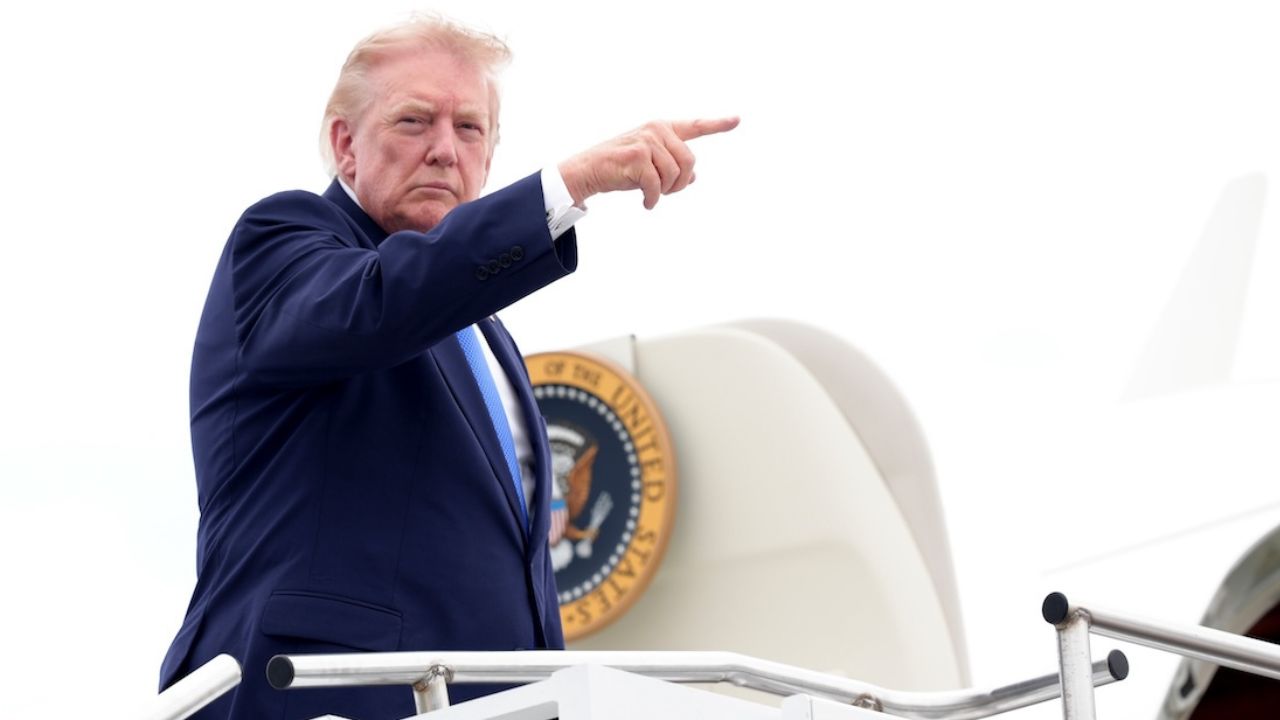

President Donald Trump gestures while boarding Air Force One at Morristown Municipal Airport in Morristown, N.J., Sunday, Aug. 2, 2026, as he prepares to return to Washington (AP Photo/Jacquelyn Martin).
The Trump administration scored two legal victories Tuesday after a federal appeals court ruled in favor of Immigration and Customs Enforcement (ICE) in related cases challenging the agency’s use of force.
The lawsuits were filed by protesters and journalists who said ICE agents used tear gas, pepper spray and pepper balls to disperse demonstrators and observers near the agency’s facility in Portland, Oregon.
The cases reached the U.S. Court of Appeals for the 9th Circuit after district judges issued injunctions restricting ICE and other agencies from using those crowd-control tactics. In both matters, the same three-judge panel overturned the lower-court orders, drawing a distinction between protected protest activity and conduct associated with the Portland anti-ICE demonstrations.
“The First Amendment shields the people from governmental suppression of their right to protest peacefully and speak freely,” U.S. Circuit Judge Kenneth K. Lee, who was appointed by President Donald Trump, wrote in a 34-page opinion. “But the First Amendment cannot be a sword to justify vandalism of federal buildings, criminal trespass of government property, or obstruction of law enforcement.”
U.S. Circuit Judge Eric C. Tung, another Trump appointee, reached a similar conclusion in a 15-page opinion. He opened by citing protesters’ “acts of lawlessness, including assaulting federal officers, and vandalizing and trespassing upon federal property.”
U.S. Circuit Judge Ana de Alba, an appointee of President Joe Biden, dissented in both cases.
Lee’s longer opinion described the plaintiffs as “peaceful protesters and independent journalists who were exposed” to tear gas while standing at the edge of the demonstrations or otherwise becoming caught in the government’s response.
But the majority relied on the differences among the demonstrators to determine that the plaintiffs could not proceed as a class.
The opinion explained:
[T]here is little in common between an Antifa provocateur who destroys the security camera at the ICE facility and a peaceful protester who holds a sign several hundred feet away on the public sidewalk. Simply put, the plaintiffs here have not shown the existence of common evidence that can resolve in “one stroke” the class members’ claims that hinge on a wide array of facts. That is error.
YOU MAY ALSO READ: US Treasury Chief Scott Bessent Moved to Base After Iranian Threats
At the district court level, the plaintiffs had secured relief by arguing that the government retaliated against them for exercising their First Amendment rights to protest.
As summarized by the appeals panel, the preliminary injunction prohibited the government from deploying “non-lethal crowd-control munitions unless someone ‘poses an imminent threat of physical harm’ to law enforcement or other persons.”
The 9th Circuit rejected that retaliation theory, concluding that the force used by the government was incidental rather than aimed at suppressing protected speech.
“We are left with a more plausible explanation of events,” Lee wrote. “[T]he five plaintiffs (out of hundreds of protesters) were not intentionally targeted for their First Amendment activity but were rather unfortunate collateral casualties during a chaotic effort to quell disorder.”
In Tung’s shorter opinion, the majority criticized the lower court’s reasoning as effectively recognizing “a right to be free from exposure to tear-gas chemicals used by law enforcement officers as a means of crowd control.”
The 9th Circuit said the plaintiffs had not established that such a substantive-due-process right was “deeply rooted in our Nation’s history.” The panel also repeatedly cited the U.S. Supreme Court’s decision overruling Roe v. Wade.
The majority offered an extended rebuke of the district court:
Plaintiffs would return us to a time before Glucksberg and Dobbs were decided, when Roe v. Wade put judges in the position of creating new rights rather than securing those rights established or recognized by our Constitution, when judges devised extra-constitutional rules that overrode legislative acts authorized by the will of the people or invalidated law-enforcement action long understood to be permissible. That we cannot do.
“The district court’s preliminary injunction is vacated,” Tung’s opinion concluded.
The post ‘Creating new rights’: 9th Circuit sides with ICE, reverses injunctions over ‘non-lethal’ crowd control methods, tear gas first appeared on Law & Crime.


