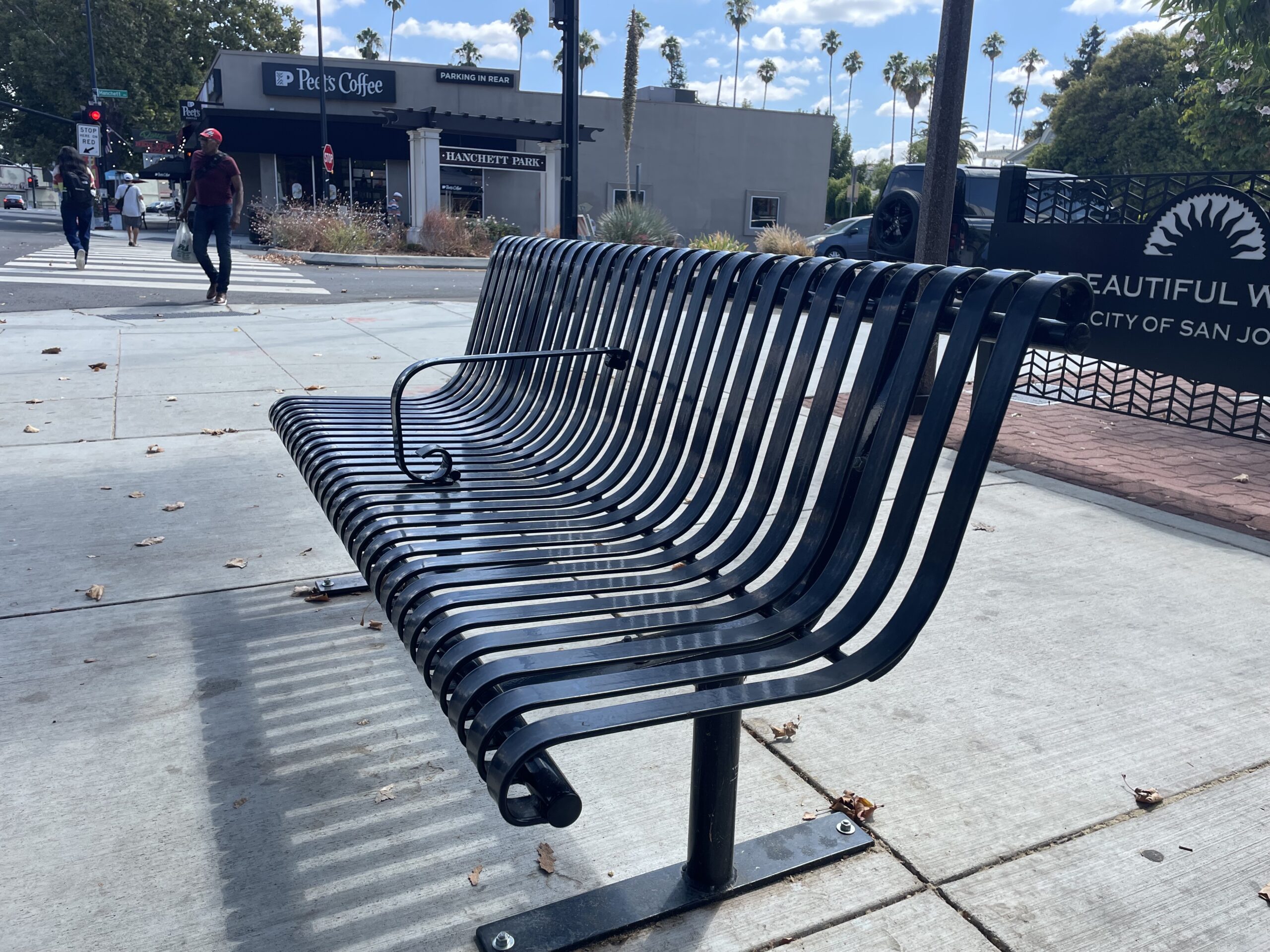

(NEXSTAR) – Once you notice it, you can’t ignore it. Hostile architecture, also known as hostile design or defensible architecture, is prevalent in urban areas and public spaces.
You may have encountered it outside businesses, at bus stops, on sidewalks, and in parks, as it manifests in various forms. It’s termed “hostile” because it discreetly (or sometimes overtly) discourages people from staying.
“Through design you are making them uncomfortable so that they leave, or you’re making particular activities that they tend to do uncomfortable,” said Anastasia Loukaitou-Sideris, an urban planning professor and dean at UCLA’s Luskin School of Public Affairs.
A typical example of hostile architecture is straightforward: a bench split in two, generally to deter someone from lying on it. The bench’s structure (metal slats with gaps) is comfortable enough for a brief rest but subtly discourages extended stays.

Some transit stations eliminate benches altogether, offering riders a surface to lean against instead.
Some hostile designs are more overtly unfriendly. Metal spikes, for example, can be found on sidewalks or beneath awnings to stop people from sitting or lying down.
However, at times it’s less noticeable. For instance, when large steel planter bins were added to San Francisco sidewalks, locals noted that it wasn’t merely for aesthetic purposes but was also intended to reduce space for tents on the sidewalk.
Another San Francisco neighborhood tried to do the same thing but with large boulders, which were ultimately removed.

The Seattle Department of Transportation once installed bike racks under an overpass. Critics said there was little need for bike parking there, and the way they were positioned was more likely designed to keep people from setting up tents, the Urbanist reported. The city ended up removing the bike racks.
Another more subtle example of hostile design are metal bars or divots that interrupt long benches or railings. These are usually used as a tactic for deterring skateboarders.

Hostile design can also be less about the physical space. “Another example is there was a Skid Row park in Los Angeles where the authorities would start the sprinklers at night so people could not sleep in the park,” Loukaitou-Sideris said. There are also stories of businesses blasting loud music outside to discourage gathering or loitering too long.
In recent years, much of the conversation around hostile architecture has centered around issues of homelessness. It’s part of a larger conversation about how public spaces are designed and who they are for.
On one side of the debate, Loukaitou-Sideris said: “You can consider bus stops public spaces because everybody can sit there and they should be open and accessible to the public, right? And unhoused people often use the bus — sometimes they use it as shelter but sometimes they use it to go to work, or reach a destination. So by excluding them from these spaces, does it retain the publicness of the bench?”
But on the other hand, “Local governments would say that if the space is occupied constantly by an unhoused person, then other legitimate riders will not be able to use it.”
While many pieces of hostile design target homeless people, in particular, they’re not the only people impacted. An uncomfortable bench is uncomfortable for everyone, not just someone trying to sleep on it. If steel planters or boulders take up half of the sidewalk, you’ll have less room to walk or push a stroller. If there are spikes on the ground under an awning outside a store, you’ll have a harder time standing there to shelter from the rain.
-

Another piece of defensive design to keep people from sitting or sleeping. (Getty Images) -
These anti-homeless spikes aren’t as spiky, but get the message across nonetheless. (Getty Images) -
Some hostile design targets pigeons, not people. (Photo by: Pauleheult/Eye Ubiquitous/Universal Images Group via Getty Images) -
These planters were placed by a Home Depot store in Playa Vista, California, to discourage people from parking their RVs illegally. (Allen J. Schaben / Los Angeles Times via Getty Images) -
This Los Angeles bus stop shows another example of a divided bench. (Photo by Alexi Rosenfeld/Getty Images).(Luke Johnson / Los Angeles Times via Getty Images) -
Boulders under a freeway interchange in San Francisco around usual homeless encampment on Thursday, December 21, 2017, in San Francisco, Ca. (Photo By Liz Hafalia/The San Francisco Chronicle via Getty Images) -
Hostile street architecture designed to prevent homeless people sitting, standing or sleeping in London.(photo by Mike Kemp/In Pictures via Getty Images Images) -
Rocks are installed on a concrete surface to keep people away. (photo by Mike Kemp/In Pictures via Getty Images) -
A three-seat wooden bench with clear dividers. (Getty Images) -
This Los Angeles bus stop shows another example of a divided bench. (Photo by Alexi Rosenfeld/Getty Images) -
South Kensington Underground tube station in London, England, UK. (Photo by Nicolas Economou/NurPhoto via Getty Images) -
Boulders line the street of Clinton Park just off of Dolores St. on Tuesday, 9 24, 2019, in San Francisco, Calif. Someone has put boulders up on the sidewalk to keep the homeless tents out and the Department of Public works has no plans to remove them. (Photo By Liz Hafalia/The San Francisco Chronicle via Getty Images)
The debate is nothing new — there are examples of hostile architecture that date back more than 100 years — and it rages on in state legislatures, academic spaces and online. What may seem like a relatively small design choice can encompass issues of discrimination, access to public resources, social control and individual freedoms.
Let’s go back to the example of the bench for a moment.
Selena Savic, co-editor of “Unpleasant Design,” describes it on an episode on the “99 Percent Invisible” podcast:
“A classic is the bench with armrests in between, which of course let you rest your arm on the armrest, but at the same time they restrict any other kind of use than sitting upright. The only way this bench can be used is by three people sitting next to each, not looking at each other — which is not the only thing you can do on a bench. Especially, it’s not the only normal and legal thing you can do on a bench.”
By trying to keep someone from sleeping on the bench, designers may end up keeping people from wanting to use it at all.
Savic continued, “When we expect people to do bad things to the bench before we think of anything good that people might do to this bench, I think that’s a very sad approach to public space.”


