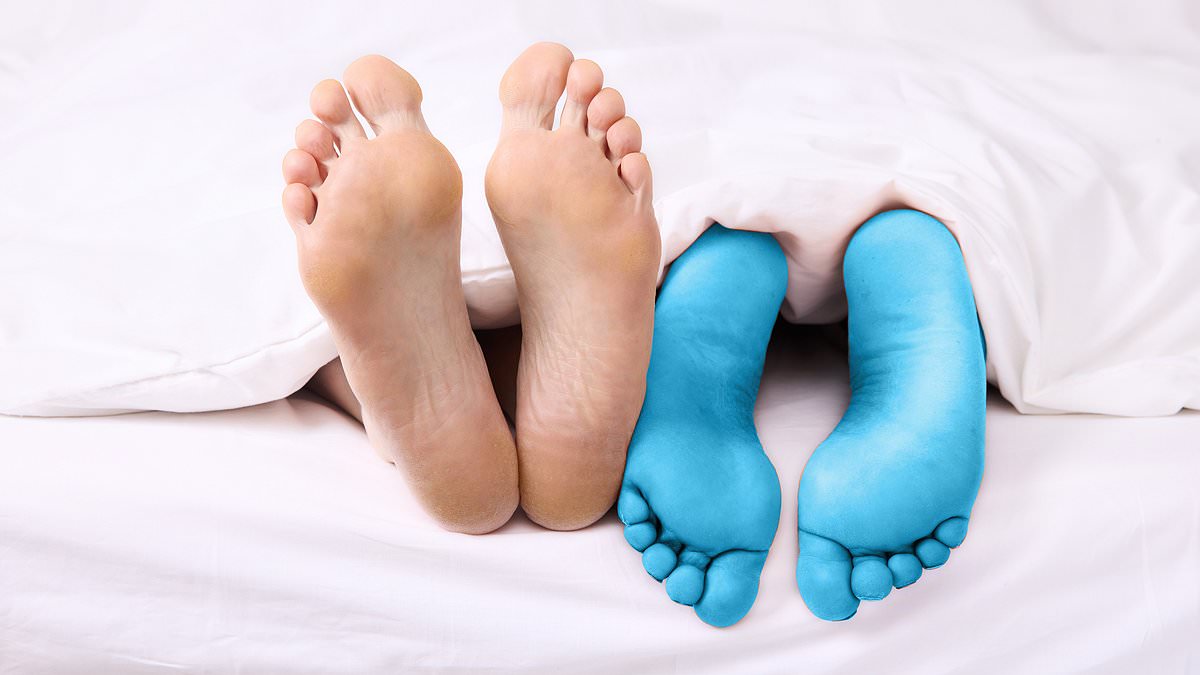

The great domestic autumn battle has begun – and it’s being fought on two fronts.
On one side, women are rushing to haul the winter duvet out of the cupboard, shivering in the autumnal chill.
On the other, men are digging in their heels, dreading sweaty, sleepless nights and insisting the lightweight summer cover will do just fine.
Add in the simmering row over the thermostat and the scene is set for months of marital discord.
So who is right? And do women genuinely run colder than men?
The scientific fact is that men may need to begin showing more empathy, as there is solid evidence women genuinely experience the cold more intensely.
Research indicates that women not only find comfort at temperatures two or three degrees Celsius higher than men but also that they actually perform better at work when it is slightly warmer.
The explanation is complex, according to physiologist Dr. Clare Eglin from the University of Portsmouth, and involves the differences in how male and female bodies operate.

Women’s hormones can affect how warm or cool they feel – and it can fluctuate throughout the menstrual cycle
‘In general, men and women both have the same core body temperature of around 37°C,’ Dr. Eglin notes. ‘However, what differs is our skin temperature, which influences how cold or warm we feel. Women’s skin temperature is generally lower than men’s.’
This is partly due to metabolism, especially at rest—that is, how much heat and energy are generated just from burning calories to support the body’s essential functions.
‘The greater the muscle mass, the more energy is burned and the more heat is produced, even when inactive. Since men typically have more muscle mass than women, they generate more heat,’ Dr. Eglin elaborates.
Even shivering – the body’s way of generating warmth by rapidly contracting the muscles – is more effective for men.
‘If you were to match a man and a woman with the same body shape and the same muscle mass, they would thermoregulate in the same way,’ she says.
‘But you would almost never be able to do that because men and women are different.’
Even with the same muscle mass, women’s body fat is distributed differently, which also makes them more sensitive to the cold.
Women have more subcutaneous fat – which sits in a layer under the skin – that insulates the organs but leaves the skin cooler.

For both sexes, sensitivity to cold increases with age – narrowing the gap in how men and women perceive temperature
‘It means women’s skin sits a bit further away from the blood vessels that would keep it warm, so even if the core is warm, the skin will feel cooler,’ Dr Eglin adds.
There is also evidence that the sex hormone oestrogen causes women’s blood vessels in the skin to narrow more quickly than men’s in cold weather.
‘This conserves heat for organs like the heart and brain, but that comes at the expense of women’s hands and feet, which will feel cold and may mean women need gloves and warm socks more than men during winter,’ she says.
Men, however, do not need to shut down the blood vessels in their skin to preserve core body temperature.
Women’s hormones can also affect how warm or cool they feel – and it can fluctuate throughout the menstrual cycle.
They may feel cooler in the first phase of the cycle, during and just after a period, when oestrogen is dominant.
Following ovulation, when levels of the hormone progesterone rise, women’s body temperature can spike by 0.3C to 0.5C, making many feel warmer.
‘Potentially, this means women are more susceptible to heat stress if exposed to extreme heat in the weeks after ovulation, and to hypothermia if exposed to cold during the first couple of weeks of their cycle,’ Dr Eglin says. ‘It’s a small difference, but some women do feel it.’
Office managers should also take note: studies show room temperature can affect cognitive performance. At colder temperatures, one study found men outperformed women on maths and verbal tasks. But when the temperature rose a couple of degrees, women came out on top.
‘Women are more comfortable at around 24C, while for men it’s 21C or 22C,’ Dr Eglin says.
For both sexes, sensitivity to cold increases with age – narrowing the gap in how men and women perceive temperature.
For men, their metabolism slows down, their muscle mass lessens, and their skin becomes thinner, making it harder to generate heat.
And for women, the drop in oestrogen during menopause, with a reduction in subcutaneous fat, makes the cold even worse.
Wearing layers inside, moving regularly, and staying hydrated can all help, Dr Eglin says.
Until then, the message to couples arguing over the thermostat is simple: compromise.
Set the dial between your ideal settings, and use blankets or lighter layers so that everyone is comfortable.
3 WAYS TO END DUVETDING DONGS
1. The Scandinavian sleep method
Two separate single duvets instead of one double. Each partner picks the thickness they prefer – a light cover for hot sleepers, a thicker one for those who feel the chill. It means no more midnight tug-of-war and fewer disturbances from a wriggly partner. The only drawback is making the bed can be trickier.
2. Split-tog or partner duvets
Specially designed duvets with different tog ratings on each side. One half stays cool, the other snug – all under a single cover. They provide individual comfort while keeping the look of the bed cohesive.
3. Supersize the duvet
Choose a lighter duvet one size larger than the bed itself. The extra width and length mean more coverage – so the chilly partner can cocoon while the warmer one avoids a stifling winter-weight cover and simply sticks a leg out.