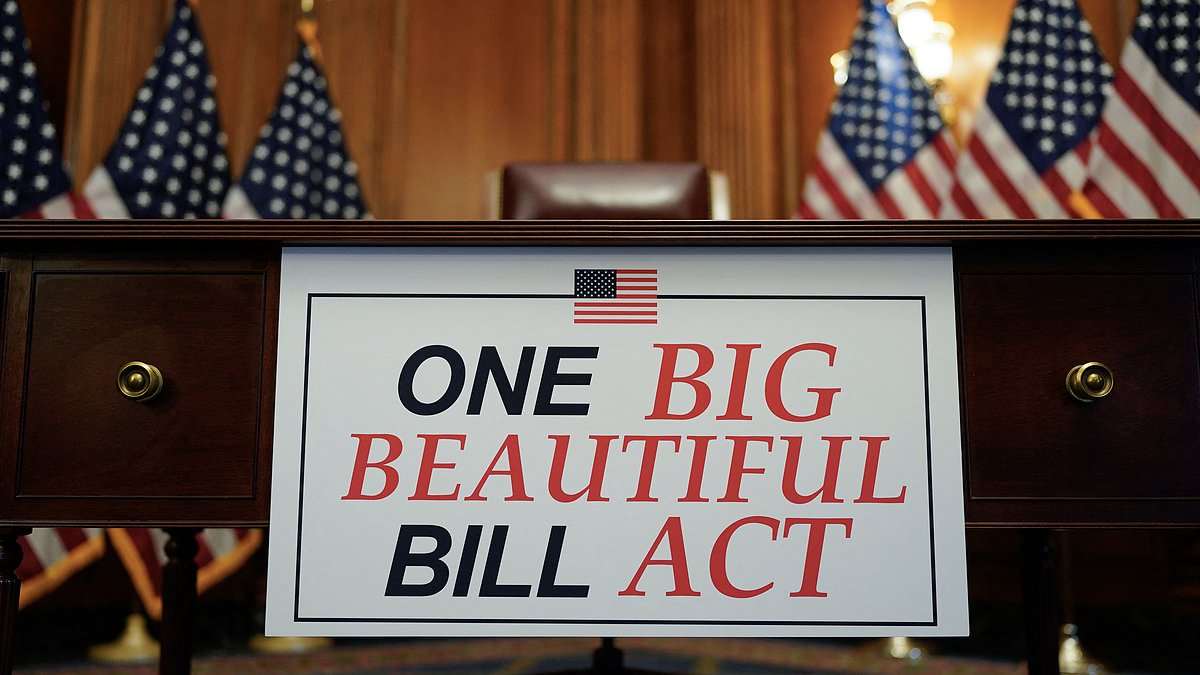

Ever wondered what a tax-free life would look like? For some Americans, it’s becoming closer to reality.
The new tax legislation under President Donald Trump’s ‘One Big Beautiful Bill Act’ might enable millions to avoid paying any federal income tax for the tax year 2025, when they file in 2026.
Estimates from the Tax Policy Center suggest the percentage of households not paying income tax could rise from 40% to 42%.
People who will benefit the most from the new tax law include parents, overtime workers, tip-makers, seniors aged 65 and up, and adoptive families.
Tipped workers will be able to deduct up to $25,000 in tips from taxable income, and overtime workers can deduct up to $12,500 of overtime pay.
Seniors will be allowed to deduct an extra $6,000 on top of their standard deduction.
Parents can claim a child tax credit — $2,200 per child — with refundable options, and the adoption tax for families is now refundable.
This is largely due to additional deductions, including the standard deduction, child tax credit, and earned income credit, allowing many working- and middle-class taxpayers to completely eliminate their income tax burden without needing intricate tax strategies.

New tax laws under President Donald Trump’s ‘One Big Beautiful Bill Act’ could allow millions of Americans to pay $0 in federal income tax

Fort Lauderdale economist Michael Szanto
Experts say that, because the new tax breaks mostly go to lower and middle-income taxpayers, they will not blow a huge hole in the budget.
This is partly because these groups contribute a smaller proportion of the total federal income tax revenue, especially when compared against tax reductions for high-income individuals or businesses.
‘These deductions won’t affect government deficit so much,’ Fort Lauderdale economist Michael Szanto told the Daily Mail.
According to Szanto, the top 10% of earners in the United States already contribute the bulk of federal income taxes. Therefore, unless these taxpayers receive substantial tax reductions, overall federal revenue won’t decrease significantly.
‘Payroll taxes on the other hand disproportionately affect lower income families,’ Szanto explained.
‘Those who receive large amounts of their income through tips and overtime can be helped by this new package,’ he continued.
‘Everyone should work carefully to study to maximize the credits and deductions applicable to their respective situation.’
Karla Dennis, a tax expert and CEO of the tax strategy company KDA, Inc., stated, ‘Ordinary, hardworking Americans will see the most advantage.’
‘The way to maximize this new law is to be intentional with planning. Families should use retirement accounts, health savings accounts, and dependent care accounts to reduce taxable income,’ Dennis said.
‘Workers should be sure to claim every credit they qualify for, especially child and education related credits. Seniors can lean on the larger standard deduction and lower tax rates on investment income.
She added: ‘The people who track their finances and use these tools during the year will be the ones who truly win… Everyday Americans can now benefit in a very simple way while wealthier households will need to focus on layered planning.’
The Wall Street Journal presented multiple different scenarios in which someone could pay $0 in federal income tax.
For example, a married couple that makes $100,000 (including overtime pay) with two kids under 13 could use child tax credits, standard deduction, and maybe overtime/tip deductions to reduce tax to $0.
A single waitress with one child could use tips deduction, earned income tax credit, standard deduction, and child credit to eliminate her tax bill.
Or a retired couple with multiple income sources could use standard deduction, senior deduction, charitable deduction, and tax-exempt portions of Social Security to reduce income tax to zero.
Notably, even if someone pays nothing in federal income tax, they may still pay payroll taxes, state income tax, sales tax, and property tax.
In many cases, these taxes are larger than any eliminated federal income tax.


