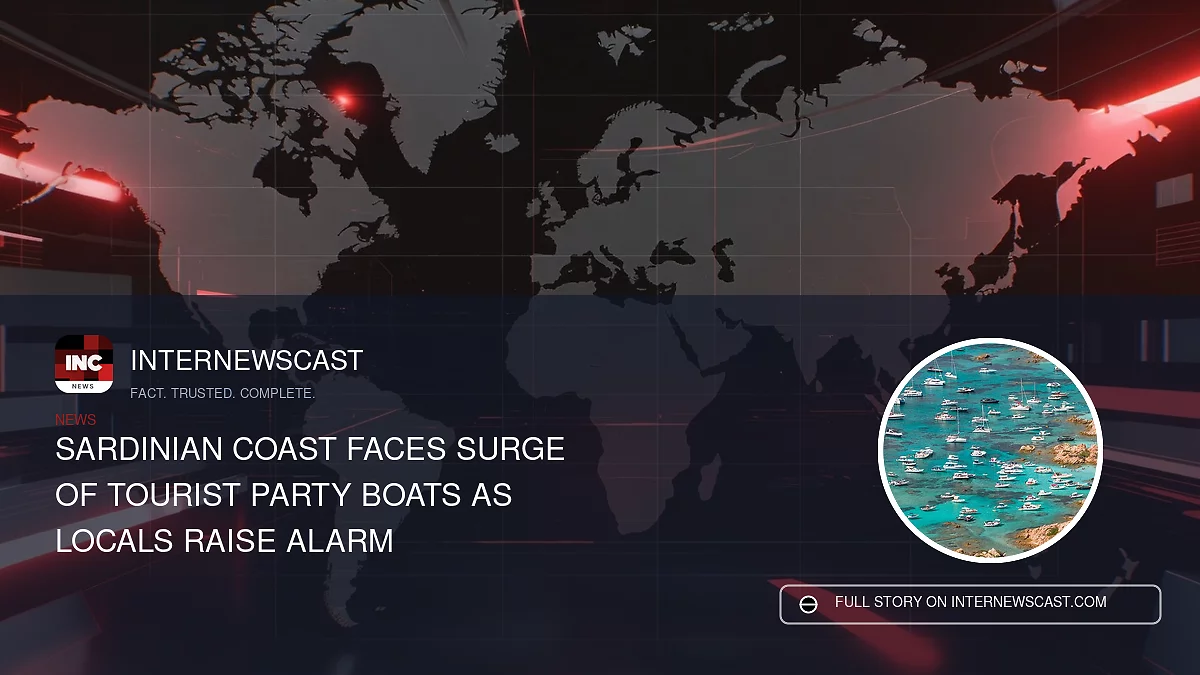

Some of Sardinia’s most treasured coastal beauty spots are under mounting pressure this summer as locals and environmental campaigners warn that waves of tourist party boats are overwhelming fragile marine areas.
Yachts, inflatable dinghies and floating party vessels have crowded sections of the Mediterranean around the Italian island, with particular concern focused on Maddalena National Park, a protected archipelago off Sardinia’s northeastern coast.
New footage from the area, which includes roughly 60 islands, shows the waters jammed with pleasure boats, while conservationists say anchors dropped from the vessels are damaging the seabed.
In one widely shared clip, a karaoke boat party can be heard blasting music across the water.
Rosanna Giudice, president of Maddalena National Park, told La Nuova Sardegna that the boats arrive “swarming in like locusts.”
Giudice said up to 6,500 boats have been recorded in the area, despite the park being able to handle only about 2,500 vessels per day.
The coastline has long drawn celebrities, business figures and political leaders. Silvio Berlusconi, Italy’s late former prime minister, owned a mansion in the area and once hosted Sir Tony Blair there.
Italy’s current prime minister, Giorgia Meloni, also spent part of this month on holiday in the region.

Yachts and party dinghies have been swarming the Mediterranean Sea surrounding the Italian island this summer

Footage has emerged of the protected region packed with pleasure craft whose anchors are tearing up the sea bed

One particularly egregious video showed a karaoke boat arty blaring music in the protected area
Lino Cozzuto, head of Guardie Ambientali Sardegna, an environmental protection group, told The Times: ‘Local governments have long tried to protect the beaches by limiting visitor numbers, but out at sea anchoring is out of control.’
Italian law requires boats to anchor at least 650ft from beaches and 320ft from rocky shores.
But many dinghies rented by day-trippers often go far closer, bypassing beach quotas and posing a risk to swimmers and the environment.
These holidaymakers have been emboldened by the rise of boat-rental apps, which make it far easier to book pleasure craft.
On top of this, local firms have pushed back against rules that aim to protect the environment. In the spring, the park introduced restrictions and priority rules for access via the sea, but boat rental associations slammed ‘the use of serious environmental concerns to justify measures to disrupt competition’.
But perhaps the biggest problem is enforcement. The protected park is around 47,000 hectares, of which only 2,500 are on land.
Mr Cozzuto said the swarm of boats has generated an ‘enormous amount of work’ for the coastguard.
Italy has long had a problem with overtourism, and authorities are now taking extreme measures to curtail the problem.

The protected park is around 47,000 hectares, of which only 2,500 are on land making enforcement hard

As many as 6,500 boats have been seen in the area, when it is only able to accommodate around 2,500 a day

Locals said the swarm of boats has generated an ‘enormous amount of work’ for the coastguard
Tourists who leave their belongings and towels on sun beds have now been warned they face confiscation and fines.
Dubbed ‘furbetti dell’ombrellone’, which translates to ‘umbrella cheats’, local authorities in Italy are clamping down on those who attempt to save spots on public beaches when they are not there.
Holidaymakers could find themselves charged up to €500 (£428). Officials dealt with ‘umbrella cheats’ on Laghetto Beach in Torre del Greco recently and saw around 40 unattended items, such as chairs, tables and parasols, removed.
Some of the belongings had been left unattended for more than two days and those hoping to recover their belongings face a long process to get them back.
Overnight crackdowns in Castellabate, Campania, during July saw 200 items taken by officials.
In Campomarino, Campobasso, 170 items were removed.
Meanwhile on Micenci beach in Sicily, hundreds of items, including unattended loungers and beach towels, were confiscated.
Graziano Gagliardi, general manager at Private Italy Tour, said: ‘These fines are not being imposed simply because authorities dislike unattended towels.
‘The rules exist to preserve access to publicly owned coastline and stop people informally claiming the best parts of the beach for days at a time.’
He explained that although Britons may view the behaviour as similar to reserving a hotel pool lounger, it isn’t quite the same as ‘a free Italian beach is public land’ so different rules apply.
Leaving behind items can also make cleaning the beach difficult and create possible dangers if things like umbrellas aren’t properly secured during bad weather.