Australia has some of the richest deposits of mineral sands and rare earth minerals in the world, and the US wants access to them, hoping to counter China’s dominance of the industry.

Rare earths, a term that might sound misleading, aren’t actually all that rare. Despite the name, these elements play a crucial role in a variety of modern technologies.

From consumer electronics and electric vehicles to medical devices and robotics, rare earth elements are fundamental to many cutting-edge advancements. They are also significant in the production of military equipment.

Rare earths are a group of 17 elements in the periodic table, most of them known as lanthanides.

However, extracting and processing these materials is costly, labor-intensive, and often harmful to the environment.

They’re crucial too for the green energy transition. Solar and wind energy and electric vehicles all depend on rare earth elements.
Dr Vlado Vivoda from the Sustainable Minerals Institute at the University of Queensland told SBS News earlier in the year that despite the name, they’re not actually scarce.
“So a lot of them are not actually rare, but they’re hard to mine and even harder to separate and process safely. So that’s what makes them geopolitically important.”
Rare earths are tightly bound together with other elements in nature, so separating them is a complex process often involving at least 50 stages.

Historically, most countries have relied on China for the supply of rare earths. According to expert Vivoda, China rose to prominence in this field during the 1990s.
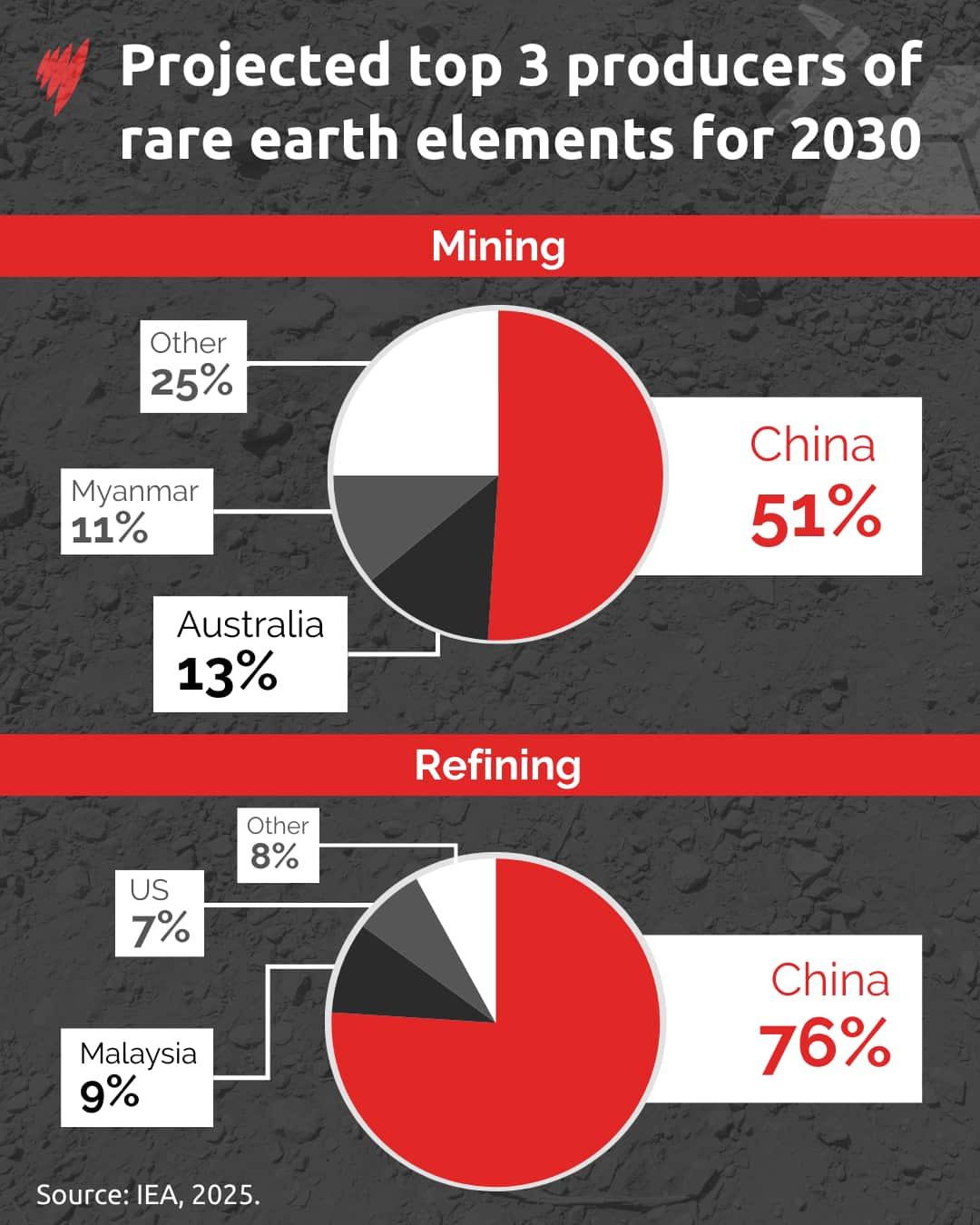
A graph depicting the projected top three producers of rare earth elements

In a strategic move to bolster national security amid global uncertainties, Prime Minister Albanese announced in April an initial $1.2 billion investment. This funding aims to establish a reserve of critical minerals, including rare earths, which are deemed essential for Australia’s future.

Most countries have left the work to China, which Vivoda says emerged as a key player in the 1990s.

“China appeared as the ideal candidate to take in some of that industry, to do it at home with a bit more lax environmental regulations. And it was the cheapest place to do all this. Plus China had some of the largest reserves as well of rare earths.”
China now controls the majority of the rare earths supply chain, accounting for around 70 per cent of mining and 90 per cent of processing, according to the International Energy Agency.
That lion’s share is unlikely to change; however, over the next five years, Australia is on track to become the second-biggest producer of rare earth elements.
Earlier this year, China threatened to halt exports of rare earth minerals to the United States, amid an ongoing tariff row, after which Trump funded billions of dollars of incentives for investors in the minerals, as part of his ‘big, beautiful bill’.

In April, Albanese announced an initial investment of $1.2 billion to set up a strategic reserve of critical minerals, including rare earths, which he described as key to Australia’s national security “in a time of global uncertainty”.
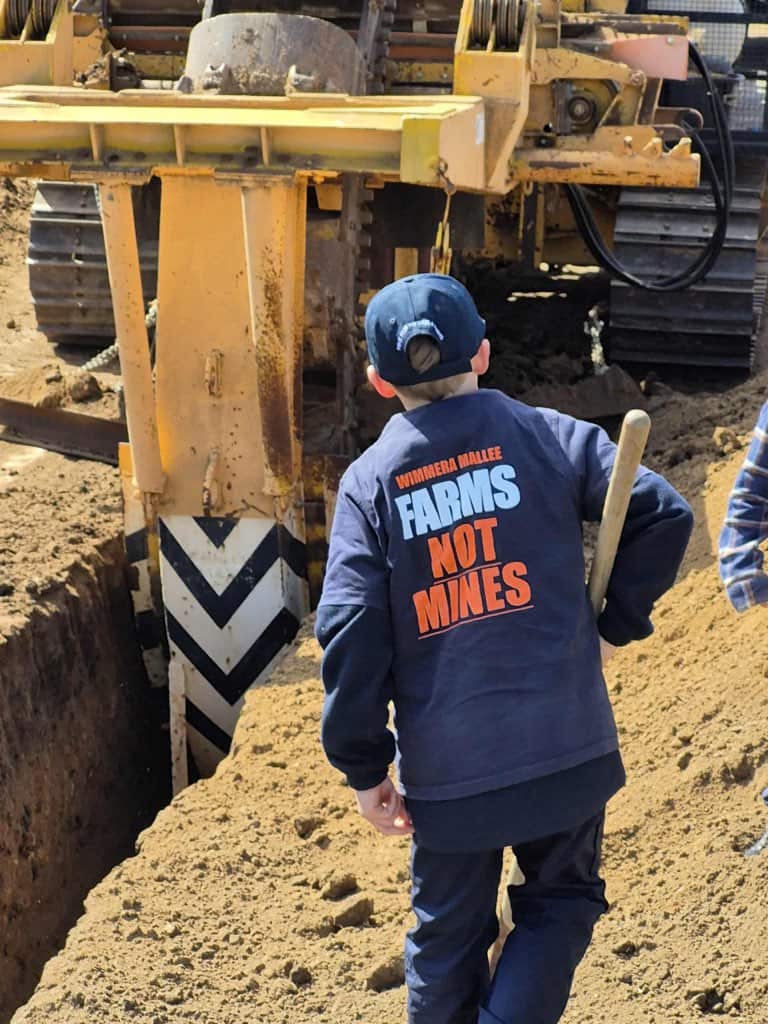
A child walking alongside a digger wearing a shirt that reads 'FARMS NOT MINES'

Farmers gathered this month to protest against a pipeline to enable the Donald Mineral Sands project, south-east of Minyip in Victoria. Source: Supplied

The government has also agreed to loan over $2.6 billion to two firms to establish separate refineries — Arafura Rare Earths mine in the Northern Territory and Iluka Resources in Western Australia.
But Australia’s push to become a bigger player in the global race for rare earth minerals relies on digging up prime agricultural land, which has led to pushback from some farmers.
You May Also Like

Julie Bishop Resigns as ANU Chancellor Amidst Ongoing Controversy: What’s Next for the University?

Julie Bishop has reportedly stepped down from her position as chancellor of…

Trump Denounces Iranian Attacks as Leadership by ‘Lunatics

Donald Trump has commented on the recent tensions between the United States…

Australia’s Soaring Welfare Bill Predicted to Surpass New Zealand’s Entire Economy by 2027

Australia is on the brink of a welfare expenditure surge so significant…

From Family Vacation to Unimaginable Fear: Fio’s Battle with Cancer and Life Beyond Recovery

A seemingly routine family vacation to New Zealand took a dramatic turn…

Family with IS ties communicates from aircraft ahead of imminent arrival in Australia

In Brief Some returning adults will face charges, the AFP commissioner has…

Government Unveils Gas Export Reservation Plan: Balancing Act Sparks Debate

In Brief The policy will begin in July 2027 and bar gas…

Climactic Confrontation Looms in Rebel Wilson’s Intense Dispute with Co-Star

The curtain is falling on a whirlwind courtroom drama involving Hollywood’s Rebel…

ISIS Brides Facing Historic Charges: Crimes Against Humanity and Terror Allegations Unveiled

Two women with alleged connections to ISIS are facing charges related to…

Keir Starmer Confronts Pivotal Challenge as Discontent Rises Within Labour Party

In brief UK Labour faces heavy losses in local polls across England…

WA Budget Introduces $100 Fuel Assistance for All Drivers

Every driver in Western Australia is set to receive a $100 fuel…

Legal Victory: AFL Legends Cleared of Affray Charges, Restoring Reputations

Two AFL champions have been cleared of any involvement in a Boxing…

American Rapper’s Endorsement of The Voice Sparks Outrage from Critics: Calls to ‘Fix Your Own Country’ Erupt

Renowned for his iconic track “U Can’t Touch This,” American rapper MC…