
Meteorologists are advising residents along the US East Coast to brace for turbulent seas, potential beach erosion, and stormy weather as Storm Melissa intensifies in the Atlantic.
On Friday, the National Hurricane Center reported that Melissa is currently “nearly stationary” to the southeast of Jamaica, having already swept across Haiti where it tragically claimed three lives on Thursday.
Though Melissa is still positioned in the Caribbean, officials caution that its anticipated turn towards the northeast might lead to storm-induced conditions like rough surf, powerful rip currents, and various coastal threats along the US East Coast. The precise impact and timing, however, are still being evaluated.
AccuWeather experts reiterated these concerns, noting that the storm’s path through the Caribbean and into the Atlantic will largely depend on the development of a jet stream dip over the eastern US next week.
“Regardless of how close the storm approaches the US,” they remarked, “we expect to see rough seas, beach erosion, and coastal flooding along a significant portion of the East Coast in the coming week.”
In its Friday forecast, AccuWeather projected that Melissa is likely to strike Jamaica as a major hurricane early next week, with a subsequent landfall anticipated in Cuba.
Lead hurricane expert Alex DaSilva warned: ‘At this time, the odds of direct rain and wind impacts from Melissa reaching the US East Coast are low.
‘However, there are scenarios that could bring Melissa closer to South Florida, and at the very least, some indirect impacts from Melissa are anticipated, not only in South Florida but well to the north along the Atlantic coast.’

While the storm remains in the Caribbean, hurricane trackers cautioned that its eventual northeast turn could bring storm-related impacts, including rough surf and coastal hazards, to the East Coast, though the exact timing is uncertain

The erratic storm was expected to drop copious rain on Jamaica and the southern regions of Haiti and the Dominican Republic (pictured). At least three people were reported killed in Haiti
He added that the massive waves Melissa unleashes north of Cuba will have some impacts on US beaches hundreds of miles away.
As Melissa shifts into the southwestern Atlantic, meteorologists expect a significant dip in the jet stream to form across the eastern US.
This pattern could spark a new storm, potentially a strong nor’easter, along the Atlantic coast by late October.
Even a weaker coastal system, interacting with Melissa offshore, could produce stronger winds and rougher seas along the coast, AccuWeather warned.
Forecasters noted on Friday that Melissa could trigger ‘catastrophic’ flash flooding and landslides across Haiti, the Dominican Republic and Jamaica as it moved slowly through the Caribbean Sea.
The NHC expects the storm to unleash up to 20 inches of rain in the region by Monday, the New York Times reported.
DaSilva warned: ‘Melissa is forecast to rapidly intensify to a major hurricane while slowly churning over the warm waters of the Caribbean.
‘Because the storm is expected to move so slowly, some parts of Jamaica could experience hurricane conditions for 72 hours or longer.

Meteorologists warned the massive waves Melissa unleashes north of Cuba will have some impacts on US beaches hundreds of miles away

The US East Coast could see indirect impacts from Storm Melissa sometime next week, meteorologists warned
‘Melissa is evolving into a slow-motion disaster. Millions of people are at risk of catastrophic impacts. We are increasingly concerned about the threat of a humanitarian disaster unfolding.’
The Air Force Reserve flew through Melissa this morning and found the storm’s center much farther east-southeast than last night.
The NHC said that it is unclear if this is due to actual movement or the storm reorganizing.
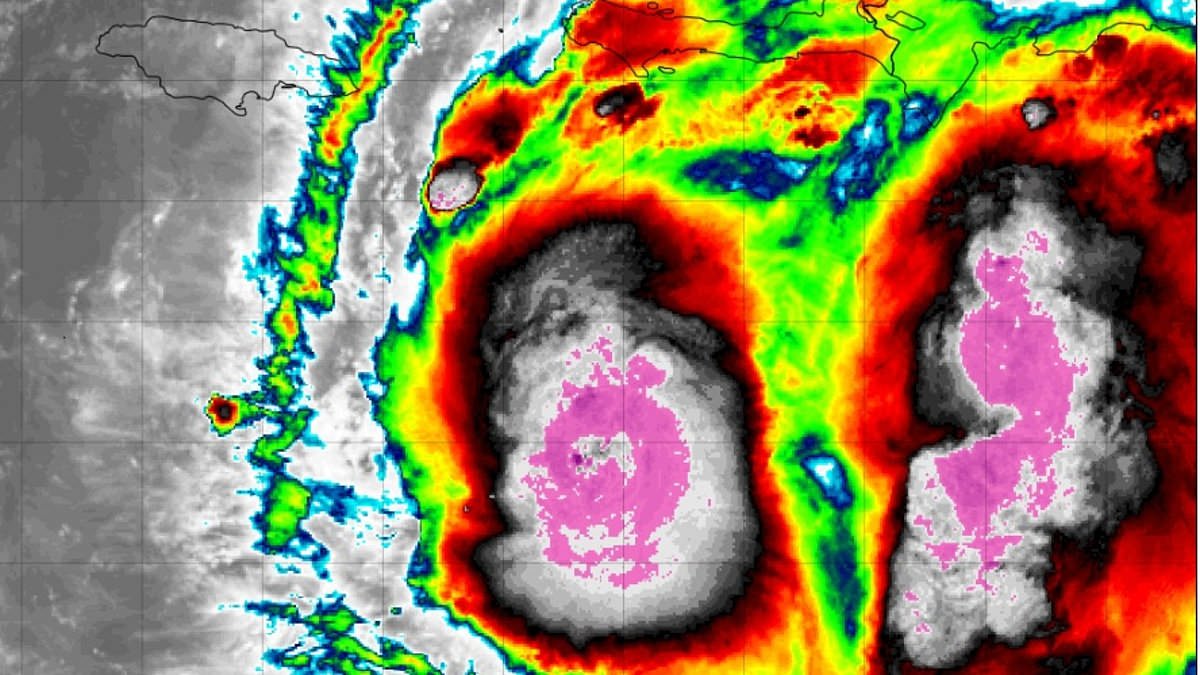
Satellite images show Melissa remains about the same, with strong thunderstorms mainly on its southeastern side, while winds from the northwest are disrupting some of the storm’s flow.

As Melissa shifts into the southwestern Atlantic, meteorologists expect a significant dip in the jet stream to form across the eastern US. This pattern could spark a new storm, potentially a strong nor’easter, along the Atlantic coast by late October
Aircraft measured peak winds at about 49 knots, which supports keeping Melissa at about 46 mph for now.
As the impending hurricane continues to brew south of Jamaica, DaSilva added that there’s a real possibility the storm will see its winds increase to more than 157 mph, making it the third hurricane to reach Category 5 strength this year.
‘The exceptionally warm waters, reaching hundreds of feet deep, will act like jet fuel, providing extra energy for Melissa,’ DaSilva explained in a statement.
‘People in the path of this storm need to prepare for the risk of catastrophic impacts,’ he added.
To this point, wind shear in the Caribbean has been the key to holding Melissa in check, creating disruptive gusts that can weaken storms and break up their structure.
The AccuWeather team noted that this was the case on Wednesday and Thursday, nearly causing Melissa to collapse back down into a tropical depression with winds falling to 40mph.
However, those winds are now expected to die down over the weekend, allowing Melissa to form a powerful and organized core of warm Caribbean moisture and severe thunderstorms.