
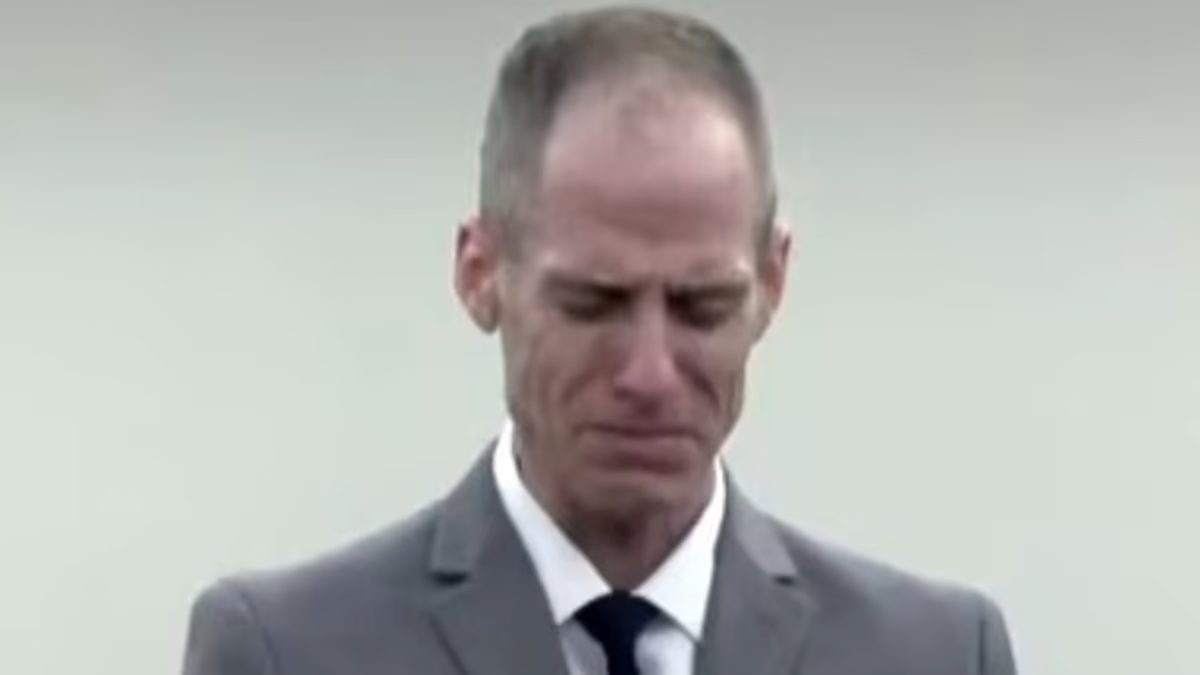
A Jamaican migrant convicted of raping his wife and sister will not be deported from Britain after a tribunal ruled that his bisexuality could place him at risk if he is returned home.
The 51-year-old man was sentenced to a combined 18 years in prison. However, he will remain in the UK after judges found that deporting him could breach his rights under Article 3 of the European Convention on Human Rights (ECHR).
The Home Office had previously rejected his appeal, describing him as a “danger to the community”. An immigration tribunal has now concluded that returning him to Jamaica could expose him to harm because of his sexuality.
The man, identified only as ‘OB’ after being granted anonymity, was jailed for five years in 2013 for raping his wife. He was also placed on the sex offenders’ register for life, the Upper Tribunal in London heard.
A year later, he was convicted of historical sex offences, including the attempted rape of a female under 16, the rape of a female over 16 and penetrative sex by a person over 16 with a relative over 18. He was sentenced to 13 years at Basildon Crown Court.
During sentencing, the judge said: “I have no doubt he will continue to minimise and blame others for this conviction. It would appear that he also managed to manipulate his family to ensure that they did not believe his sister.”
OB, who says he was a prominent musician and teacher in Jamaica, arrived in the UK legally in 2003 and worked in a senior teaching position. His wife and child later joined him.
After receiving a deportation order in 2018, he applied for asylum, arguing that he would face danger in Jamaica because he is bisexual.
The Home Office refused his claim because of his “particularly serious offence”. Although a First-tier Tribunal accepted that OB was bisexual, it nevertheless upheld his deportation. The Upper Tribunal later overturned that decision on Article 3 grounds, which state that “no one shall be subjected to torture or to inhuman or degrading treatment or punishment”.
Consensual same-sex activity between men remains criminalised in Jamaica, while same-sex marriage is prohibited. OB also says he is engaged to a younger man who was 20 when he first proposed.
Immigration judge Joanna McWilliam said there was “nothing positive to say about his presence in the UK” and acknowledged that deportation would serve the public interest. However, she was required to allow OB’s appeal under the ECHR.
Judge McWilliam said prosecutions for homosexuality in Jamaica had become less common, but warned that gay people continued to face “mob violence”, creating a potential risk for OB.

The 51-year-old migrant, who says he was a prominent musician and teacher in Jamaica, was sentenced to a total of 18 years at Basildon Combined Court
She said: “On the basis that [OB] is a bisexual man, I accept that there are aspects of his case which are supported by the background evidence.
“Moreover, while the [Home Office] says that [OB] has not provided evidence of past persecution, he mentioned past persecution in his asylum interview.
ALSO READ: Father-in-Law Admits Killing Trans NYT Executive With Wife, Docs Say
“He said that he was regularly hit with sticks and was hit with a bottle. He was beaten up when he was aged 18 by a group of men with weapons.
“They called him Batty Man. I have considered what [OB] said in the interview in the round.
“Whilst I have great reservations about much of what [OB] says, considering this evidence in the context of the background evidence as a whole, it is credible that [OB], who has been found to be bisexual by the First-tier Tribunal, would have been perceived as gay and that, as a result, he would have been subject to attacks.
“I accept that he was attacked, applying the lower standard of proof.”
Judge McWilliam added that, had the appeal been considered under Article 8 of the ECHR, which protects the right to family life, she would not have allowed it in light of his convictions.
She said: ‘The comments of the sentencing judge about [OB] are illuminating. Having heard him give evidence I reach the same conclusion about his character.
‘In the absence of risk under Article 3, I would have no hesitation in dismissing the appeal under Article 8.
‘The [Offender Assessment System] report presents a negative picture of the [OB] who has at no time accepted responsibility for his heinous crimes.
‘The author of the report states that [OB] portrayed himself as the victim and that he was unable to show remorse. [OB] remains a risk to the public.
‘There is nothing positive to say about the [OB’s] presence in the UK. His philanthropic claims are fictional.
‘He presents a risk to children and young people. Hopefully he will not be placed in a position of trust in the future.
‘[OB’s] deportation is in the public interest and the only rational conclusion that could be reached on the evidence, in the absence of a risk under Article 3, is that any breach of [OB’s] rights under Article 8 would not come close to outweighing the public interest in his deportation.’
A Home Office spokesman said they can’t comment on individual cases, but said: ‘We are reforming our human rights laws to prevent them being abused by foreign criminals with no right to be in the UK.
‘This includes domestic legislation to tighten the application of the European Convention on Human Rights in immigration cases, and working with European partners to ensure it remains fit for modern migration challenges.’


