Share this @internewscast.com
US Supreme Court judges raised doubts on Wednesday over the legality of President Donald Trump’s sweeping tariffs in a case with implications for the global economy that marks a major test of Trump’s powers.
Both conservative and liberal judges sharply questioned the lawyer representing Trump’s administration about whether the president had intruded on the power of Congress in imposing tariffs under a 1977 law meant for use during national emergencies.
But some of the conservative judges also signalled that they were wrestling with their recognition of the inherent power that presidents have in dealing with foreign countries, suggesting the court could be sharply divided in the outcome of the case.

The Supreme Court currently comprises a 6-3 conservative majority.

In a session that extended over two and a half hours, justices probed the legality of Trump’s use of a 1977 statute to enforce tariffs indefinitely, questioning if such significant executive actions necessitate explicit authorization from Congress.

The challenge involves three lawsuits brought by businesses affected by the tariffs and 12 US states, most of them Democratic-led.

Trump has mounted pressure on the Supreme Court, urging it to uphold tariffs which he considers pivotal to his economic and foreign policy strategies.

The tariffs — taxes on imported goods — could add up to trillions of dollars for the United States over the next decade.

Utilizing the International Emergency Economic Powers Act (IEEPA), Trump applied tariffs affecting almost all of the United States’ trading partners.

Typically, the Supreme Court deliberates for several months before delivering decisions, but the Trump administration has requested an expedited ruling in this matter, leaving the decision’s timeline uncertain. Source: AAP / Kent Nishimura / POOL / EPA

Trump solicitor general John Sauer kicked off the arguments by defending the legal rationale employed by the president, but immediately faced questions raising scepticism over the administration’s arguments about the language and purpose of the statute at issue.

Under IEEPA, the president is empowered to address “an unusual and extraordinary threat” during a national emergency.

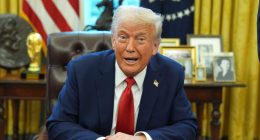
Donald Trump wearing a suit standing at a podium, holding up an executive order in front of a crowd

While the US Supreme Court typically takes months to issue rulings after hearing arguments, the Trump administration has asked it to act swiftly in this case, though the timing of the decision remains clear. Source: AAP / Kent Nishimura / POOL / EPA

IEEPA gives the president power to deal with “an unusual and extraordinary threat” amid a national emergency.

It had historically been used for imposing sanctions on enemies or freezing their assets, not to impose tariffs.

Sauer said Trump determined that US trade deficits have brought the nation to the brink of an economic and national security catastrophe.

But what does the law say?

The US constitution grants Congress, not the president, the authority to issue taxes and tariffs.
The imposition of taxes on Americans “has always been the core power of Congress,” conservative chief justice John Roberts told Sauer, adding that these tariffs seem to be raising revenue, which the constitution contemplates as a role for Congress.
Conservative justice Amy Coney Barrett questioned Sauer about his argument that IEEPA’s language granting presidents emergency power to “regulate importation” encompasses tariffs.

“Can you point to any other place in the code or any other time in history where that phrase together ‘regulate importation’ has been used to confer tariff imposing authority?” Barrett asked.

Trump is the first president to use IEEPA to impose tariffs, one of the many ways he has aggressively pushed the boundaries of executive authority since he returned to office in areas as varied as his crackdown on immigration, the firing of federal agency officials and domestic military deployments.

Does the court have power over Trump?

US treasury secretary Scott Bessent said in the lead-up to the arguments that if the Supreme Court rules against Trump’s use of IEEPA, his tariffs are expected to remain in place because the administration would switch to other legal authorities to underpin them.
In fact, conservative justice Samuel Alito asked about a different statute that has gotten less attention, known as Section 338 of the Tariff Act of 1930, could provide an alternate basis for Trump’s tariffs.

Liberal justice Elena Kagan pressed Sauer about his claim that Trump’s tariffs are supported by the president’s inherent powers under the constitution.


Kagan said the power to impose taxes and regulate foreign commerce are usually thought of as “quintessential” powers belonging to Congress, not the president.
Conservative justice Brett Kavanaugh signalled potential sympathy for Trump, noting that former president Richard Nixon imposed a worldwide tariff under IEEPA’s predecessor statute in the 1970s that contained language similar to “regulate importation”.

Share this @internewscast.com
You May Also Like

Australia Day Honours 2026: Celebrating the Full List of Distinguished Awardees

Celebrated Olympian Cathy Freeman has been awarded Australia’s highest accolade for her…

Canadian Teen’s Fatal Encounter Highlights Underestimated Dingo Risks on K’gari, Family Reveals

A Canadian backpacker, who tragically lost her life on an Australian beach,…

Tragic Gold Coast Plane Crash Claims Two Lives and Ignites Bushfire

Two Men Perish in Fiery Plane Crash, Sparking Bushfire Near Regional Airfield…
A teenager has been sentenced for setting a fellow Don Dale inmate's cell alight and threatening to kill him.

UN Urges Australia to Improve Human Rights Practices

Australia has been urged to do better on keeping children and Indigenous…
The ghostly and obscured sun shrouded in dense, orange-grey smoke from a devastating forest fire. The summer sun struggles to penetrate the haze, casting an eerie glow.

Australia’s Heat Records Shattered: Impact Felt Across Post Offices, Police Stations, and Airports

The sweltering heatwave gripping South Australia, Victoria, New South Wales, and Queensland…
Grok to 'obey law' after AI app used to nudify women and girls

EU Initiates Inquiry into Musk’s AI Bot Concerning Sexual Deepfake Allegations

Grok Imagine prompted a public backlash in multiple countries, including Australia, when…
The rally continued, despite the police incident. Picture: Michael Philipps

Panic Ensues at Perth Rally Amid Suspected Explosive Threat

A man is in police custody after a device was thrown into…
General Zhang Youxia has fallen victim in the latest purge of the Chinese military by President Xi Jinping.

Xi Jinping’s Strategic Maneuver: A Stark Reminder That No One is Immune in China’s Political Landscape

Chinese President Xi Jinping has taken another step towards a total power…

Albanese Demands Justice: Perth Explosives Suspect to Face Legal Reckoning

Prime Minister Anthony Albanese has called for stringent legal action against a…
Google Maps - Never Never River in NSW

Tragic Incident: Two Fatalities, Pregnant Woman Hospitalized Following Drowning in Scenic River

In a tragic turn of events, three men lost their lives, and…
Knox teacher Wiliam Gulson arrives at   Downing Centre Court on Tuesday, 27 January 2026.  Gulson has been charged with child grooming.   Photo: Sam Mooy / The Sydney Morning Herald

Sydney Educator Convicted in Child Procurement Case

A former school teacher’s excuses for graphic internet searches and a sexualised…
The Einasleigh Hotel, 400 kilometres north-west of Townsville.

Queensland Flood Alert: Unprecedented Rainfall Engulfs Communities

In northern Queensland, residents are grappling with an unexpected flood emergency following…