
Astronomers have recently made a groundbreaking discovery by capturing a radio signal from a perplexing interstellar object zipping through our Solar System at remarkable speed.
This significant detection was achieved using South Africa’s MeerKAT radio telescope, which observed hydroxyl radicals (OH) surrounding the celestial body on October 24. The presence of these molecules is critical as they emit a unique radio signature that instruments like MeerKAT can identify.
Harvard professor Avi Loeb, who has been examining the object, known as 3I/ATLAS, since the summer, elaborated on this phenomenon, stating, “These molecules leave a distinct radio signature that telescopes like MeerKAT can pick up.”
The analysis of the detected molecules reveals intriguing details about 3I/ATLAS. It suggests that the surface temperature of this enigmatic visitor is approximately –45°F, and its size is estimated to be up to six miles in diameter.
“This absorption signal constitutes the first radio detection of 3I/ATLAS,” Professor Loeb further elaborated, highlighting the significance of this observation.
This discovery comes shortly after 3I/ATLAS made a close approach to Earth’s orbital plane, which provided astronomers with an ideal opportunity to study it more closely.
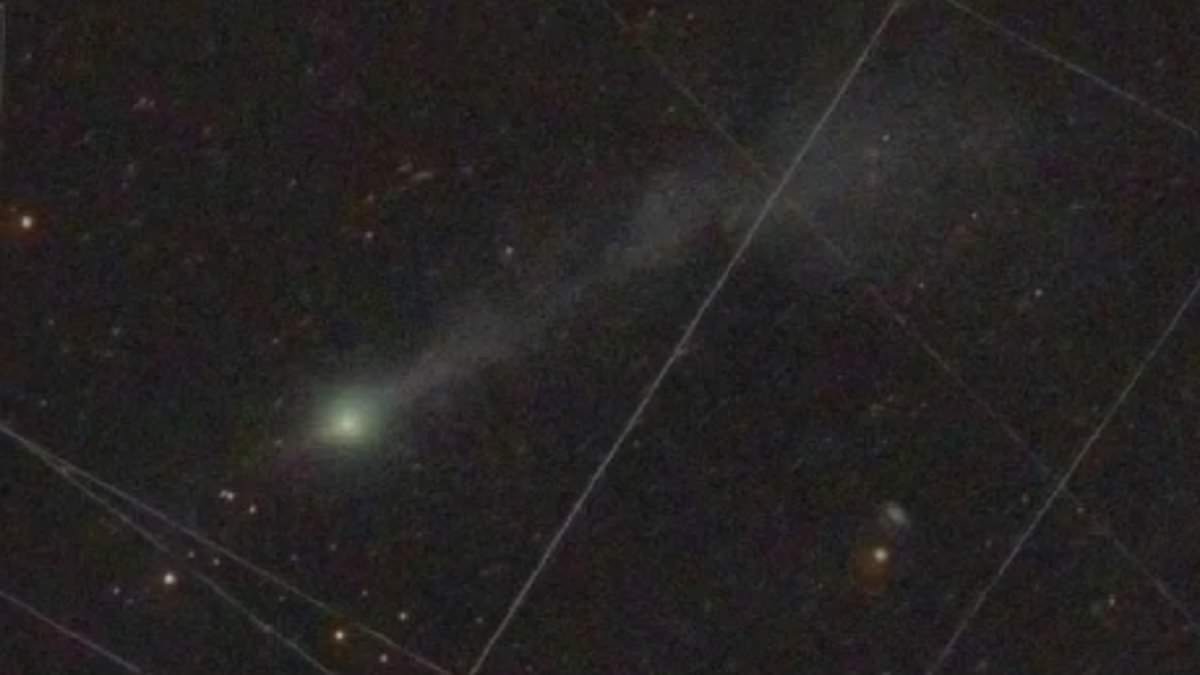
Optical images captured on November 9 reveal that the object is ejecting enormous jets of material stretching nearly 600,000 miles sunward and almost 1.8 million miles in the opposite direction – roughly the diameter of the sun or the moon in the sky.
At its current distance of 203 million miles from Earth, these distances represent the first clear measurements of the vast size of 3I/ATLAS’s activity.

Optical images captured on November 9 (pictured) reveal that 3I/ATLAS is ejecting enormous jets of material both toward and away from the sun
According to Professor Loeb, the new measurements suggest the interstellar object measures at least three miles across.
‘It could be six miles or larger,’ he added.
For comparison, the famous interstellar object 1I/’Oumuamua, discovered back in 2017, measured only a few hundred feet.
The extreme scale of 3I/ATLAS’s jets raises fundamental questions, according to the Harvard professor.
If the object is a natural comet, the jets should move much more slowly and would require months to reach the observed distances.
Instead, the extraordinary mass, density, and brightness of the outflows suggest something unusual may be happening.
‘The numbers are challenging for a natural comet explanation,’ Professor Loeb said.
‘The required mass loss, the rapid perihelion brightening, and the size all point to anomalies.’
The true nature of 3I/ATLAS will be determined on December 19 – when the objects makes its closest approach with Earth.
At this time, space telescopes like Hubble and Webb should be able to measure its velocity, composition, and total mass of the jets once and for all.

South Africa’s MeerKAT radio telescope (pictured) detected absorption lines from OH molecules, made of oxygen and hydrogen, around the object on October 24
These observations may help determine whether 3I/ATLAS is a conventional icy comet or perhaps powered by technological thrusters, which could produce similar jets with far less mass loss.
Meanwhile, NASA’s Juno spacecraft is scheduled to probe the object on March 16, 2026, when it passes 33 million miles from Jupiter, using its dipole antenna to search for low–frequency radio signals.
Observatories around the world are also monitoring the object, partly because its trajectory aligns within 9 degrees of the direction of the famous 1977 ‘Wow!’ Signal.
Loeb added: ‘3I/ATLAS is giving us a rare opportunity to study an interstellar object in real time.
‘The combination of radio and optical data shows it is shedding massive amounts of material, moving at incredible speeds, and behaving in ways that challenge our understanding of natural comets.’