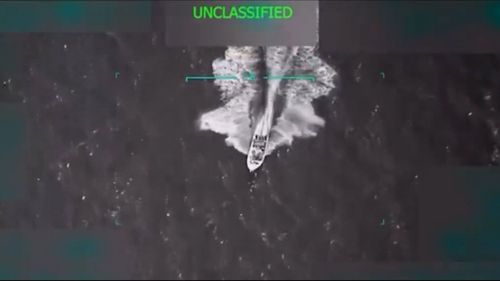
Intelligence gathered by US forces suggests that a targeted boat was intending to “rendezvous” with another vessel to transfer illegal drugs, according to Adm. Frank Bradley. During his briefing, Bradley noted that although the military failed to locate the second vessel, there was still a significant chance the narcotics could eventually reach the United States from Suriname. This possibility, he argued, warranted the decision to strike the smaller boat, even though it wasn’t directly en route to US shores when the attack occurred.
US drug enforcement officials have indicated that trafficking routes through Suriname largely aim at European markets, while those intended for the US have primarily shifted to the Pacific Ocean in recent years.
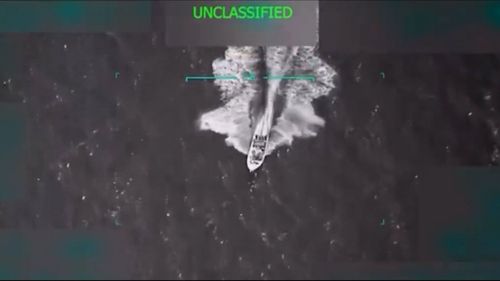
This new information further complicates the Trump administration’s justification for repeatedly striking the boat and eliminating survivors, claiming it was necessary to avert a potential threat to the US.
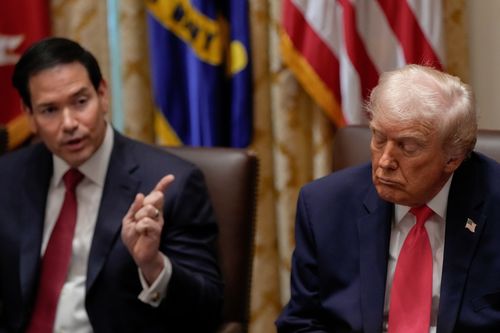
Shortly after the strike, Secretary of State Marco Rubio told reporters in Florida that the alleged drug-carrying boat was “probably headed to Trinidad or some other Caribbean country.” In contrast, President Donald Trump, in his announcement on September 2, stated, “The strike occurred while the terrorists were at sea in international waters transporting illegal narcotics, heading to the United States.”
Bradley, who was leading the Joint Special Operations Command during the time of the strike, admitted that the boat had turned around upon spotting American aircraft overhead. This was previously reported by CNN in September.
The US military ultimately launched four strikes on the boat. The initial strike split the boat in half, leaving two survivors clinging to the wreckage. Subsequent strikes killed the survivors and sunk the vessel, as reported by CNN on Thursday.
The survivors were also waving at something in the air, the sources said Bradley told them, although it’s unclear whether they might have been surrendering or asking the US aircraft they had spotted for help.
The Pentagon did not immediately respond to a request for comment.
It is considered a war crime to kill shipwrecked people, which the Pentagon’s law of war manual defines as people “in need of assistance and care” who “must refrain from any hostile act.” Although most Republicans have signalled support for President Donald Trump’s broader military campaign in the Caribbean, the secondary strike on September two has drawn bipartisan scrutiny â including, most consequentially, a vow from the Senate Armed Services Committee to conduct oversight.
Hegseth’s role in the secondary strike â including the precise orders he gave Bradley â continues to be a point of scrutiny.
Politicians were told on Thursday that Hegseth had made clear before the mission began that the strikes should be lethal, CNN has reported, but that he was not made aware of the survivors until after they had been killed, one of the sources with direct knowledge said.
Bradley understood the mission objective to be to kill all 11 individuals on board and sink the boat, a US official said. But the order was not specifically an order to kill all and provide no quarter, meaning that someone who surrenders will be killed, which has “specific implications” and is illegal, the US official said.