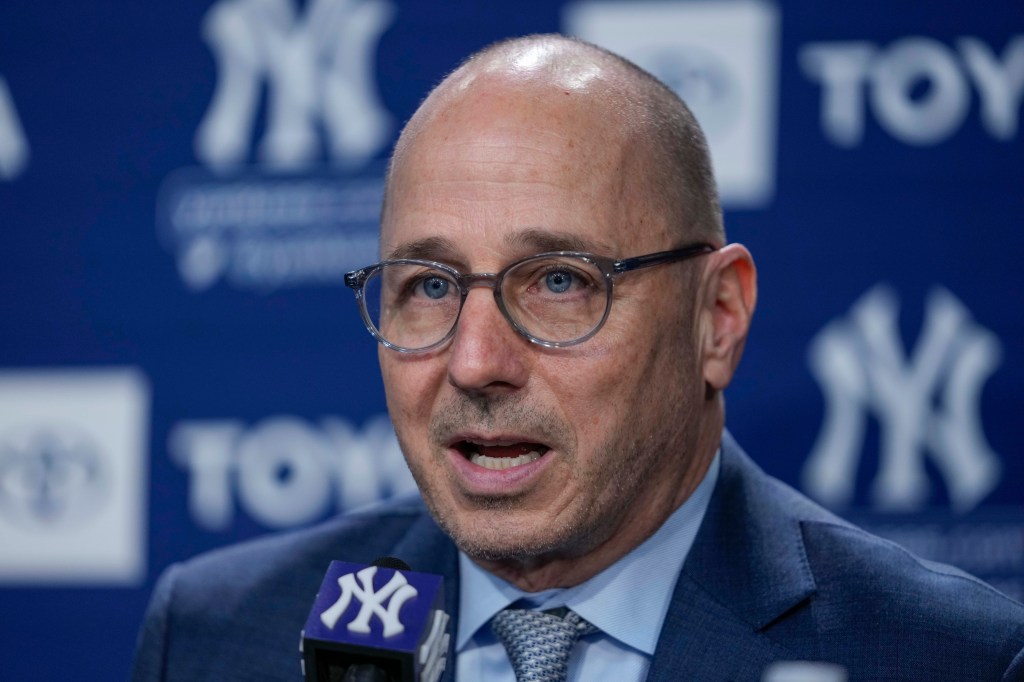


ORLANDO — At the Winter Meetings on Sunday night, Brian Cashman addressed the Yankees’ financial strategy, clarifying that team owner Hal Steinbrenner has not provided a specific budget for the offseason.
Recently, Michael Kay, a broadcaster for YES Network and a host on ESPN Radio, suggested there is a significant likelihood that the Yankees aim to keep their payroll below $300 million—a target they’ve surpassed in the last two years. When questioned about Kay’s remarks, Cashman stated, “You’d have to ask Michael where he got that information.”
Cashman reiterated, “As I mentioned earlier, Hal hasn’t set a strict budget limit for me, and that remains unchanged. Hal’s instructions are clear: ‘present everything to me,’ and that’s what I’ll keep doing.”
When probed further about any directives to reduce spending, Cashman replied, “Hal hasn’t communicated anything of that sort to me. Michael might have more insight on that if you’re curious.”
Earlier in the offseason, Steinbrenner noted it would be “ideal” to reduce the Yankees’ payroll, which reached $319 million last year. However, he also admitted that such a reduction might not be feasible.
Earlier this offseason, Steinbrenner said it would be “ideal” to lower the Yankees’ payroll after they spent $319 million last season, but he also acknowledged that that isn’t necessarily going to happen.
“I’m sure that’s every owner’s [ideal],” Cashman said. “You’d love to win the whole thing at less of a cost if you possibly can.”
As of Monday morning, the Yankees’ projected competitive balance tax payroll for 2026 sat at $283.6 million, per Cot’s Contracts. With the team still hoping to re-sign Cody Bellinger, in need of bullpen and bench help, and standing to benefit from the addition of a frontline starter, staying under $300 million or $304 million — the highest penalty tax threshold — will be difficult.
Having a payroll lower than last year’s total of $319 million, meanwhile, wouldn’t sit well with the Bronx faithful with the Yankees looking for their first championship since 2009.
Asked if the Yankees need to spend more to improve their roster, Cashman said there are “a lot of different ways to skin a cat.”
Cashman also discussed the possibility of trading major league talent for major league talent. He specifically acknowledged that his lineup is too left-handed, so he is “open-minded” to trading from a larger group that includes well-paid players such as Jazz Chisholm Jr. and Ryan McMahon.
TUCKER HASN’T VISITED. WILL IMAI?
Cashman said that Kyle Tucker has not visited the Yankees’ facilities in Tampa, Fla. He declined to say if he expects the corner outfielder to do so.
Tucker, a Tampa native, recently visited the pennant-winning Blue Jays’ complex in Dunedin, Fla.
Tucker is baseball’s top free agent, but the Yankees have been focused on Bellinger. Tucker is a younger and better hitter than Bellinger, but he is also going to cost more.
Cashman declined to say if he’s made a formal offer to Bellinger yet, but he spoke to his agent, Scott Boras, on Saturday.
Cashman also wouldn’t say if he expects another Boras client, Tatsuya Imai, to visit New York after the Winter Meetings. However, the Yankees are interested in the Japanese ace, and Cashman said he’d “love to add a starter” to a rotation that has lots of arms but will be without Gerrit Cole, Carlos Rodón and Clarke Schmidt on Opening Day.
Max Fried, Cam Schlittler and Will Warren, meanwhile are all coming off career-high workloads.
COULD WEAVER COME BACK?
With the Yankees in need of bullpen help and Devin Williams already signing with the Mets, Cashman said that he has been in touch with Luke Weaver’s agent.
Once a journeyman starter, Weaver became a reliever and transformed his career with the Yankees, totaling a 3.21 ERA over the last two seasons. However, he struggled following a hamstring injury this past season and shared his frustrations over his inability to adjust — mentally and physically — after the Yankees approached him with some pitch-tipping concerns ahead of the playoffs.
The Yankees typically avoid pricey contracts for relievers, but they have a few holes to fill.