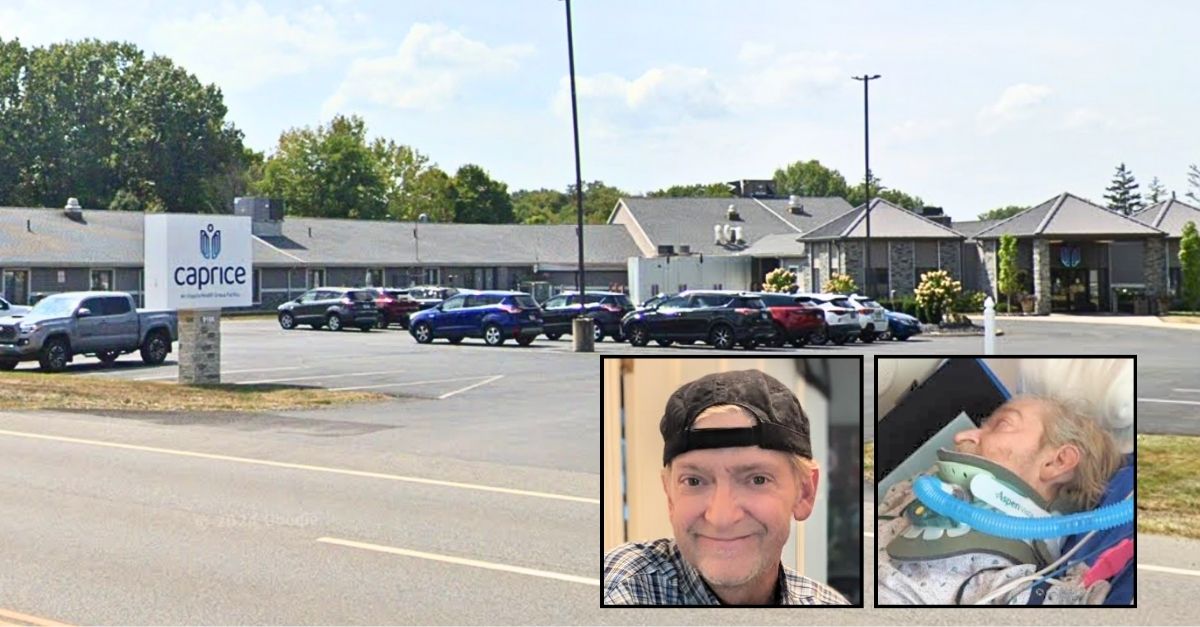

Left inset: Craig Latchaw. Right inset: Craig Latchaw wearing a cervical collar to assist with supporting his spine before being transferred to the MetroHealth Medical Center’s trauma division after allegedly falling at the Caprice Health Care Center in Ohio (Michael Hill Trial Law). Background: The Caprice Health Care Center in North Lima, Ohio, where Craig Latchaw allegedly fell and suffered a fractured spine (Google Maps).
A tragic incident at an Ohio nursing home has sparked a legal battle, as the family of a 64-year-old man claims the facility’s negligence led to his untimely death. The man, who was receiving care at Caprice Health Care Center, reportedly suffered a severe fall while attempting to reach the bathroom. This accident resulted in devastating injuries, including a fractured spine and misalignment of his C1 and C2 vertebrae, ultimately causing his demise.
The family of Craig Latchaw has filed a lawsuit against the nursing home, alleging that the staff failed to provide adequate care. According to their complaint, a nurse discovered Latchaw on the floor but conducted an insufficient examination that overlooked the serious injuries he had sustained. Instead of recognizing the gravity of the situation, the staff allegedly repositioned him in his bed without further medical evaluation.
Latchaw’s family asserts that the nursing home was well aware of his high risk of falling due to several factors, including his limited mobility, reliance on oxygen and trach equipment, pain management regimen, and use of psychotropic medications. They argue that despite these known vulnerabilities, the facility failed to provide necessary precautions and timely assistance.
The lawsuit highlights ongoing issues with response times to Latchaw’s calls for help. The complaint details that when he or his family activated the call light for assistance, it often went unanswered for extended periods. On some occasions, the call would not be answered at all, forcing family members to search for staff to help Latchaw with basic needs, such as using the bathroom. These delays often led to embarrassing situations for Latchaw, causing him distress in front of his family.
The fateful fall occurred on December 12, 2024. Two nursing assistants found Latchaw on the floor at the foot of his bed and summoned a nurse. According to the complaint, Latchaw communicated that he had been trying to reach the bathroom. However, the staff allegedly failed to monitor his condition adequately following the incident.
It wasn’t until nearly 17 hours later, on the morning of December 13, 2024, that a nurse discovered Latchaw in a severely deteriorated state. By then, he was lethargic and unresponsive, unable to communicate or respond to verbal stimuli. The family argues that this delay in recognizing his critical condition contributed significantly to his death.
As a result of his condition, EMS was called to transport Latchaw to Mercy St. Elizabeth Boardman Hospital’s emergency department. Paramedics indicated that he “sounded very congested and was coughing up yellow mucus,” per the complaint. He also had a fever of 100.4 degrees and a heart rate of 90 beats per minute, which his family says made him “borderline tachycardic.” He was also suffering from a bout of pneumonia.
“A CT scan revealed a new fracture of Craig’s spine, and a misalignment of the C1 and C2 bones of his spine,” the complaint alleges. “In response to these concerns, Craig was placed into a cervical collar, or stiff neck brace, to assist with supporting his neck.”
Craig’s injuries were “severe” and required care that was “beyond the means” of Mercy St. Elizabeth Boardman Hospital’s emergency department, so he was transferred to MetroHealth Medical Center’s trauma division. Latchaw began having “trouble breathing” and became tachycardic three days later, with him being moved to the intensive care unit for respiratory distress on Dec. 13, 2024.
“Craig’s family met with an orthopedic spine surgery team,” the complaint says. “They were informed that attempting surgery on Craig’s spine would be very high risk and he was unlikely to have a good outcome from surgery, with a high possibility he would not survive the procedure.”
Latchaw’s family decided to pursue “comfort care” and he was placed in a hospice care center. He “died a premature death” on Dec. 23, 2024, with the Mahoning County Coroner’s Office listing the cause as being “complications of cervical fracture” and “unwitnessed fall,” according to the complaint. His family says the manner of death was ruled as “accidental.”
The family allegedly called Caprice Health Care Center to find out why Latchaw fell under its watch. Its director of nursing told them he “had a right to fall,” according to the complaint.
“Every resident has the right to fall,” the director allegedly said in a phone call to Latchaw’s family. “We can not implement interventions without a cause.”
The family’s attorney, Michael Hill, of Michael Hill Trial Law, tells Law&Crime that Latchaw’s case is ultimately about “corporate choices” being made that “put profits ahead of safe care.” He notes how the Latchaw family trusted the Caprice Health Care facility to provide a level of care that was “promised” to them.
“Instead, the facility ignored known risks, failed to respond when Craig needed help, and did not identify catastrophic injuries for nearly a full day,” Hill says.
The family is requesting a trial by jury and is suing for compensation “for the harms and losses sustained as the result of the negligence, recklessness, conscious disregard, reckless disregard, conduct by which — through heedless indifference to the consequences — the defendants or their staff disregarded a substantial and unjustifiable risk that the health care provider’s conduct is likely to cause, at the time those services or that treatment or care were rendered.”
Caprice Health Care Center did not respond to Law&Crime’s request for comment on Monday.


