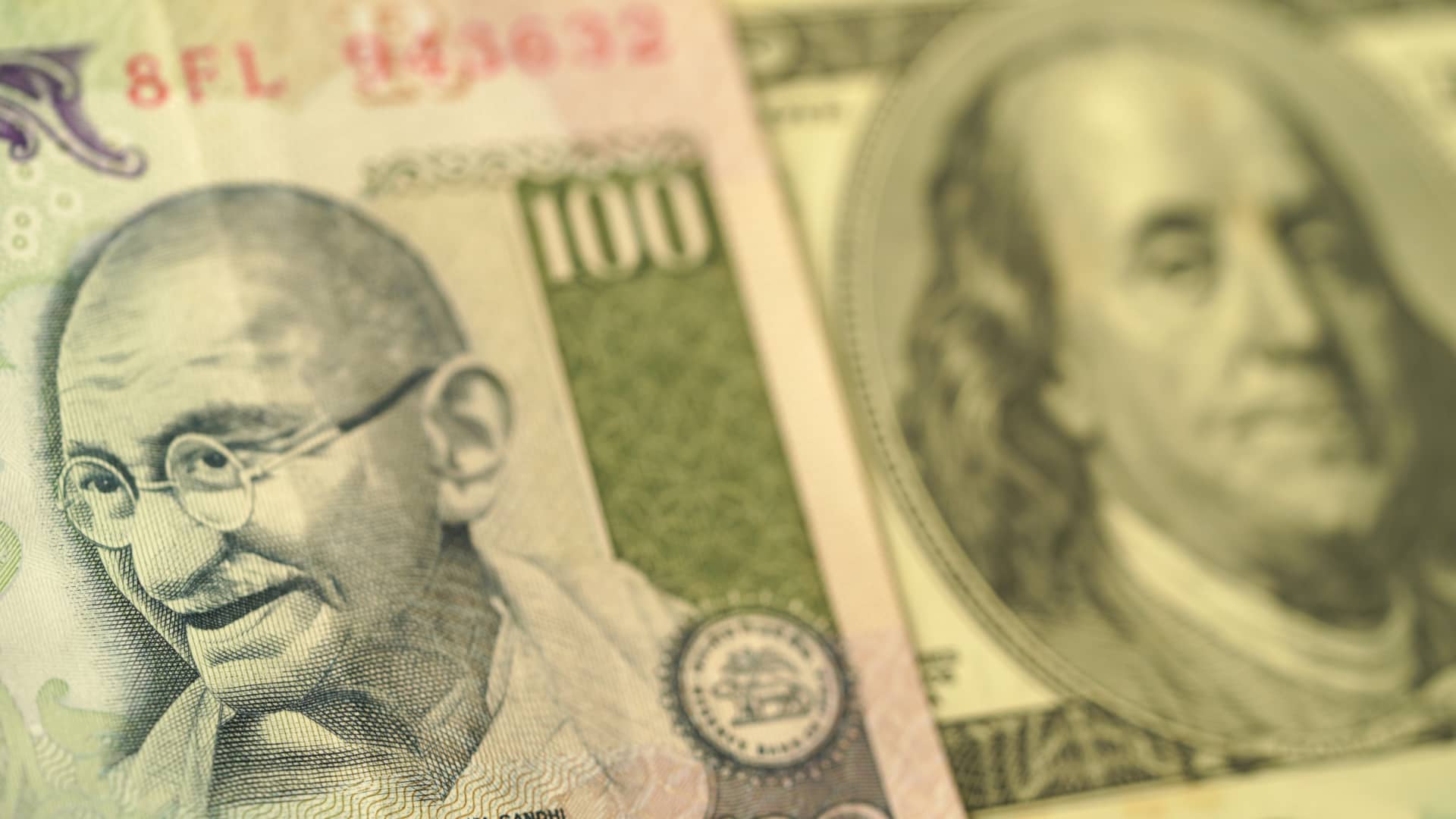

On Monday, the Indian rupee experienced limited movement as consistent interbank dollar demands dampened the uplift from a global increase in risk appetite.
Wong Yu Liang | Moment | Getty Images
The ongoing stalemate over the U.S.-India trade agreement, coupled with continuous foreign fund outflows, has placed a significant burden on the rupee this year, positioning it as Asia’s worst-performing currency.
Experts from Nomura and S&P Global Market Intelligence predict that the rupee, belonging to the world’s fifth-largest economy, could weaken to 92 against the dollar by the end of March, with any potential appreciation largely dependent on a successful trade deal with the U.S. Recently, the rupee was trading at 89.6 against the dollar.
“We currently see the rupee as undervalued, with a correction expected once there is greater clarity on the U.S.-India trade negotiations,” stated Hanna Luchnikava-Schorsch, head of Asia-Pacific economics at S&P Global Market Intelligence.
S&P Global anticipates that a trade agreement will be reached within the next six months.
India is among the highest tariffed countries in the world at 50% — levies that dwarf even those on China — as trade talks between New Delhi and Washington continue to drag on.
After steep tariffs came into force in August, India’s exports to the U.S. fell nearly 12% in September and 8.5% in October, though they rebounded sharply in November, rising 22.6%.
The main economic risk is that India could lose the momentum in supply chain shifts from firms that cater mainly to the U.S. market, due to sustained high tariffs, said Sonal Varma, Nomura’s chief economist, India and Asia ex-Japan.
“Prolonged uncertainty has led to foreign portfolio outflows, and a weaker rupee can affect import costs and inflation,” she added.
A weak rupee though could make exports more competitive, with low price growth in the country also allowing it to absorb the impact of imported inflation due to currency depreciation.

At the start of the month, the Indian currency breached the 90-mark against the greenback, an important psychological trigger, having started the year at 85.64 to a dollar. It took less than 15 trading sessions for the currency to cross 91-rupee to a dollar mark.
Bearish foreign investors
Global investors have been bearish on India for most of this year, with net outflows of more than $10 billion across investment classes so far this year, data from securities depository NSDL shows.
The key reason for the fall in rupee is not India’s current account deficit as it is expected to be in the manageable level of 1%-1.5%, Somnath Mukherjee, CIO and senior managing partner at ASK Private Wealth, told CNBC’s “Inside India.”
He added the rupee will stay under pressure until there’s a reversal of outflows of foreign portfolio investors.
Outflows were particularly sharp in Indian equities with foreign portfolio investors being net sellers on a year-to-date basis, withdrawing nearly $18 billion as of Dec. 19.
“The depreciation of the rupee is a double-edged sword for FIIs” said Luchnikava-Schorsch.
While it could be “a good entry point for Indian equities” but investors will assess the negative impact of “protracted rupee weakness and trade policy uncertainty,” government finances, and overall growth outlook, she said.
India’s central bank, which in its monetary policy meeting earlier this month had reaffirmed its policy to let markets forces determine the rate of exchange, reportedly intervened “aggressively” on Wednesday to curb the currency’s slide.


