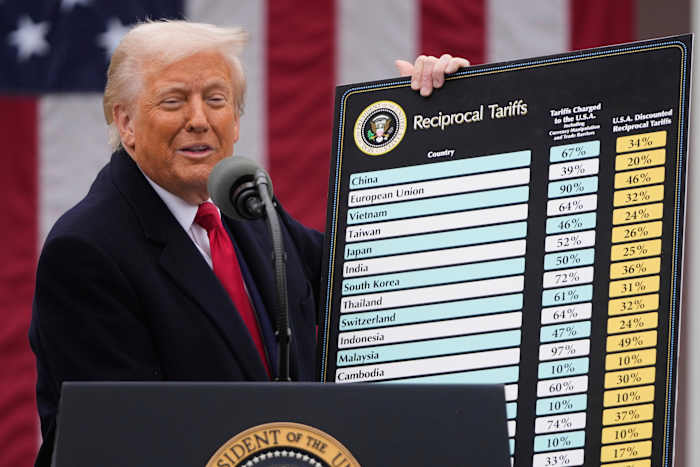


Throughout this year, President Donald Trump has issued numerous threats concerning tariffs and made bold trade promises. Many of these have led to a significant wave of new import taxes that have shifted the direction of U.S. economic policy, although some have yet to materialize as we approach the end of 2025.
Trump’s unfulfilled tariff threats highlight his strategy of leveraging high tariffs to coerce countries into negotiating new trade agreements, retaliate against trade barriers, or penalize political adversaries. This approach coincided with the implementation of various tariffs, including new taxes on imported metals and reciprocal tariffs with key trading partners like China, resulting in widespread uncertainty for consumers and businesses globally.
Here’s a closer look at some of Trump’s major, yet-to-be-realized, tariff threats and promises from this year and their current status.
External Revenue Service
In his own words:
1. On January 14, Trump stated on social media: “For too long, we’ve depended on taxing our great citizens through the Internal Revenue Service (IRS). It’s time to charge those who profit from us through trade, ensuring they finally contribute their fair share. January 20, 2025, will mark the establishment of the External Revenue Service.”
2. Trump in his Jan. 20 inaugural address : “We are establishing the External Revenue Service to collect all tariffs, duties, and revenues. It will be massive amounts of money pouring into our Treasury, coming from foreign sources.”
What happened: The External Revenue Service has yet to be established as of the end of December. While administration officials continued to reiterate plans for launching the External Revenue Service during Trump’s first months back in office, the entity does not yet exist.
200% tariff on European wine, Champagne and spirits
In his words:
3. Trump in a March 13 social media post: “The European Union, one of the most hostile and abusive taxing and tariffing authorities in the World, which was formed for the sole purpose of taking advantage of the United States, has just put a nasty 50% Tariff on Whisky. If this Tariff is not removed immediately, the U.S. will shortly place a 200% Tariff on all WINES, CHAMPAGNES, & ALCOHOLIC PRODUCTS COMING OUT OF FRANCE AND OTHER E.U. REPRESENTED COUNTRIES.”
What happened: The EU’s planned levy on American whiskey — which it unveiled as part of broader retaliation in response to Trump’s new steel and aluminum tariffs — was postponed, with the latest delay reportedly running until at least February.
Trump’s 200% tariff threat on European alcohol never materialized. But spirits were not included in the EU-U.S. trade deal struck over the summer, which set a 15% rate on most European imports.
100% tariff on foreign-made films
In his words:
4. Trump in a May 4 social media post: “The Movie Industry in America is DYING a very fast death … I am authorizing the Department of Commerce, and the United States Trade Representative, to immediately begin the process of instituting a 100% Tariff on any and all Movies coming into our Country that are produced in Foreign Lands.”
5. Trump in a Sept. 29 social media post: “Our movie making business has been stolen from the United States of America, by other Countries, just like stealing ‘candy from a baby’ … I will be imposing a 100% Tariff on any and all movies that are made outside of the United States.”
What happened: Despite Trump’s repeated threats, the U.S. has yet to impose a 100% tariff on foreign films. After his initial May promise to initiate the process, the White House said no final decision had been made. Also still unclear is how the U.S. would tax a movie made overseas.
Tariffs on pharmaceutical drugs
In his words:
6. Trump in a Cabinet meeting on July 8: “We’ll be announcing something very soon on pharmaceuticals. We’re going to give people about a year, a year and a half, to come in. And after that, they’re going to be tariffed … They’re going to be tariffed at a very, very high rate , like 200 percent.”
7. Trump in a Sept. 25 social media post: “Starting October 1st, 2025, we will be imposing a 100% Tariff on any branded or patented Pharmaceutical Product, unless a Company IS BUILDING their Pharmaceutical Manufacturing Plant in America.”
What happened: The president did not sign an executive order imposing a 100% tariff on pharma products on Oct. 1 and, as of today, no levy has been put into place. But Trump previously suggested that steep levies on pharmaceutical drugs could arrive further down the road, telling CNBC in August that he would start by charging a “small tariff” and potentially raise the rate as high as 250%. Meanwhile, trade agreements with specific countries set their own rates or exemptions — with the U.K., for example, securing a 0% tariff on all British medicine exported to the U.S. for three years. The administration also announced deals with specific companies with promises of lower drug prices.
100% tariff on computer chips
In his words:
8. Trump on August 6: “We’ll be putting a tariff of approximately 100% on chips and semiconductors … But if you’re building in the United States of America, there’s no charge.”
What happened: A sweeping 100% on computer chips has yet to go into effect. When announcing his plans to impose the levy back in August, Trump was not specific about the timing. And other details have remained scarce.
$2,000 tariff dividend
In his words:
9. Trump in a Nov. 9 social media post: “People that are against Tariffs are FOOLS! … A dividend of at least $2000 a person (not including high income people!) will be paid to everyone.”
What happened: Details about how, when and if a tariff dividend will reach Americans are still scarce. Budget experts have said that the math doesn’t add up. And Treasury Secretary Scott Bessent suggested that it might not mean checks from the government. Instead, Bessent told ABC in November, the rebate might take the form of tax cuts. White House National Economic Council Director Kevin Hassett also told CBS News that it’s up to Congress.
Copyright 2025 The Associated Press. All rights reserved. This material may not be published, broadcast, rewritten or redistributed without permission.