Share this @internewscast.com
One of the biggest questions that has hung over the United States’ capture of Venezuelan leader Nicolas Maduro has been: Who is actually in charge?
With few details of how the US plans to actually “run” the country — as flagged by US President Donald Trump — Australian international law experts say it could see the US in a situation as a potential occupying power.
In the early hours of Saturday local time (5pm AEDT), US forces seized Maduro and his wife Cilia Flores from their compound in Venezuela and put them on a warship before flying them to the US to stand trial in New York on a range of criminal charges.
Maduro’s abduction follows months of rising tensions between Venezuela and the US that led to a US military buildup in the region and several deadly strikes on vessels in the Caribbean Sea, which it accused of facilitating drug trafficking.
While many Western nations oppose Maduro and believe he stole Venezuela’s 2024 election, there have been calls for the US to respect international law and questions about the legality of its actions.
Shortly after Maduro and Flores were captured, Trump said the US would “run the country” until there could be a “safe, proper and judicious transition” of power.
While his secretary of state Marco Rubio has since appeared to backpedal on those remarks, Trump has doubled down.
“We’re in charge,” Trump told reporters on Monday AEDT.
The assertion came after Maduro’s vice president, Delcy Rodriguez, who is now acting as interim president, appeared to hit back at Trump’s claims she’d privately indicated a willingness to work with the US administration.

Understanding the recent turbulent shifts in Venezuela’s political scene is crucial, especially as we ponder the future of its governance.

Delcy Rodriguez has emphasized the need for a “balanced and respectful” diplomatic relationship between Venezuela and the United States.
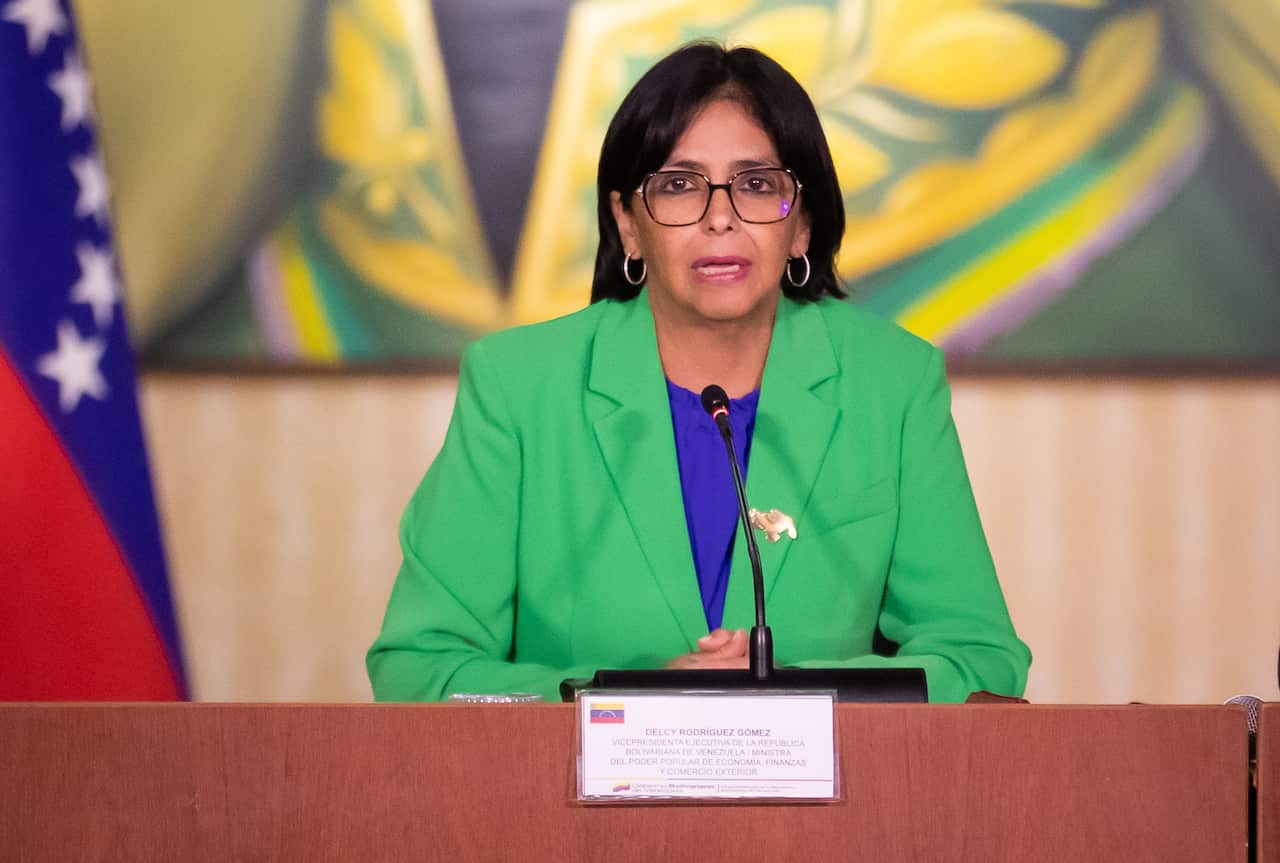
Delcy Rodriguez, like Maduro, is a member of the United Socialist Party of Venezuela and has served as the country’s vice president since 2018.
She was declared the acting president by Venezuela’s highest court following Maduro’s capture.
A woman in a green blazer, standing at a podium, is speaking.

During a recent address, she declared, “We will never again be a colony of any empire,” alluding to Venezuela’s history under Spanish rule from the 16th century until its independence in the early 19th century.

Meanwhile, Rubio has presented a more measured stance compared to Trump’s previous rhetoric. Speaking with ABC, he indicated that the U.S. intends to steer the situation through diplomatic channels, stating, “We are guiding the direction in which this will progress.”

Citing leverage such as an ongoing US blockade on sanctioned tankers, Rubio warned Venezuela’s severely weakened economy would “not be able to move forward until the conditions that are in the national interest of the United States” and the Venezuelan people were met.
Those conditions included taking moves to stop drug trafficking and keeping Venezuela’s oil industry out of the hands of US adversaries.
Rubio said the US does not recognise Rodriguez as a legitimate leader of Venezuela.
“We don’t believe that this regime in place is legitimate via an election,” he said.

He also highlighted that genuine legitimacy for Venezuela’s governance would come through a transition period and the establishment of true democratic elections, which have been absent thus far.

On Monday, Rodriguez called for a “balanced and respectful” relationship between the US and Venezuela — one built on the principles of “sovereign equality and non-interference”.
Trump, when asked if he had spoken to Rodriguez, replied: “Don’t ask me who’s in charge because I’ll give you an answer and it’ll be very controversial.”

Pressed on what he meant, Trump said: “It means we’re in charge.”

What might the US’ next steps be — and is there any framework?

While Trump has suggested there’d be no need to put US military forces in Venezuela should Rodriguez comply with US demands, he hasn’t ruled it out either. “We’re not afraid of boots on the ground,” he said.
Don Rothwell, a professor of international law at the Australian National University, said the Trump administration has been taking an “increasingly expansive interpretation and approach” to the operation of US law in a range of situations.

Rothwell said Maduro’s seizure had been “perhaps the most expansive interpretation that one can immediately identify at the moment”.
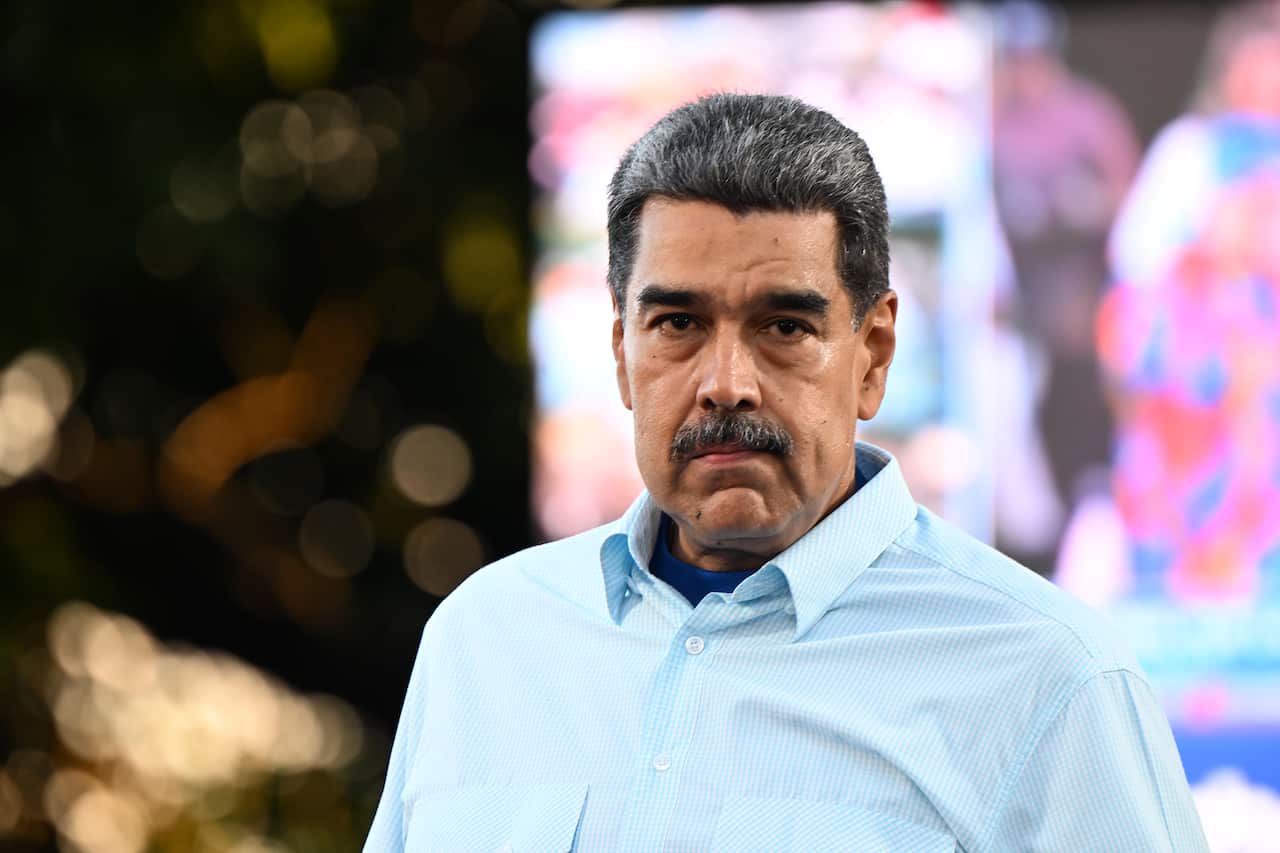
Nicolas Maduro, wearing a blue shirt.

Nicolás Maduro is awaiting trial on criminal charges in New York. Source: Getty / Alfredo Lasry R

With Maduro on trial in New York, having pleaded not guilty to the narco-terrorism charges against him, Rothwell said two scenarios could hypothetically see the US “run” Venezuela as Trump has flagged, but that neither seems likely.

If the US were to militarily intervene in Venezuela and the Venezuelan government were to capitulate, the US would become an occupying power, according to Rothwell.
It would exercise those powers under the Fourth Geneva Convention, the legal framework which sets out the duties of an occupying force and the rights of citizens.
“That doesn’t appear to be likely at the moment unless the United States is prepared to invest significant military resources in doing so,” he said.
Another possible — but also unlikely — scenario would be Venezuela inviting the US to run the country, or the United Nations deciding to create an interim government there.

“In the face of a functioning Venezuelan government, where, it needs to be acknowledged, there’s been a transition of power to the acting president, Rodriguez, all of that at the moment seems very far-fetched,” he said.

Shannon Brincat, a senior lecturer in politics and international relations at the University of the Sunshine Coast, told SBS News there is no precedent for a state to take control of parts of another state for its own use.
The US managing the oil of Venezuela after regime change “would be, potentially, strong evidence of occupation”, Brincat said, incurring the range of duties on an occupying power.
“Without the local sovereign’s freely given consent and authority, that would seem to be a hostile occupation,” he said.
Tamer Morris, an international law lecturer at the University of Sydney, said the US had no legal claim to control or to seize Venezuela.
“If the United States takes control of Venezuela without consent of Venezuela — and I’m assuming because the president is in custody he has not given his consent — this would be classified as a form of occupation and would be completely illegal,” he told the ABC.

“Specifically after 1945 we banned what is known as conquest, which is states can take territory or take resources by use of force.”

What about the opposition?

Questions about Venezuela’s future leadership have also emerged regarding opposition leader María Corina Machado.
Machado, who celebrated Maduro’s abduction by the US and has repeatedly praised Trump and the actions of his administration, has called for Venezuelans to recognise Edmundo González as the country’s legitimate president.
With Machado disqualified from running, González was the main opposition candidate against Maduro in the 2024 federal election, in which the latter was contentiously declared the winner.

Vote tallies were not publicly provided, and the government-controlled National Electoral Council were accused of falsifying results. Protests erupted, and multiple world governments — including the US — challenged the result, made allegations of electoral fraud and recognised González as Venezuela’s leader.
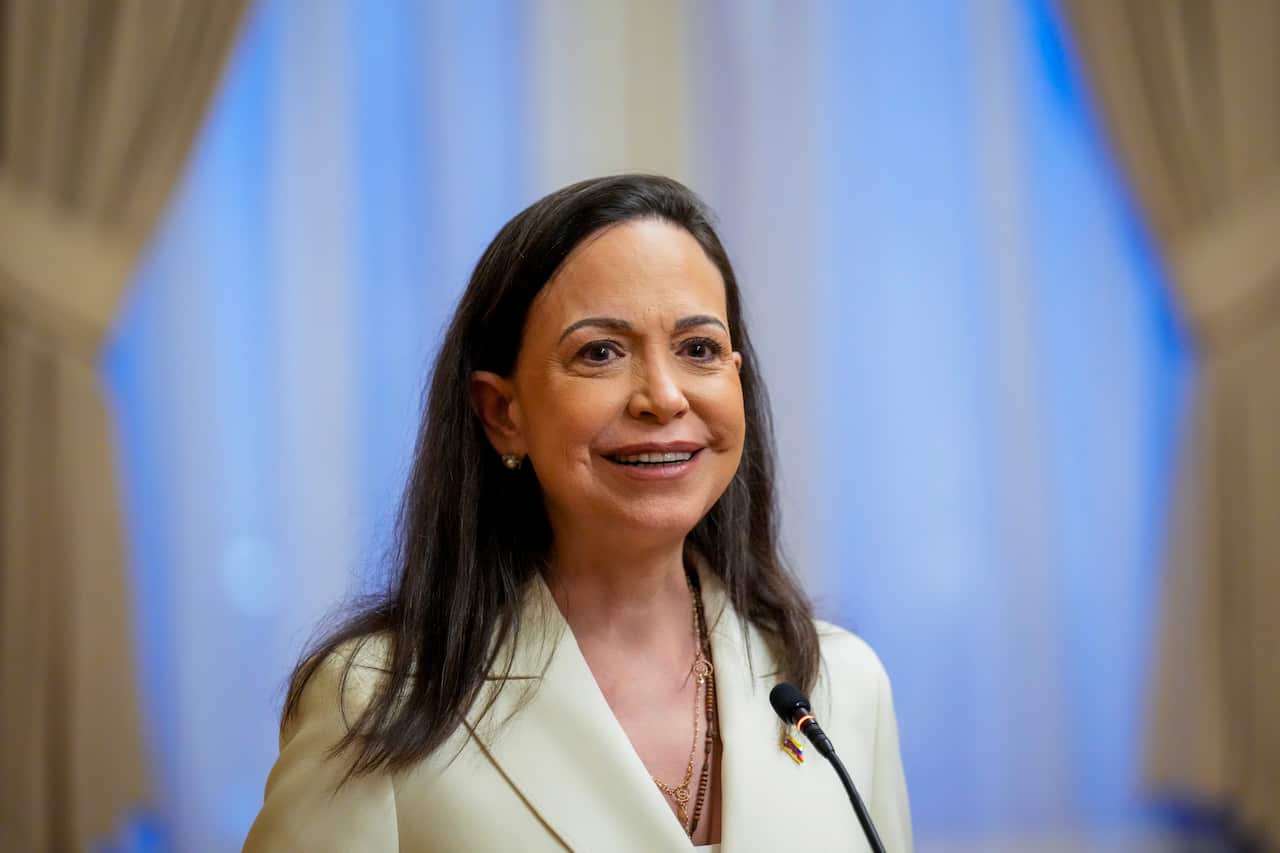
A woman in a white blazer speaking into a microphone.

While Venezuela’s opposition leader, Maria Corina Machado, has been suggested as a possible next leader of the country, US officials have dismissed the idea. Source: AAP / EPA / Ole Berg-Rusten

After a request from the public prosecutor’s office, an arrest warrant was issued for González in the aftermath, on a range of charges, and he was granted asylum in Spain.

Rubio, speaking to NBC’s Meet the Press program on Monday, said while he supported Machado, much of the Venezuelan opposition was currently in exile, and that the US was focused on short-term plans over the next few weeks.
Trump, similarly, has dismissed the idea of working with Machado, saying she doesn’t have enough support within Venezuela.

“I think it would be very tough for her to be the leader,” Trump said on the weekend.

How are Venezuelans feeling?

In the 13 years he was in power, following the death of his predecessor, Hugo Chávez, Maduro was seen by many as authoritarian, and his government was accused of fraud, corruption, suppressing opposition, and human rights abuses — charges he denied.
Venezuela’s economy also nosedived further under Maduro’s rule.
As the situation in Venezuela continues to escalate without a clear sense of what will happen next, those who will be most impacted will be those living day to day in Venezuela.

On the ground, reactions to Maduro’s ousting have appeared conflicted.
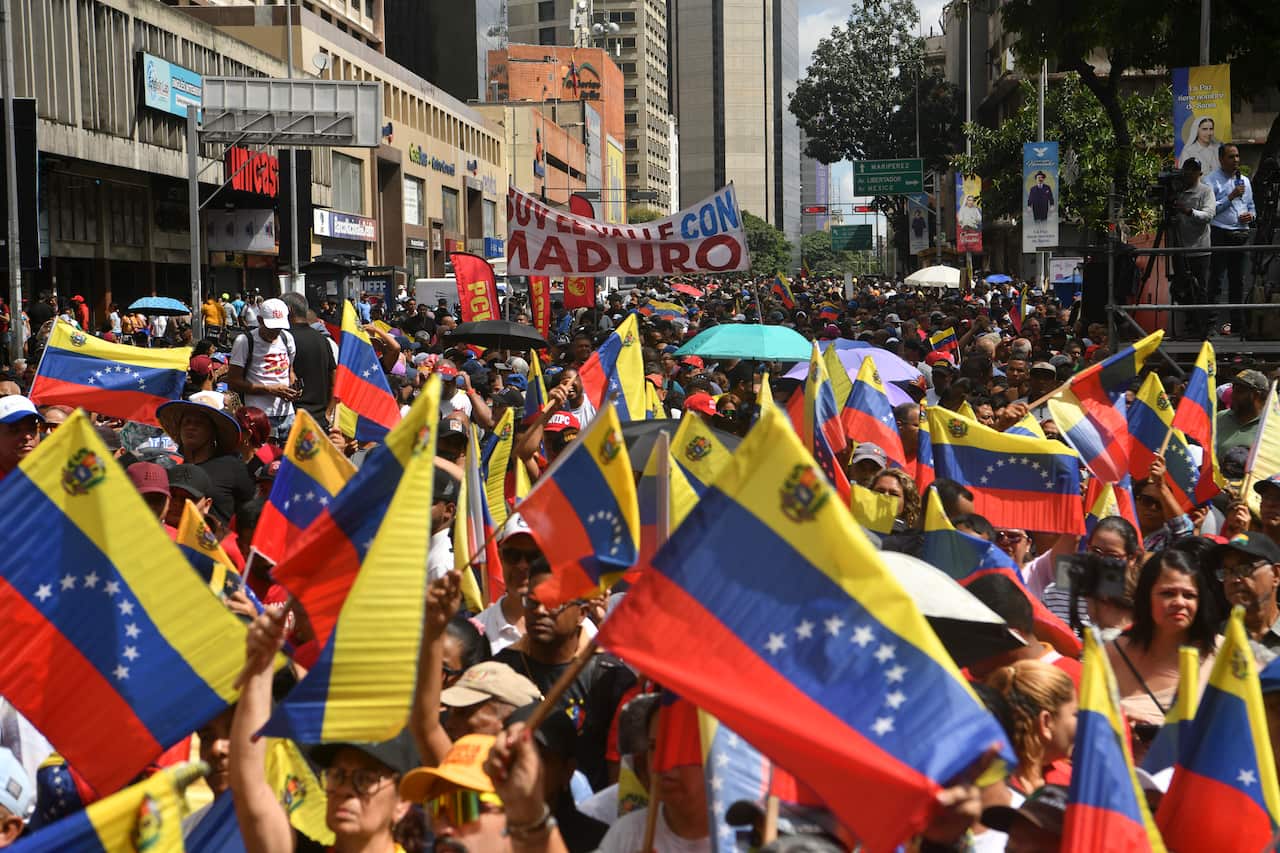
A large crowd of people walking down a street, waving Venezuelan flags.

Pro-government supporters attend a rally a day after the capture of Nicolás Maduro in Caracas. Source: Getty / Carlos Becerra

While some Venezuelans have expressed joy at Maduro’s ousting and hope for the future, others worry the US intervention will create further instability.

In Caracas, resident Ronald Gaulee said many people now saw a moment of transition.
“There should be a positive change for all Venezuelans because it has been 28 years of government, and now is the time for transition in this country,” he told the Reuters news agency.
“Now, we have to wait for these people to speak out and see what they have to say. Everything should happen now, and we should get out of this situation.”

Khaty Yanez lives in the Chilean capital Santiago and is one of an estimated 7.7 million Venezuelans — 20 per cent of the population — who have left the country since 2014.

“We are free. We are all happy that the dictatorship has fallen and that we have a free country,” Yanez told Reuters.
But Caracas resident Franklin Jimenez said the US’ capture of Maduro would “create an even worse conflict than the one we have now”.
“Look at the situation we’re living [in],” Cecilia Romero said. “There’s anxiety and desperation, and we don’t know what will happen.”
Joaquin Restrepo, another Caracas resident, also said many people felt unclear about what the future would look like in the days ahead.

“We’re all living with this uncertainty to see what will happen, what the directives will be, so we can continue with life,” Restrepo said.
Raul Sanchez-Urribarri, associate professor of crime, justice and legal studies at La Trobe University, told SBS News the people of his home country have suffered greatly for many years.
“This is a country that lost over 70 per cent of its economy, eight million people, a quarter of its population.
“So, this is a moment of trepidation, of fear for the present, for the future. But at the same time, for many people, a bit of hope in the sense that it could well be that the opening has the potential for opening other scenarios for the country. And all those sentiments and all those concerns can coexist.”
— With additional reporting by Reuters and Agence France-Presse

Share this @internewscast.com
You May Also Like

Affordable Weight Loss: Health Minister Announces Subsidy for Wegovy

Australians could soon get cheaper access to the popular weight-loss drug Wegovy,…
The French Alps, popular among outdoor sports enthusiasts, have featured in many video games

Level Up Your Travel: Discover Real-Life Destinations Inspired by Your Favorite Video Games

Exploring the world by visiting the filming locations of beloved movies has…

Australian Teen Accused of Hoax Calls Triggering Mass Shooting Alerts in the US

Swatting involves making false emergency calls to provoke an immediate and large-scale…
'You know what their defence is? Two dog sleds'

Unbelievable Defense Strategy: The Surprising Role of Dog Sleds

Speaking on board Air Force One as he returned to Washington on…
Eloise Worledge

$1 Million Reward Announced in 50-Year-Old Cold Case of Missing Girl

A $1 million reward has been announced for information about the disappearance…
Report reveals surge in bulk billing GPs

Study Unveils Significant Increase in Bulk Billing General Practitioners

Sydneysiders are currently shelling out an average of $50 for a GP…
Flood levels are rising in parts of Queensland after relentless rain.

Queensland Town Breaks 110-Year Rainfall Record Amid Ex-Cyclone’s Powerful Downpour

A town in Queensland has experienced its wettest day in over a…
Prime Minister Anthony Albanese has recalled parliament early to new hate speech and gun laws in response to the December 14 terrorist attack at Bondi Beach.

Urgent Parliamentary Session to Address Post-Bondi Terror Attack Reforms

In the wake of the December 14 terror attack at Bondi Beach,…

Rose Byrne Shines Bright: Australian Star Clinches First Golden Globe Victory!

Australian Rose Byrne has joined the winners’ list at the 2026 Golden…
Three members and the chair of the Adelaide Festival Board have resigned following the continued fallout from the controversial decision to dump Australian-Palestinian author Randa Abdel-Fattah from the renowned writers' week.

Festival Under Fire Responds to Controversy Following Palestinian Author’s Removal

The executive director of Adelaide Writers’ Week has described the current situation…

Cuba Remains Resolute Amidst Trump’s Urging to Negotiate “Before It’s Too Late

United States President Donald Trump has said no more Venezuelan oil or…
Mates emerge to every 'diver's worst nightmare'

Diver’s Dilemma: Surviving the Ultimate Underwater Nightmare

Two divers have found themselves stranded in the ocean after surfacing to…