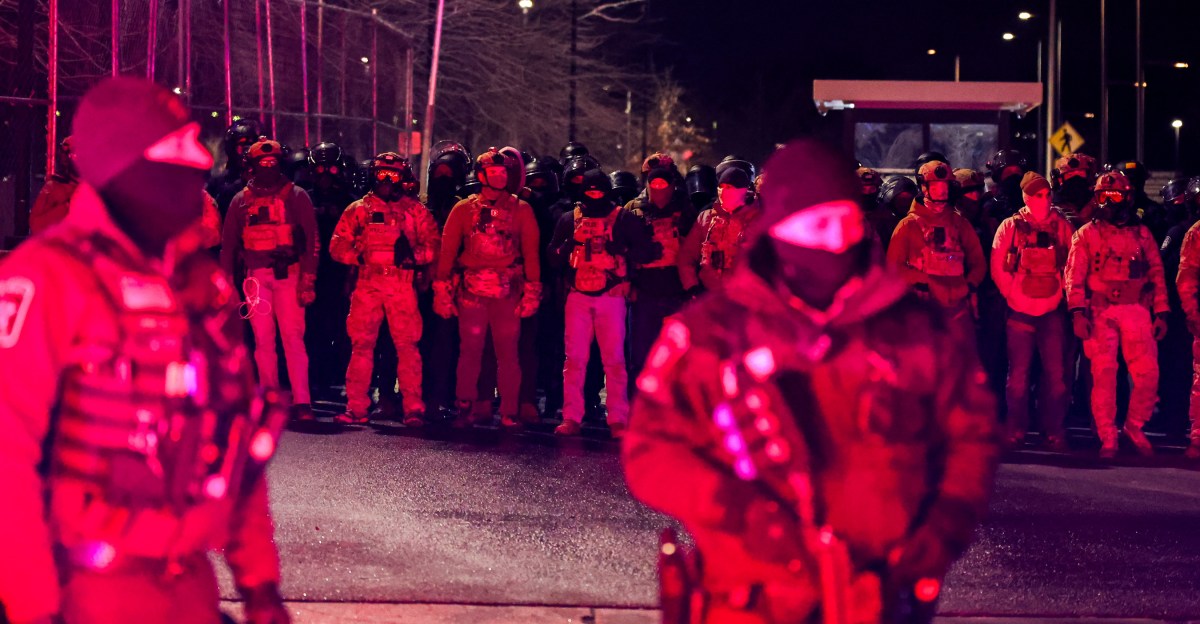

After federal agents fatally shot Alex Pretti on Saturday morning, the Department of Homeland Security quickly portrayed him as a menacing threat. According to DHS, Pretti was armed with a gun. However, a Bellingcat video analysis suggests he was unarmed at the time of the incident. Contradicting DHS’s account, reports from The New York Times indicate Pretti was holding a phone, not a firearm. Tragically, Pretti’s life ended while he was on his knees, surrounded by armed Border Patrol agents, who fired multiple rounds at him.
In the United States, the Second Amendment is staunchly defended, particularly by conservatives. Minnesota, where Pretti resided, permits open carry with a license. Despite living in an area frequently plagued by violence from masked and armed individuals, Pretti’s actions have been heavily scrutinized. This raises questions about why lethal force is so often used by law enforcement, who are tasked with maintaining order. At the end of the day, it seems the narrative often shifts to assessing how much the victim deserved their fate.
Back in July 2020, Portland, Oregon, saw over a hundred federal officers from various agencies deployed by DHS. Instead of calming tensions, they engulfed downtown in a dense haze of brownish tear gas. Rather than dispersing the crowds, this provoked and angered them further. The city perceived this as intentional torment and defiantly faced the tear gas.
Amid the ongoing protests, debates raged about whether the events in Portland and other cities were “protests” or “riots.” This debate focused narrowly on protesters’ actions, seemingly ignoring the broader context. On the ground in Portland, such a narrow focus felt like missing the essential point.
Protesters’ tactics challenged traditional notions of nonviolence. Equipped with gas masks and shields, they used leaf blowers to redirect tear gas back at the federal agents who deployed it. Others hurled plastic bottles at the officers, partly out of disdain and partly for amusement at the sight of bottles bouncing off militarized helmets. While there was no intention to harm the officers fatally, these actions diverged from the peaceful protests of the past, like the historic marches in Selma.
If Portland was indeed the scene of a riot, it was arguably provoked by federal actions. The agents’ use of rubber bullets, pepper balls, and gas canisters escalated tensions, challenging and even defying the notion of “nonlethal” force.
These unequal expectations were unfair to civilians. And they are being applied again, with greater weight and brutality, to the people of Minneapolis.
It is obvious that ICE’s presence in Minnesota is a source of conflict and anxiety. As feds leave disorder and fear in their wake, Minnesotans without training or state-issued protective gear are being asked to behave with greater restraint than the armed agents who are supposed to be upholding the law.
Early reporting would suggest that Pretti was violently killed while engaging nonviolently with federal law enforcement. Videos show that he was holding a phone and moving to help a protester when agents grabbed him by the legs and wrestled him to the ground. The agents shout that he has a gun only after they’ve pinned him to the ground.
Why must the victims of state violence be entrusted with the task of not escalating a situation?
But whatever happened, the physical coordinates of Pretti’s purported gun in the few seconds leading up to his killing are far less relevant than the ongoing siege of the Twin Cities. What, in the face of this aggression, is so relevant about his demeanor or his attitude or how he approached the agents right before his death? Why must the victims of state violence be entrusted with the task of not escalating a situation, when they’re not drawing a salary or health insurance or pension on the taxpayer’s dime?
The people are being charged with keeping the peace, asked to stand firm against the federal agents who are disrupting it. This is a sick form of double taxation — your paycheck gets docked so that a guy in a mask can beat you up while you try to calm him down. “That’s fine, dude, I’m not mad at you,” Renee Good told ICE agents moments before they shot her through the side window of her car. Did she deserve to die because she did an inadequate job of tempering their feelings?
What is the point of pinning someone to the ground before pouring pepper spray in his face? What is the point of all of this, except to anger the public, and then to respond to that anger with even more force? ICE, CBP, and Border Patrol have proven themselves incapable of obeying the law, let alone enforcing it for others; unable to self-soothe, let alone keep the peace. ICE and its ilk are not an answer to a problem, but a problem with only one solution. They are malignant, they are worthless, and they should not exist.


