
The Irish Mail on Sunday has uncovered that the proprietors of one of Ireland’s latest car hire companies have a history of leaving substantial debts in their previous ventures.
Easirent.ie, which operates from locations near Dublin, Cork, and Shannon airports, is under the ownership of the Hanley family, based in the UK. This business was officially registered in Ireland in 2023.
ER Travel Ltd, located in Swords and responsible for the Irish branch, currently boasts retained earnings of €3.3 million and manages a car fleet valued at over €6 million.
Despite these impressive figures, past enterprises managed by the principal owners, Nick Hanley and his son Paul Jon, have accumulated significant debts in the UK.
Their use of the Easirent brand has also stirred controversy with a formidable opponent, Sir Stelios Haji-Ioannou, the billionaire founder of easyJet.

Easirent’s Nick Hanley’s has family connections through his father to Kenmare, Co Kerry

Easirent’s Irish operation is run by Nick Hanley’s son, Paul Jon Hanley. Easirent.ie was first registered as a business name in Ireland in 2023.
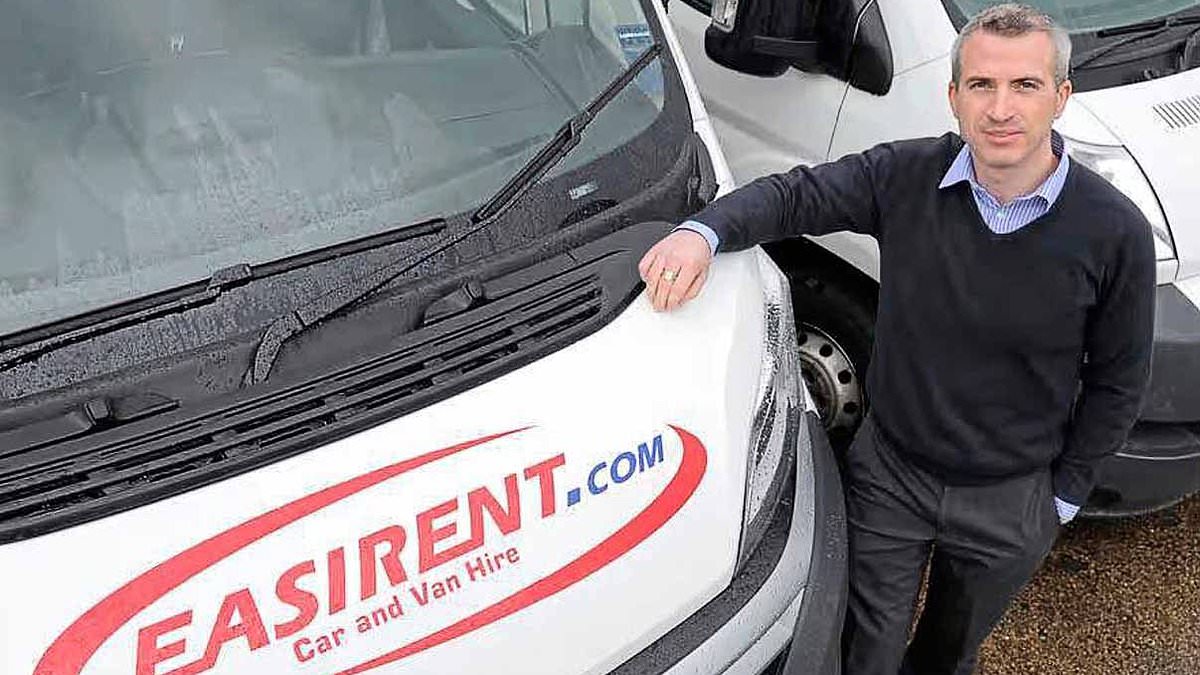
Nick Hanley, the original founder of Easirent, is 75 years old and hails from Wigan, with familial roots in Kenmare, Co. Kerry. Currently, the Irish operations are overseen by his 46-year-old son, Paul Jon.
The Irish business is the latest in a string of car rental firms that the Hanleys have run since 1999.
Although the Hanleys committed no wrongdoing, most of these firms have collapsed leaving behind millions in unpaid debts.
These debts include more than £2.6m (€3m) owed to HM Revenue & Customs (HMRC) and another £2m-plus owed to other creditors.
Despite these business failures, the Hanley family has always been able to keep its Easirent brand and begin trading afresh immediately via new companies.

Nick Hanley and his wife Kate. Nick’s mother Rita was from the famous Italian Cassinelli family who ran the 100-bed hotel and live music venue, the Casinelli Motor Inn just outside Wigan
Nick Hanley set up his first vehicle rental business – Standish Self Drive – in 1987 with two second-hand Ford Transit vans.
Initially, the business – run via a UK-registered company called Beachmore PLC – was successful.
In January 1998, Nick Hanley posed for local newspapers as he signed a £10m deal for 1,000 new cars.
By 1999, Standish Self Hire had a turnover of £16m, 300 staff and a fleet of more than 5,000 vehicles, operating from 23 depots across the UK. But later that year, just before Christmas, the business went into administration with debts of £14m.
Unable to rescue the firm, Mr Hanley then began a new car hire firm called Easirent – something he was able to do because he owned nine of the depots used for the original business in his own name.
Mr Hanley was legally entitled to start again and he did not engage in any wrongdoing at all but this instant, phoenix-like resurrection angered creditors and those who lost their jobs at Christmas, making front page news locally.
‘I think Nick Hanley has come out of this smelling of roses while we face a bleak Christmas,’ one of those who lost their jobs told the Manchester Evening News.
‘Anger as crashed car firm boss starts again’ was the headline above the story. Mr Hanley told the paper: ‘People may be angry that I’ve started again but you can’t just sit back and say, ‘I’m washed up.’
Those owed money also expressed their frustration.
‘It galls us that while we have to absorb this debt, Nick Hanley has started afresh without a care in the world,’ one creditor owed £9,000 told the Wigan Evening Post.
Nick Hanley said the 250 vehicles used for the new Easirent business had originally been leased to Standish Self Drive in his own name, and if he didn’t use them in a new business, he would have to find £2m to pay for them.
At the time, Mr Hanley told the Wigan Observer and District Advertiser newspaper: ‘We are doing very well and we are very busy picking up a lot of Standish Self Drive’s old customers. The clock is rolling back. It’s just like old times.’
In the article, he spoke of opening new branches where his old firm used to be based and being able to re-employ up to 30 former staff.
He later complained about the tone of the reporting of his first business failure in a letter to the Wigan Observer.
He wrote: ‘When times were tough, I was always first to manage without wages for up to 12 months at a time to ensure survival. All profits were ploughed back into the company and we employed 300 people, all well paid and treated like family.’
Mr Hanley’s letter said the collapse of his firm was due to factors outside his control linked to the collapse in second-hand car prices.
‘We gave everything we had to save our company – all our savings, all our pension money and every hour God sent to try and make it work,’ the letter said.
‘For suppliers to suggest I have ditched one company and merrily started another is ludicrous – I have lost a lifetime’s savings and I have been saddled with substantial debt from the finance companies for which I am personally liable.
‘Standish was my pride and joy and losing such a company has been devastating to me and my family. It is like a bereavement. There are very few successful people in this country who have not sailed very close to the edge at some time or other and they can understand the situation.’
While it traded as Easirent, Mr Hanley’s new business was run via a new company called Penfold Ltd, which he had just incorporated.
Initially, the new firm did well but history was to repeat itself. A decade later, in November 2009, Penfold Ltd also went bust and administrators were appointed.
It owed HMRC £1,225,000 of unpaid VAT, PAYE and National Insurance Contributions (NIC). But in a pre-packaged deal, Mr Hanley was able to buy back the business, without its debts, for £245,000, payable in instalments over 10 months.
This was possible because HMRC was not by law treated as a preferential creditor, as it is now. Debt free again, Mr Hanley resumed trading as Easirent via a new firm called Penfold Fleet Ltd.
Explaining the decision to sell back to a company controlled by Mr Hanley, the administrators said this was better for creditors than selling off assets piecemeal.
Administrators also said customer continuity would ‘maximise realisations from debtors’ while employment would be preserved.
Free from debt, Mr Hanley’s new firm was initially profitable. But by November 2011, had losses of £850,000 despite staff reductions and two depot closures.
According to the firm’s filed accounts, ‘the company fell behind in its obligations to HMRC’. The accounts state the company had ‘provided a bond in relation to VAT in the sum of £50,000’. But this was swallowed when arrears grew and HMRC sought another ‘£153,000 which the Company was unable to pay’.
In November 2011, the company asked for a ‘Time To Pay Arrangement’ with HMRC to deal with arrears but this was rejected.
By March 2012, his latest firm was in administration and administrators agreed the best option for creditors was to sell it to a firm Mr Hanley controlled called Easiassist Ltd.
The price paid was £100,000 and it was agreed this could be paid in instalments of £10,000 a month.
On this occasion, HMRC was left out of pocket to the tune of £738,834. Easiassist changed its name in 2015 to ER Travel Services Ltd – but always traded using the Easirent brand.
Mr Hanley built the Easirent business back up again and soon had 2,800 vehicles, 252 staff and was generating annual revenue of £30m.
But it was only marginally profitable until 2018 and in February 2020 was put into administration again by Barclay’s Bank, which was owed £809,000.
This time, debts to HMRC amounted to £655,690. The latest administration was blamed on factors including a ‘significant data handling fine in July 2018 from their merchant services provider’.

The use of the Easirent brand has ignited the ire of billionaire easyJet founder, Sir Stelios Haji-Ioannou who has been in legal dispute with the Hanleys since 2000
When asked by the MoS this week, Mr Hanley declined to specify what this fine relates to.
Other issues blamed included unprofitable regional branches, a deflated second-hand car market and low-cost competition.
The business was sold by the administrator to a firm controlled by Mr Hanley – this time called ER Capital Ltd.
The price was £1.28m, of which £450,000 was paid on the sale date with the balance due in 10 monthly instalments.
According to the administrator, this offer was the only one received from 18 parties contacted and ‘provided the best outcome for creditors in the circumstances’. Unsecured creditors owed £5m recovered 6.3 pence for every pound lost.
Meanwhile, Mr Hanley continued trading as Easirent, via ER Capital, until July 2021, when he sold the business to Leasys S.P.A., a European car leasing and hire firm owned by an Italian auto financing group.
The new owners did not trade under the Easirent brand, which Mr Hanley retained. Today, as well as being in Ireland, the Hanleys have expanded to the US.
Easirent is not a member of the Car Rental Council of Ireland (CRCI), an industry group that facilitates complaints and operates a code of practice for members.
In the US, Easirent is also not a member of the Better Business Bureau (BBB), a non-profit organisation that focuses on growing marketplace trust.
Asked about this by the MoS, Mr Hanley did not explain this decision. That hasn’t stopped hundreds of Easirent customers from logging complaints to the BBB.
In Ireland, review sites such as Tripadvisor and Trustpilot have logged hundreds of poor reviews of the hire company.
This week the Competition and Consumer Protection Commission (CCPC) also confirmed it had received 16 helpline contacts about easirent.ie last year.
For operational reasons, the CCPC could not give details of ‘outcomes of complaint screening or ongoing investigations’.
Mr Hanley said the administrations and sales his companies had gone through ‘were lawful, independently supervised insolvency processes conducted by licensed insolvency practitioners acting in the interests of creditors’.
He added that online complaints and reviews written about Easirent contained ‘unproven assertions, many of which are disputed, resolved, or anecdotal’.