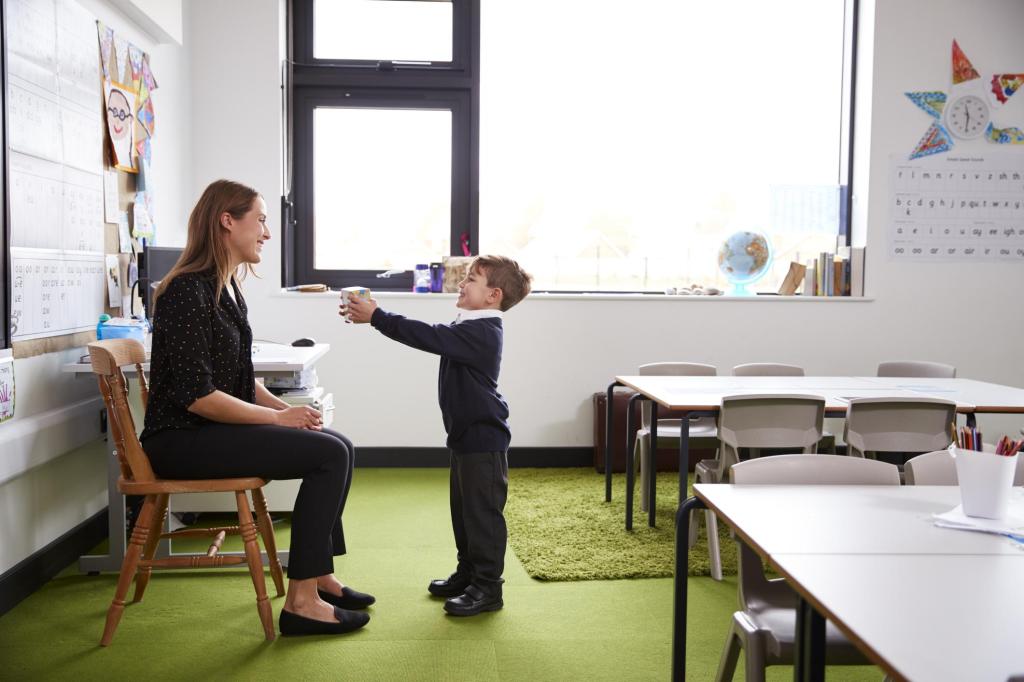


Dear Eric: I’ve spent over two decades as a preschool teacher, during which there are several occasions when children and their parents might choose to give us gifts. These moments, which are entirely optional, typically occur around Christmas, Valentine’s Day, Teacher Appreciation Week, and Graduation.
While I never ask for or expect these gifts, I am always grateful when they are given and make sure to express my appreciation and thanks for their thoughtful gestures.
Though it doesn’t happen frequently, it truly warms my heart when families show appreciation for our dedicated efforts.
My boyfriend believes I should demonstrate humility by telling the children and their families to give their gifts to someone in greater need, suggesting that handmade items are more meaningful. Although I agree that gifts are not the motivation behind my work, I feel uncomfortable with the idea of telling families, especially the young children, that I don’t want their presents. Many of these kids are thrilled to give something they personally selected.
I believe that part of the joy lies in the act of giving and witnessing my response to their kind gesture. I am determined not to dampen the spirit of generosity that families are nurturing in their children. It leaves me wondering: just how much more humble and modest can I be?
Is it wrong for me to accept these gifts?
– Gifted Educator
Dear Gifted: Not guilty! (Bangs gigantic imaginary gavel!) Your boyfriend is putting too much thought into something that doesn’t really concern him. I don’t have to tell you how hard teachers work or how important you are to the healthy development of the children you teach. If some of the parents want to express their gratitude for the (hopefully well-paid, but usually not well-paid-enough) work you do, let them!
Gift-giving is a form of communication, and it can be quite good for children to learn one way of expressing thanks. It doesn’t sound like you’re making a huge deal out of it or creating a situation where students without gifts would feel ashamed. It sounds like this is something between you, the individual kids, and their respective parents.
Sure, handmade gifts are nice, too. But it strikes me as a bit ungrateful, and perhaps controlling, to demand that parents supervise another craft project rather than buying you a gift card. How they show their thanks is up to them.
If you, in turn, want to pass the gift on to someone else who needs it, that’s your prerogative. But I don’t think you need to protest more to the parents. Sometimes, when people want to say, “thank you,” the best response is “you’re welcome.”
Dear Eric: I have been in a wonderful, committed relationship for nine years but we do not live together. We are both advanced seniors whose families got along and were pleased that we were together.
The day before Thanksgiving his daughter, out of the blue, verbally attacked me over something insignificant. Her rant lasted 10 minutes while my boyfriend just sat there and said nothing.
I was totally surprised by her attack but even more so that he didn’t step in and say something to stop it. Her husband, on the other hand, interjected several times on her behalf.
I have been there for him for numerous hospital stays, Covid, joint replacements and the flu while his daughter only came once for two hours during his last hospital stay. I am disappointed, hurt and angry at both of them. On one hand I want to get past this but then do I really want to be in a situation where my man doesn’t stand up for me?
– Who Is In My Corner?
Dear Corner: You’re absolutely right to want someone to stand up for you. I’m curious if you’ve talked with your boyfriend about this. To be clear, he isn’t responsible for his daughter’s behavior, but his lack of response exposed a gap between your expectations and his expectations. It’s healthy to talk that out. It’s healthy to talk about your hurt feelings and to ask about his thoughts on what happened. I’m almost certain there’s more to this situation, considering it also involves family dynamics and an outburst that is far too severe.
He may say something along the lines of, “it was between you and her, I didn’t want to be involved.” And that’s a fine position to hold. But a statement like this gives you the opportunity to say, “that’s actually not how I saw it.” The goal isn’t to convince him of your view, or vice versa. It’s for both of you to keep learning about each other, so that future communication runs more smoothly.
(Send questions to R. Eric Thomas at eric@askingeric.com or P.O. Box 22474, Philadelphia, PA 19110. Follow him on Instagram and sign up for his weekly newsletter at rericthomas.com.)
©2026 Tribune Content Agency, LLC.