In a recent legal development, an effort to prevent the police from exercising additional powers to limit protests against the Israeli president has been unsuccessful.
The Palestine Action Group, a prominent protest organization, initiated a legal challenge against the New South Wales (NSW) government. This move came after President Isaac Herzog’s visit was classified as a major event. However, the NSW Supreme Court dismissed the case in a hearing held on Monday afternoon.
This major event declaration enables law enforcement to deploy more officers during Herzog’s visit, with the stated aim of ensuring public safety. The NSW government maintains that these enhanced powers are essential for managing crowd safety, keeping different groups separate, and minimizing the chances of conflict in the bustling areas of the city.
The legislation permits police to instruct individuals to vacate the designated event zone and to conduct searches on anyone entering or already present in the area. These measures have raised concerns among protesters, who argue that the broad classification of the visit as a major event is unwarranted, considering the lack of specific participants or spectators and the extensive geographic coverage.
Among other things, the act allows police to order people to leave the designated major event area and to search anyone who wishes to enter, or is already inside of, the area.
Protesters argued that calling the visit a major event was too broad, as there are no specified participants or spectators, and the geographic area is too large.
Protests planned across the country
The head of state began his official visit in Sydney on Monday after an invitation from the Albanese government following the Bondi terror attack, which targeted a Jewish Hanukkah celebration on 14 December.
Herzog will meet with politicians and Jewish community leaders, some of whom say the figurehead’s visit will bring great comfort.
Israeli Prime Minister Benjamin Netanyahu is subject to an International Criminal Court arrest warrant, but Herzog is not — and is granted customary immunity under international law as a visiting head of state.
Palestine Action Group’s Josh Lees — whose group has been at loggerheads with the police over the planned location for Monday’s protest — spoke to reporters on Monday before the decision was handed down.
“We’re expecting thousands and thousands and thousands of people … remember the protests happening here in Sydney are part of a nationwide day of action,” he said.
The protesters had earlier insisted they would gather at Sydney Town Hall before marching to NSW parliament, while police urged them to move the event to nearby Hyde Park.
Under the major event declaration, those who fail to comply with NSW Police directions face penalties including fines of up to $5,500.
Protests against Herzog and his official visit to Australia are planned in all capital cities and several regional centres.
Protests will be ‘massive’ yet ‘peaceful’, Lees says
Speaking after the failed legal challenge, Lees told the media the protests around the country will be “massive” and also “peaceful”.
“We’ll be heading to Town Hall for a massive protest which is happening all around the country, in something like 30 cities,” he said.
“That will be a peaceful protest.”
Hundreds of people have gathered at Town Hall for the protest, with a heavy police presence surrounding the gathering.
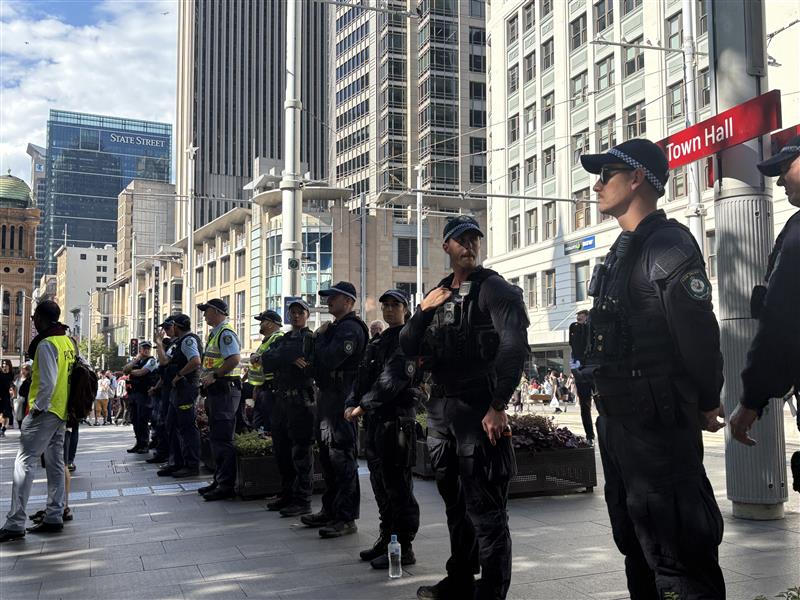
“We have been talking to police, and we’ll continue to talk to police and call on them to facilitate the march that we would like to have from Town Hall to NSW parliament,” Lees added.
What was argued in court?
Lawyers for the protesters told the NSW Supreme Court that the government’s declaration was too broad and did not meet legal requirements because no participants were specified and the geographical area was too large.
The scope of police powers was illustrated in a hypothetical laid out by barrister Peter Lange SC.
“A stereotypical barrister might happen to be searched without a warrant because he happens to be in the eastern suburbs,” he said.
“If he refuses to undergo a search … he may be excluded from the area in which he resides.”
Government barrister Brendan Lim SC argued that scenario was not useful for adjudicating whether protesters were the intended target of the declaration.
“[It is] a distorting hypothetical that is of no assistance … there is no attempt to focus on the consequences for the plaintiff,” Lim said.
He argued the declaration was not made to suppress Monday evening’s protest but rather to relocate it to Hyde Park, where Palestine Action Group has conducted hundreds of rallies.
For the latest from SBS News, download our app and subscribe to our newsletter.