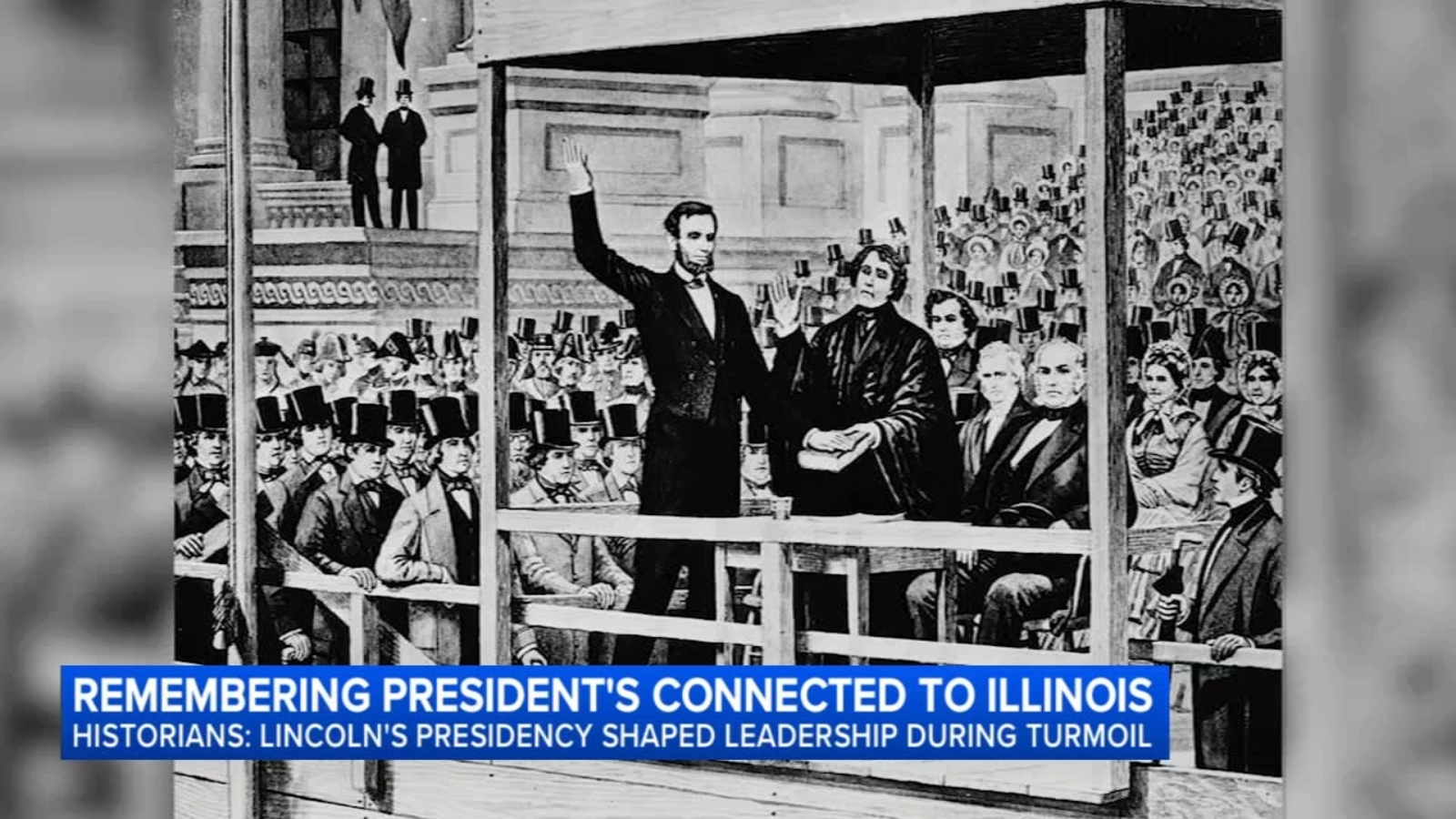

CHICAGO (WLS) — Presidents Day serves as an opportunity to reflect on the influential figures who have shaped America’s history, such as Abraham Lincoln.
Lincoln’s deep connection to Illinois and Chicago links his legacy to the region. As the nation gears up for its 250th anniversary, historians emphasize that Lincoln’s leadership provides a profound example of guiding the country through a period of national crisis.
ABC7 Chicago is now streaming 24/7. Click here to watch
“Abraham Lincoln was our 16th president, and arguably one of the most pivotal figures in American history,” remarked Erin Carlson Mast, the president and CEO of the Lincoln Presidential Foundation.
Lincoln took office in 1861, at a time when the Union and the Confederacy were on the verge of the Civil War.
“The vice president of the Confederacy was quite explicit in his belief that Lincoln would disrupt slavery in existing states, prompting them to form a new nation centered on the preservation of slave power,” Carlson Mast explained.
The Confederacy ultimately faced defeat, largely due to the Emancipation Proclamation, a wartime executive order that declared freedom for over three million enslaved African Americans.
“The nation had never been through a Civil War before. In some cases, Lincoln had to color outside the lines, if you will, test the limits of his executive power, because there was no blueprint,” Carlson Mast said.
His Gettysburg Address remains one of the most quoted speeches in American history, capturing the principles of unity, equality and self-government.
“Well, Lincoln’s approach is notable because certainly, you know, political rhetoric, including in more recent years, has become much more divisive. And that’s certainly the antithesis of what Lincoln was attempting to do with his speeches,” Carlson Mast said.
Lincoln also pushed forward major infrastructure policy, supporting the transcontinental railroad with the Pacific Railway Act, eventually giving the U.S. the Union Pacific Railroad and land-grant colleges like the University of Illinois. That helped establish Chicago as a national rail and commercial center.
“Lincoln saw rail as the future. He was very interested in investing in things that helped people,” Carlson Mast said.
He frequently spoke about the dignity of labor and economic opportunity: ideas that later echoed through labor movements that grew strong in Chicago.
“Being trapped as a wage laborer because of incredibly unfair working conditions that those were antithetical to, really the ideals of this country,” Carlson Mast said.
Lincoln was also a supporter of immigration.
“It’s during his presidency that Congress passes an act to encourage immigration, which Lincoln signs on July 4, 1864. Not only did he want the United States to be this beacon of hope for freedom-seeking people everywhere, but he understood that a way for this nation to grow was to attract immigrants,” Carlson Mast said.
Lincoln was assassinated in 1865, but scholars say his legacy remains central to understanding presidential leadership in times of division and growth.
Copyright © 2026 WLS-TV. All Rights Reserved.