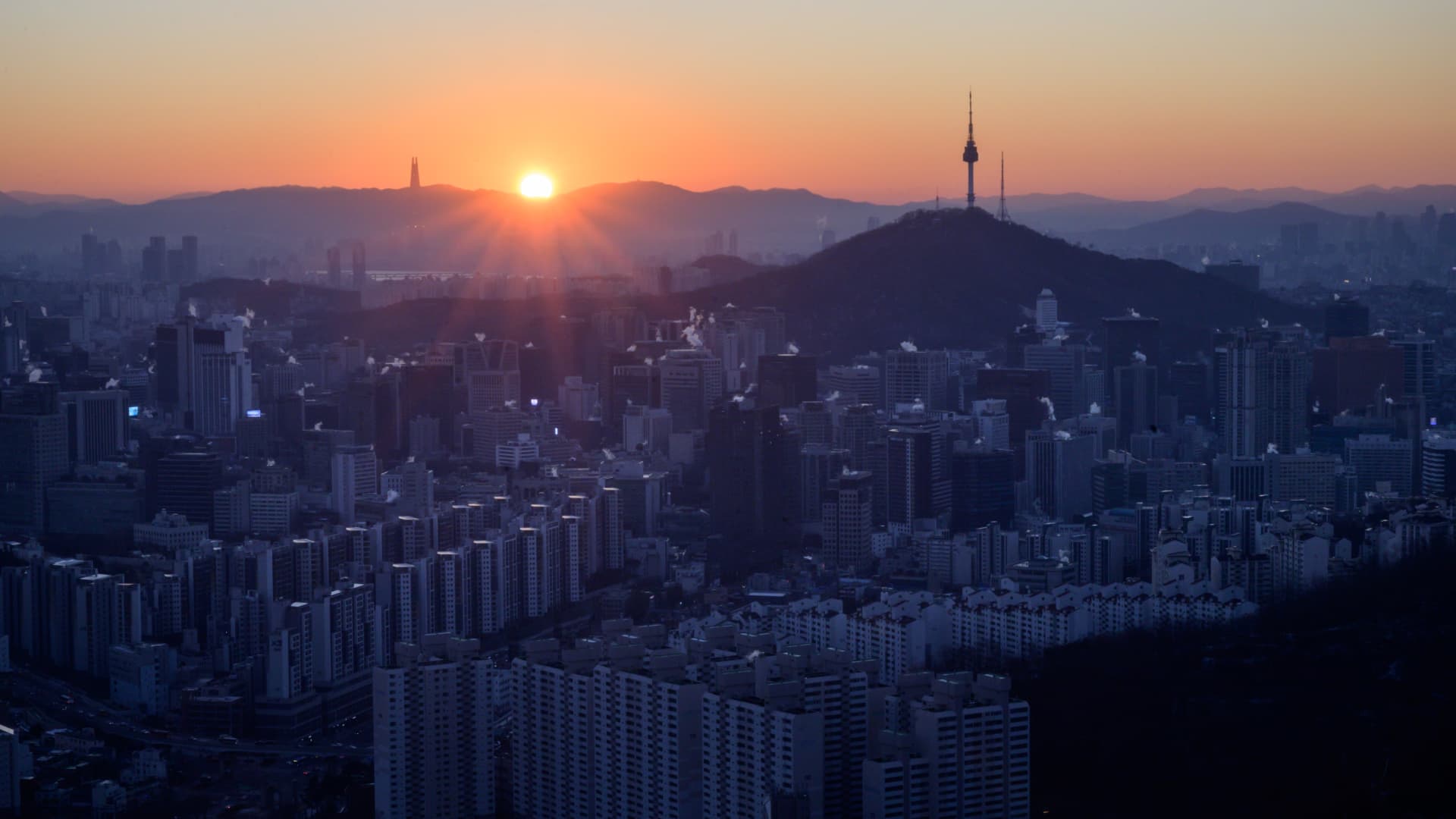
The early morning skyline of Seoul on December 16, 2020, captured by photographer Ed Jones, showcases the city under a clear sky. (Photo by Ed JONES / AFP) (Photo by ED JONES/AFP via Getty Images)
Ed Jones | AFP | Getty Images
South Korea’s Kospi index reached a new peak for the second consecutive day on Friday, driven by strong performances in the semiconductor and defense sectors. Leading this surge, SK Hynix saw its shares rise by 6.15%, while Hanwha Aerospace experienced an impressive increase of 8.09%.
The Kospi index concluded the day with a gain of 2.31%, closing at 5,808.53.
In contrast, other markets in the Asia-Pacific region mostly experienced downturns on Friday. This decline followed a dip in all three major Wall Street indexes the previous night, influenced by a slump in private credit stocks and escalating tensions between Iran and the United States.
Other Asia-Pacific markets were mostly lower on Friday, after all three major Wall Street indexes declined overnight pressured by a drop in private credit stocks and Iran-U.S. tensions.
Prospects of a strike on Iran have risen with U.S. President Donald Trump saying that he would take a call on military action against Tehran in the next 10 days.
Oil prices extended gains in reaction to that news, with U.S. crude rising 0.93% to trade at $67.05 per barrel on Friday. Global benchmark Brent gained 0.33% to $71.9.
Traders in Asia assessed Japan’s inflation data, with headline inflation for January dipping below the Bank of Japan’s 2% target for the first time in 45 months.
Japan’s Nikkei 225 fell 1.12% to 56,825.7, dragged by consumer cyclical stocks, while the Topix was 1.13% lower and closed at 3,808.48.
Shares of Sumitomo Pharma, one of the country’s largest pharmaceutical companies, were volatile in early trade, climbing as much as 6.81% before plunging. The stock closed 15.6% lower.

Separately, Japan’s Prime Minister Sanae Takaichi in her first policy speech in Japan’s parliament, reportedly warned against China’s “coercion,” saying that it “intensified its attempts to unilaterally change the status quo … in the East China Sea and South China Sea.”
Takaichi also pledged to break with “excessive fiscal austerity” in Japan and increase investments in areas like AI, chips and shipbuilding, while adding that her government would not pursue “reckless fiscal policies.”
Japanese government 10-year bond yield fell 4 basis points.
Hong Kong’s Hang Seng index fell 0.98% to close at 26,443.69, dragged by tech stocks. Mainland China’s markets were closed for the Lunar New Year holiday.
Australia’s S&P/ASX 200 ended marginally lower at 9,081.4.
Overnight in the U.S., private credit and software stocks were also under pressure, with the Dow Jones Industrial Average shedding 0.54%, and the broad-based S&P 500 slipped 0.28%. The tech-heavy Nasdaq Composite lost 0.31%.
—CNBC’s Sean Conlon and Pia Singh contributed to this report.
Correction: This article has been updated to reflect that Hong Kong markets are open today.