
As Mexico gears up to welcome the FIFA World Cup games this year, football enthusiasts are increasingly anxious about traveling to a country currently engulfed in a wave of violence. This unrest follows the recent apprehension and subsequent death of a notorious cartel leader.
The Mexican military recently took down Nemesio Ruben Oseguera Cervantes, known widely as ‘El Mencho’, who led the Jalisco New Generation Cartel. This action effectively dismantled the most influential criminal organization in the nation.
The aftermath of this high-profile operation has unleashed a fresh wave of violence, intensifying the already tense atmosphere in a country besieged by brutal cartel conflicts.
In the midst of this turmoil, which has seen cartel members obstructing roads, setting vehicles ablaze, and clashing with security forces, Mexico faces increasing scrutiny as it prepares for its pivotal role in the forthcoming World Cup.
Last year, a grim discovery was made near Akron Stadium in Guadalajara—one of the three venues slated to host four matches during the 2026 World Cup. Within a 10-mile radius, numerous human remains were unearthed.
The initial discovery occurred in February when construction workers stumbled upon plastic bags containing human remains while working on a housing project.
Later in March, a civilian activist group unearthed a cartel’s clandestine grave site, also in Jalisco.
Video footage showed searchers digging through the ground of the property in Teuchitlan.

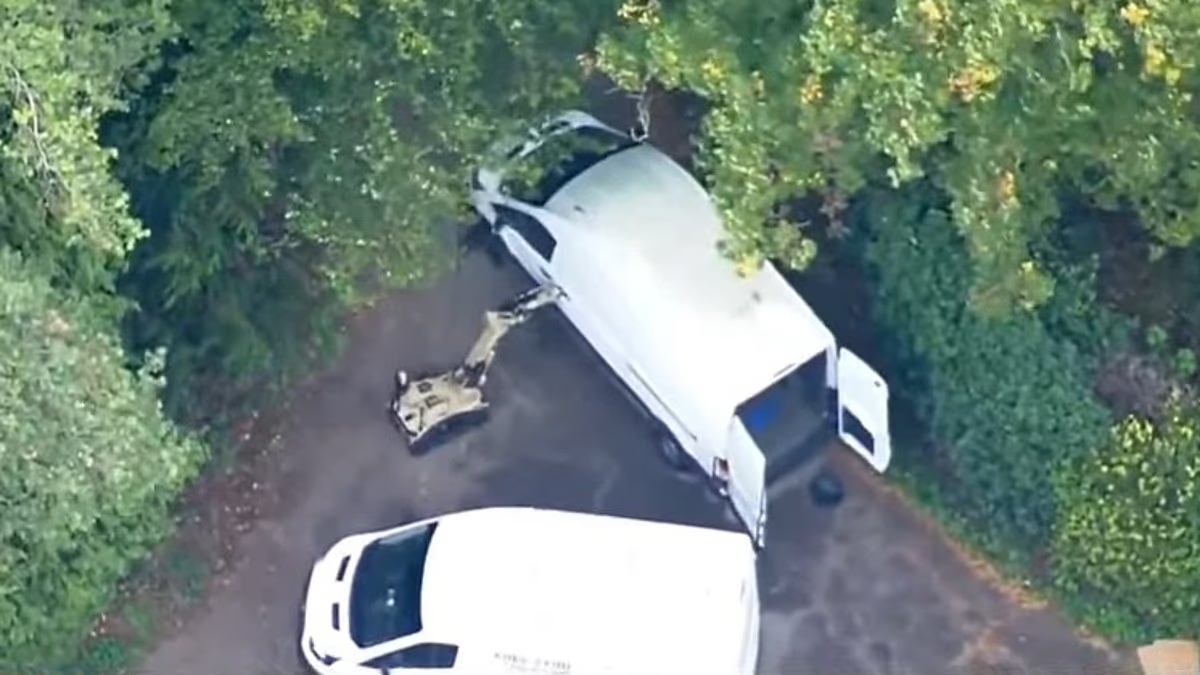
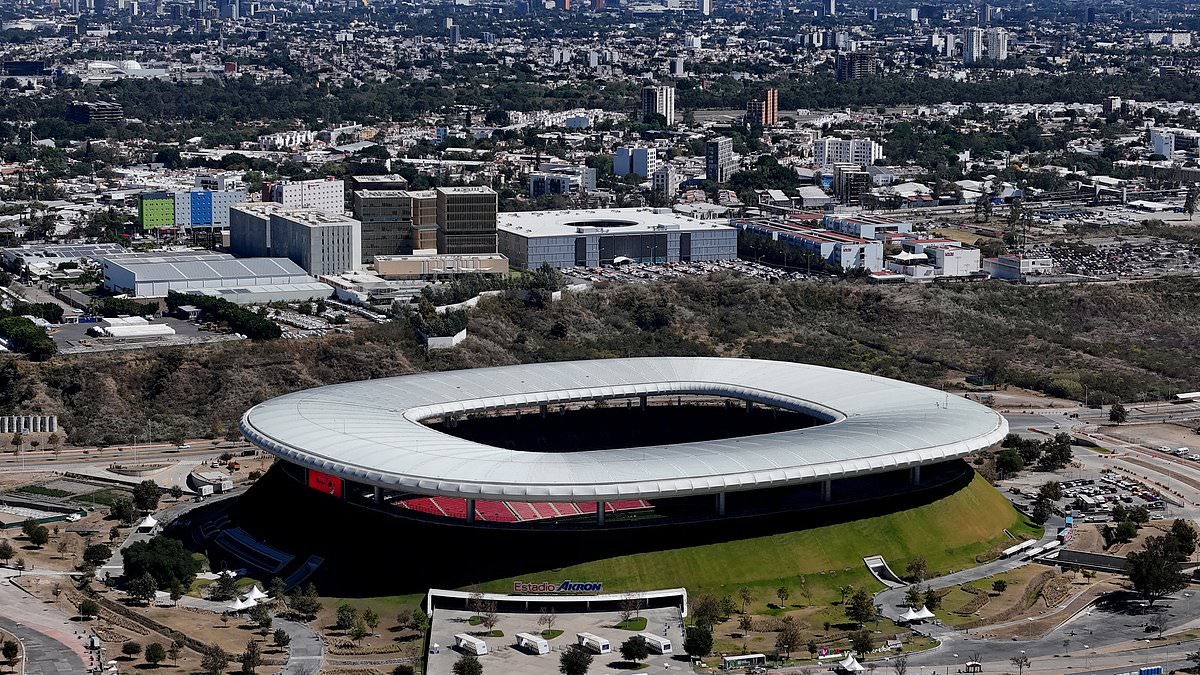
Just a few months ago, dozens of human remains were discovered within a 10-mile radius of Akron Stadium in Guadalajara (pictured)

Aerial view of the site where the clandestine grave known as “Las Agujas” was located, containing 227 bags with human remains, the largest such discovery of 2025 by the Guerreros Buscadores collective, in the municipality of Zapopan, Jalisco, Mexico, host of the 2026 FIFA World Cup, on February 18, 2026

Guadalajara will host four matches from the FIFA World Cup in 2026
The discovery was made after the Guerreros Buscadores collective of Jalisco – volunteers searching for their missing family members – received an anonymous call.
The haunting video showed at least 400 pairs of footwear strewn across a room.
Clothing items, luggage bags and backpacks were also visible that would have belonged to the victims, who at one point were kidnapped and massacred at the death camp known as Izaguirre Ranch, which was allegedly run by the Jalisco New Generation Cartel.
Other mass graves have been discovered across the state of Jalisco.
More recently, in October, as many as 48 bags containing human remains were discovered from a mass grave in Guadalajara.
The discovery of these gravesites adds to dozens of similar cases in Jalisco, which is the state hardest hit by the crisis of missing persons affecting Mexico, where more than 127,000 victims have vanished nationwide.
Most of these disappearances are linked to cartel violence that has shaken Mexico for decades after the government launched an anti-drug military operation.
One of the largest mass graves in the North American country was reported in 2017 when more than 250 skulls were found in what appeared to be a drug cartel mass burial ground on the outskirts of Veracruz.

A death camp set up allegedly by the Jalisco New Generation Cartel at the Izaguirre Ranch in Teuchitlan, a municipality in the western Mexico state of Jalisco was discovered last year

Members of the collective ‘Guerreros Buscadores’ work on three human crematoriums found while searching for their relatives at Izaguirre Ranch on March 5, 2025

At least 200 pairs of footwear along with bags were found inside a room at the remote property in Teuchitlan

A woman records clothes and shoes found at the Izaguirre Ranch after the collective ‘Guerreros Buscadores’ visited the site in Teuchitlan last year
Mexicans have now been questioning Guadalajara’s capacity to be a host city for the summer football competition, even as the government vowed that the international event, which will be jointly hosted by Mexico, Canada and the United States, will not be affected.
Restaurant owner Hugo Alejandro Perez, who lives near the football stadium in Guadalajara, is among those sceptical of the city’s capacity to hold the games.
‘I don’t think they should host the World Cup here,’ Perez said.
‘We have so many problems, and they want to invest in the World Cup? With all the violence, it’s not a good idea.’
President Claudia Sheinbaum was asked at her daily news briefing what guarantees there are that World Cup matches will be held in Jalisco.
‘Every guarantee,’ she said, adding that there was ‘no risk’ for fans coming to the tournament.
Jalisco Governor Jesús Pablo Lemus said he had spoken with local FIFA officials, who have ‘absolutely no intention of removing any venues from Mexico. The three venues remain completely unchanged.’
Portugal’s football federation has since said that it was ‘closely monitoring the delicate situatation’ in Mexico.
Its national team was scheduled to play Mexico’s team in a friendly match on March 28 at the newly renovated Azteca Stadium in Mexico City, which is scheduled to host the opening World Cup match on June 11.
The western state of Jalisco had already been facing scrutiny.
The state has been plagued by some of the starkest examples of cartel violence in recent years.
It is also the central hub for the Jalisco New Generation Cartel, whose leader ‘El Mencho’ was killed on Sunday by the military.
The operation and subsequent waves of violence killed more than 70 people.
Cartel gunmen set fire to cars to block streets in states across the country, namely Jalisco, and fought with Mexican forces into Monday as the government said the conflict was under control.
El Mencho’s death came as Mexico’s government stepped up its offensive against cartels in an effort to meet demands by US President Donald Trump to crack down on criminal groups.
The cartel, also known as CJNG, is one of the fastest-growing criminal networks in Mexico.
The White House confirmed that the US provided intelligence support to capture the cartel leader and applauded Mexico’s army for taking down a man who was one of the most wanted criminals in both countries.
On Tuesday night, Trump appeared to briefly reference the operation during his State of the Union address, saying ‘We’ve also taken down one of the most sinister cartel kingpins of all. You saw that yesterday.’
The root concern for many Mexicans is that the death of El Mencho could pave the way for more violence.
Killing kingpins can often spark internal conflict between cartel factions and push rival cartels to make territorial grabs.