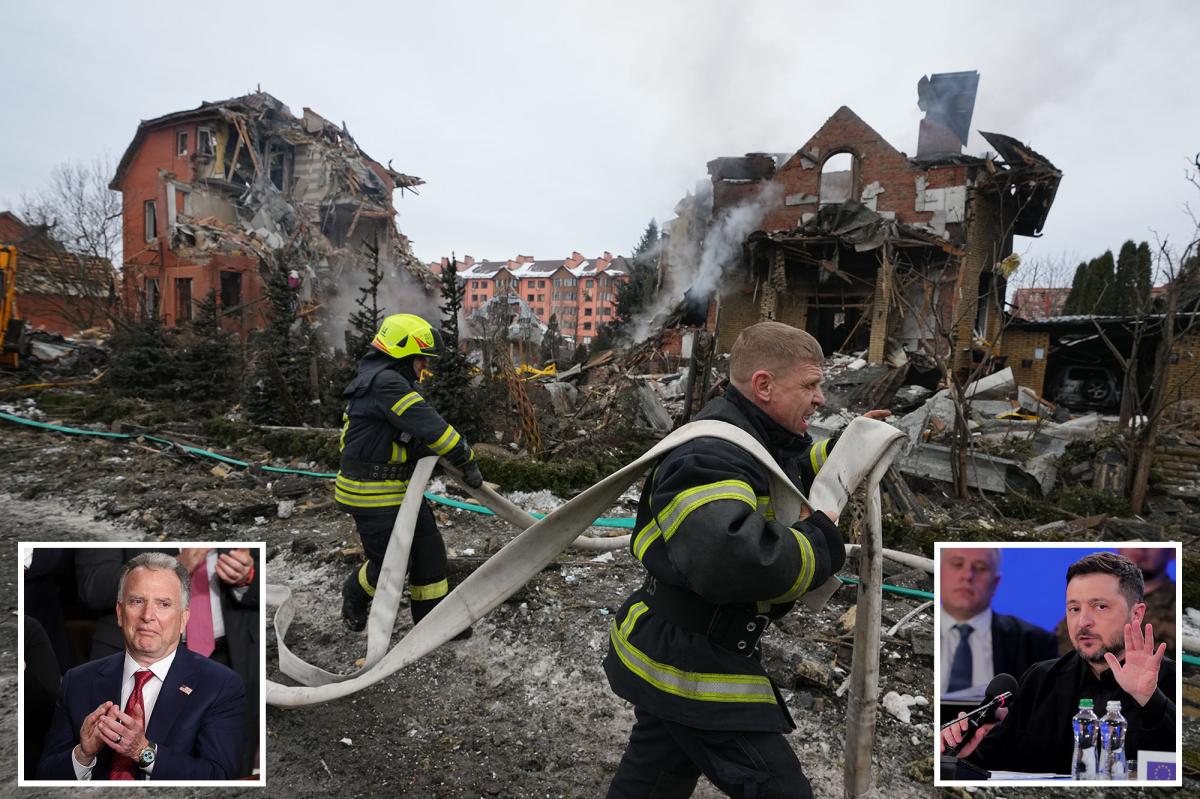


KYIV, Ukraine — This week, President Trump’s special envoy, Steve Witkoff, vowed not to endorse any peace agreement between Ukraine and Russia unless Ukrainians are confident that Moscow will no longer pose a military threat.
“There won’t be any deal unless Ukraine and its citizens are assured they can live peacefully if a diplomatic solution is reached,” Witkoff stated during a virtual address at the Yalta European Strategy conference on Tuesday. “The ultimate goal must be to ensure lasting peace.”
Witkoff emphasized the necessity for robust security measures from the United States, complemented by strong European protocols. “We laid the groundwork for this during our initial Geneva meeting, working tirelessly to establish these security assurances,” he added.
Witkoff, alongside Jared Kushner, returned to Geneva on Thursday, starting with discussions involving an Iranian delegation before proceeding to engage with Ukrainian negotiators.
“Today in Geneva, we continue our efforts within the negotiation framework,” said Rustem Umerov, Ukraine’s national security adviser and head of their delegation. “Alongside the government’s economic team, we’ll be focusing on the prosperity package: exploring mechanisms for economic support and recovery, strategies for attracting investment, and developing frameworks for long-term collaboration.”
The teams will also work to “synchronize positions” before further discussions with Russia. These talks will address “the issue of possible exchanges” of prisoners of war, Umerov noted.
“We expect concrete results regarding the return of our citizens,” he said. “We are focused on practical solutions.”
The US-Ukraine talks come ahead of a fourth trilateral meeting between Washington, Kyiv and Moscow set for next week, during which the three sides will assess whether they can make progress on arranging a meeting between Ukrainian President Volodymyr Zelensky and Russian dictator Vladimir Putin.
Witkoff said Tuesday he “strongly” believed such a meeting could happen — a breakthrough that would rank as the most significant toward resolving the conflict since Russia’s full-scale invasion of Ukraine more than four years ago.
“We think we have tried to resolve the other issues first and then leave the question of territory to the leaders,” he said. “There is a lot of work on territory; we need to consider different concepts and many options.”
Zelensky has repeatedly signaled readiness to meet with Putin to discuss the war’s end, but Putin has so far refused any serious opportunities to do so.
If the summit happens, Witkoff said, there could be another meeting that would also include President Trump — though the envoy added it was “too early to talk about” such a possibility.
“We’re going to do everything we can to help you to get to the right solution, the right peaceful solution, so that everybody in your country can live in peace one day,” Witkoff said.
The very next day, the Kremlin appeared to pour cold water on Witkoff’s optimism, with spokesman Dmitry Peskov questioning “whether there’s any point in holding a summit” between Putin and Zelensky.
Peskov added a trilateral between Trump, Putin and Zelensky should only happen once all sides are ready to “finalize agreements.”