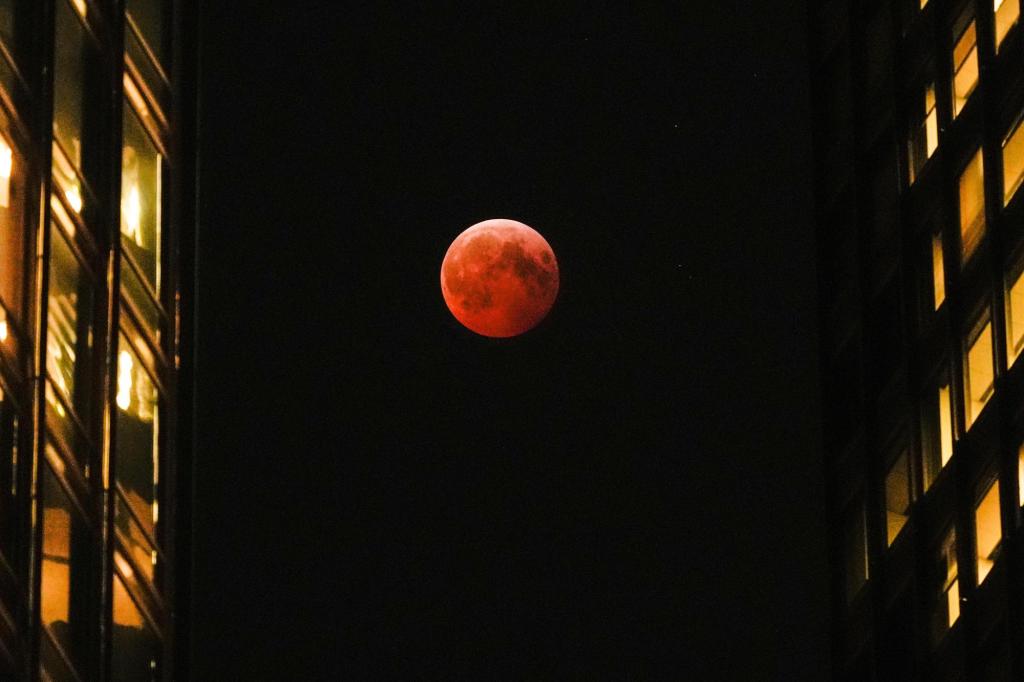


The highly anticipated March 3, 2026 total lunar eclipse has come and gone, painting the full Moon in shades of red and orange for skywatchers across North America, Central America, western South America, Australia, eastern Asia and the Pacific.
As of October 25, 2026, it remains the year’s only total lunar eclipse. A second eclipse took place on August 28, but it was partial. The next total lunar eclipse visible somewhere on Earth is expected on December 31, 2028.
What happened during the March 2026 blood moon?
The celestial event unfolded as the Sun, Earth and Moon aligned, with Earth positioned between the two. The full Moon then traveled through the planet’s darkest central shadow, called the umbra.
Rather than vanishing during totality, the Moon glowed in copper, orange and red tones. This dramatic transformation is the reason total lunar eclipses are widely known as blood moons.
That unusual coloring was caused by sunlight filtering through Earth’s atmosphere before reaching the Moon. Air molecules scatter much of the blue light, allowing the longer red and orange wavelengths to bend through the atmosphere and fall across the lunar surface.
The Moon’s precise hue depended on conditions in the atmosphere. Dust, wildfire smoke, clouds and other airborne particles can deepen the red, intensify the orange or produce a softer copper color.
When was the March 3, 2026 lunar eclipse?
The total lunar eclipse occurred on Tuesday, March 3, 2026. However, the calendar date varied in some locations because the eclipse crossed multiple international time zones.
From start to finish, including the faint penumbral stages, the eclipse lasted roughly five hours and 39 minutes. The most visually striking stage—totality—continued for approximately 58 minutes.
For viewers in Pacific time, the partial phase started near 1:50 a.m., while totality began shortly after 3 a.m. Western North America and Hawaii offered better timing, assuming the Moon remained above the horizon and clouds did not interfere.
Where was the total lunar eclipse visible?
The total phase could be seen before sunrise from much of North America, Central America and far western South America. In parts of Australia and eastern Asia, the event appeared in the evening sky.
Across the Pacific, the eclipse unfolded during nighttime hours. Some areas of central Asia and much of South America witnessed portions of the partial eclipse, though the Moon did not fully turn red everywhere.
Africa and Europe were outside the eclipse’s visibility zone. Even in regions where the event was technically visible, local conditions—including moonrise, moonset, sunrise, sunset, cloud cover and obstructions from buildings, trees or mountains—affected what observers could see.
Did the entire United States see totality?
No. Much of the United States saw at least part of the eclipse, but the complete total phase was not visible from every location.
Western states, Alaska and Hawaii generally offered the best chances of seeing totality with the Moon higher above the horizon. In the eastern United States, the Moon was near setting when totality began or peaked, so some communities saw only the opening stages.
For lunar eclipses, the local horizon can matter just as much as the published timetable. When an eclipse occurs before sunrise, an unobstructed view toward the western sky is especially important.
Why does the Moon turn red during a lunar eclipse?
A lunar eclipse is often simplified as Earth casting a shadow over the Moon, but that shadow has two distinct regions. The outer penumbra creates a faint dimming, while the deeper umbra produces the clearly visible partial and total phases.
Even after the entire Moon enters the umbra, indirect sunlight continues to reach it. This light passes through the atmospheric ring around Earth, where blue wavelengths are scattered—much as they are during colorful sunrises and sunsets.
The remaining red and orange wavelengths travel more readily through the atmosphere and curve toward the Moon. Reflected from the lunar surface back toward Earth, they create the eclipse’s iconic blood-red glow.
CHECK THIS OUT: Alaska Rep. Mary Peltola Injured in Car Crash With Family
No two total lunar eclipses look exactly alike. One may produce a vivid orange Moon, while another turns the lunar disk a deep brick red, depending on the amount of dust, smoke, clouds and other material suspended in Earth’s atmosphere.
Could you watch the blood moon without special equipment?
Yes. Unlike a solar eclipse, a lunar eclipse is safe to view with the naked eye. No eclipse glasses or special filters are required.
MORE STORY: Who is Timothy Hauschultz: Is He Guilty of Ethan Hauschultz Death – Case Trial Explained
Binoculars can make the changing edge of Earth’s shadow easier to follow, while a small telescope can reveal more detail on the lunar surface. A camera mounted on a tripod can also capture the changing brightness and color during totality.
The best viewing location is a dark area with a clear, unobstructed view of the Moon. City lights do not make lunar eclipses dangerous, but moving away from bright lighting can make the red Moon and surrounding stars easier to see.
Because the eclipse unfolds over several hours, viewers do not need to remain outside for the entire event. Checking the Moon at the beginning of the partial phase, near totality and again as it exits Earth’s shadow can show the main stages.
Was there another lunar eclipse in August 2026?
Yes. A partial lunar eclipse occurred on August 28, 2026. It was visible across areas including the Americas, western Europe, Africa and parts of the Pacific region.
The August event was unusually deep, with almost the entire lunar disk passing through Earth’s umbra. However, it did not qualify as a total lunar eclipse because a small portion of the Moon remained outside the darkest part of Earth’s shadow.
That distinction matters for skywatchers searching for a “blood moon.” A partial eclipse can produce a dramatic red or darkened section of the Moon, but only a total lunar eclipse places the entire visible lunar disk inside the umbra.
When is the next total lunar eclipse?
The next total lunar eclipse is scheduled for December 31, 2028, extending into January 1, 2029, depending on the observer’s time zone.
That event will occur more than two years after the March 2026 blood moon. Several partial or penumbral lunar eclipses may occur before then, but they will not create the same full-disk red Moon effect.
The 2028 eclipse is expected to last considerably longer in total than the 2026 event, with the precise experience varying by location and the Moon’s position above the horizon.
Why don’t lunar eclipses happen every full moon?
A lunar eclipse can happen only during a full Moon, but not every full Moon produces an eclipse. The Moon’s orbit is tilted by about five degrees relative to Earth’s orbit around the Sun.
Most months, the full Moon passes slightly above or below Earth’s shadow. An eclipse occurs only when the full Moon is close enough to one of the points where its orbit intersects the plane of Earth’s orbit.
This alignment is relatively uncommon, which is why total lunar eclipses attract worldwide attention even though they can be viewed safely without specialized equipment.
Frequently Asked Questions
Did the total lunar eclipse happen on March 3, 2026?
Yes. The total lunar eclipse occurred on Tuesday, March 3, 2026. It was visible from portions of North America, Central America, western South America, Australia, eastern Asia and the Pacific.
How long did the March 2026 blood moon last?
The total phase lasted approximately 58 minutes. The complete eclipse sequence, including penumbral and partial stages, lasted about five hours and 39 minutes worldwide.
Was the August 2026 eclipse a total lunar eclipse?
No. The August 28, 2026 event was a partial lunar eclipse. It was a deep partial eclipse, but a small section of the Moon remained outside Earth’s umbra.
When is the next blood moon?
The next total lunar eclipse, commonly called a blood moon, is scheduled for December 31, 2028. Local visibility and timing will depend on the observer’s location.
Are lunar eclipses safe to watch?
Yes. Lunar eclipses are safe to view with the naked eye, binoculars or a telescope. Unlike solar eclipses, they do not require protective eye filters.
March 2026 lunar eclipse quick facts
- Event: Total lunar eclipse
- Date: March 3, 2026
- Common name: Blood moon
- Totality: About 58 minutes
- Best-known viewing regions: North America, Central America, western South America, Australia, eastern Asia and the Pacific
- Second lunar eclipse of 2026: Partial eclipse on August 28
- Next total lunar eclipse: December 31, 2028