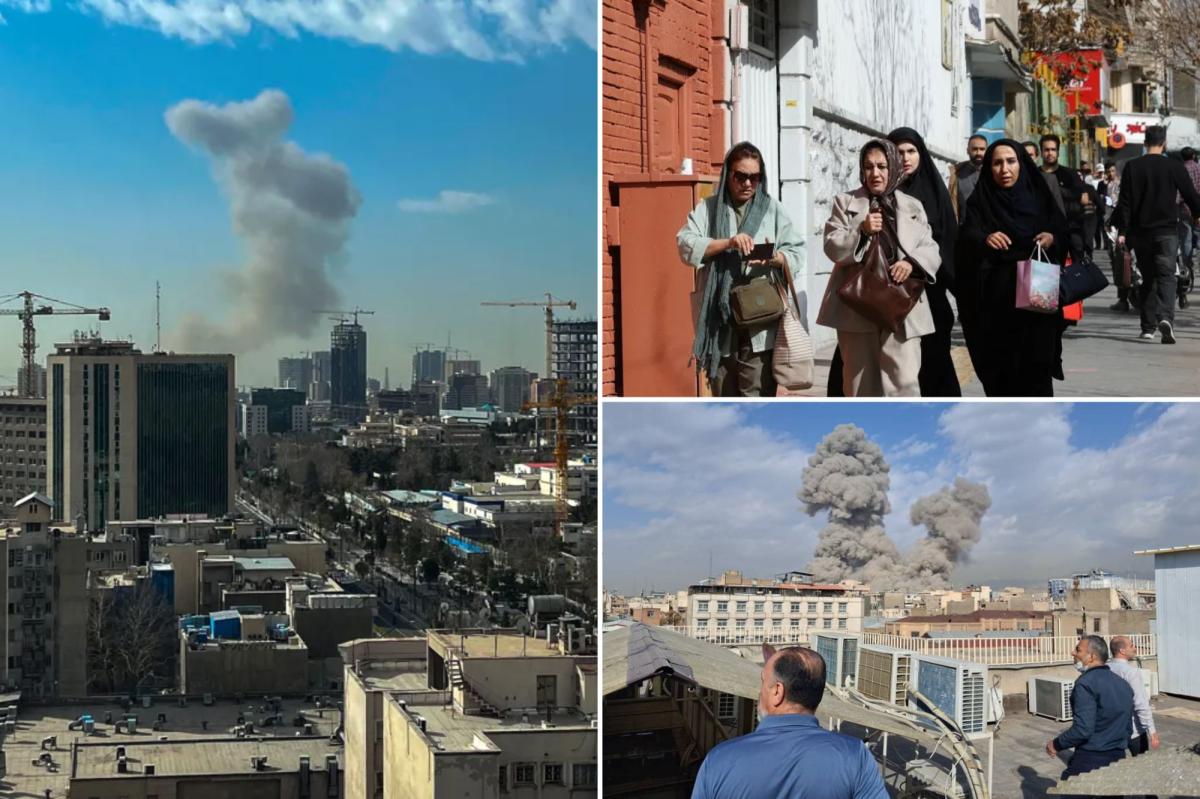


In a decisive move early Saturday, the United States and Israel conducted airstrikes on Iran, marking a significant escalation after protracted negotiations failed to dismantle the country’s nuclear program. This military action follows a substantial buildup of U.S. forces in the Middle East, underscoring the seriousness of the situation.
President Trump had consistently issued warnings to Tehran, emphasizing that refusing to reach an agreement with the U.S. would result in severe repercussions. This message was reinforced in an eight-minute video address on Saturday where Trump articulated the rationale behind the strikes.
“Our primary goal is to protect American citizens by neutralizing imminent threats posed by the Iranian regime,” Trump declared. He highlighted the ongoing danger, stating, “Iran’s hostile activities pose direct risks to the United States, our military personnel, our overseas bases, and our allies worldwide. For nearly half a century, the Iranian leadership has chanted ‘Death to America’ and pursued a relentless campaign of violence and terror targeting both the U.S. and innocent civilians globally.”
Compounding the tension, a source informed Reuters that Iran’s supreme leader, Ayatollah Ali Khamenei, was relocated from Tehran to a secure location, indicating heightened security concerns.
As of now, the full impact and scope of the U.S. and Israeli offensive remain uncertain, leaving the international community on edge as it awaits further developments.
The full extent of the American assault on Iran remains unclear.
Airstrikes were also reported in other enclaves, including Isfahan, Qom, Karaj and Kermanshah.
The ongoing US strikes were launched by air and sea with an official describing them as “not a small strike,” CNN reported.
The American attacks were targeting military infrastructure to reduce the Iranian threat to military personnel.
Israeli military officials were prepared for the “initial phase” to last over several days, with the first strikes taking place during the day as a surprise to Iran, Israel’s Channel 12 reported.
Neighboring Iraq closed its airspace after the daylight attack began.
Iranian officials claimed the regime was preparing for retaliatory strikes and that the “response will be crushing.”
Sirens sounded throughout Israel as a “proactive” measure alerting the public of a potential retaliatory strike, the IDF announced.
US Israeli ambassador Mike Huckabee warned Americans to prepare for possible airstrikes.
“We are encouraging all Embassy team & families & US citizens in Israel to be prepared for Home Front Command alerts & sirens. Stay near shelters & take immediate action at the sound of alerts or sirens,” Huckabee wrote on X.
Israel also suspended public activity, declaring only “Emergency Activity” going into effect, prohibiting education, work, and social gatherings.
Trump had reportedly been weighing options ranging from a limited strike to pressure Iran into a deal to a military campaign aimed at killing Supreme Leader Ali Khamenei and his son, Mojtaba, who is viewed as a possible successor.
The president had given the Iranian officials a 10-15 day deadline to reach an agreement on a nuclear deal on Feb. 19, asserting the regime would face “really bad things” if it didn’t.
The warning came after days of indirect negotiations in Geneva, Switzerland, between US Special Envoy Steve Witkoff and the president’s son-in-law, Jared Kushner, and Iranian Foreign Minister Abbas Araghchi. The discussions were mediated by Oman.
Trump has long insisted that he would not accept a deal that would allow Iran to continue to enrich uranium, fearing the regime would use it to build a nuclear weapon.
Tehran insists it is only seeking to enrich uranium for civilian purposes.
The US assault marks the first American-led strikes against the Islamic Republic since Operation Midnight Hammer last June, which targeted the Fordow Uranium Enrichment Plant, the Natanz Nuclear Facility and the Isfahan Nuclear Technology Center.
The US Air Force B-2 Spirit stealth bombers battered the facilities with “bunker buster” bombs, while the Navy fired sea-based Tomahawk missiles in the successful strike.
Amid the latest back-and-forth with Iran, Trump deployed two powerful carrier strike groups to the Middle East.
The USS Gerald R. Ford aircraft carrier entered the Mediterranean Sea on Feb. 20, joining the USS Abraham Lincoln in the Middle East.
A dozen Navy destroyers and three littoral combat ships are also believed to be accompanying the nuclear-powered carriers.
The US also moved more than 50 fighter jets as part of the military buildup, according to Axios.
The airfleet includes F-16 Falcons, F-22 Raptors and F-35 jets, according to independent flight trackers.
The latter jets have stealth capabilities, allowing them to strike Iran without being detected by the nation’s air defenses.
The jets joined other warplanes that had been deployed to Jordan, the United Arab Emirates, and Saudi Arabia in recent weeks.
Ahead of the assault, Iran vowed that it would retaliate against American troops in the region if the US were to launch a strike.
Tehran attacked Al Udeid Air Base in Qatar last year in response to Operation Midnight Hammer. There were no US casualties in that attack.
Earlier this year, Trump weighed military action against Iran over a deadly crackdown on anti-regime protesters, who have been calling for change over the country’s ailing economy.
The regime killed as many as 30,000 protesters, according to some estimates, as it clamped down on dissent and demands for regime change.
With Post wires
This is a developing story. Please check back for updates.