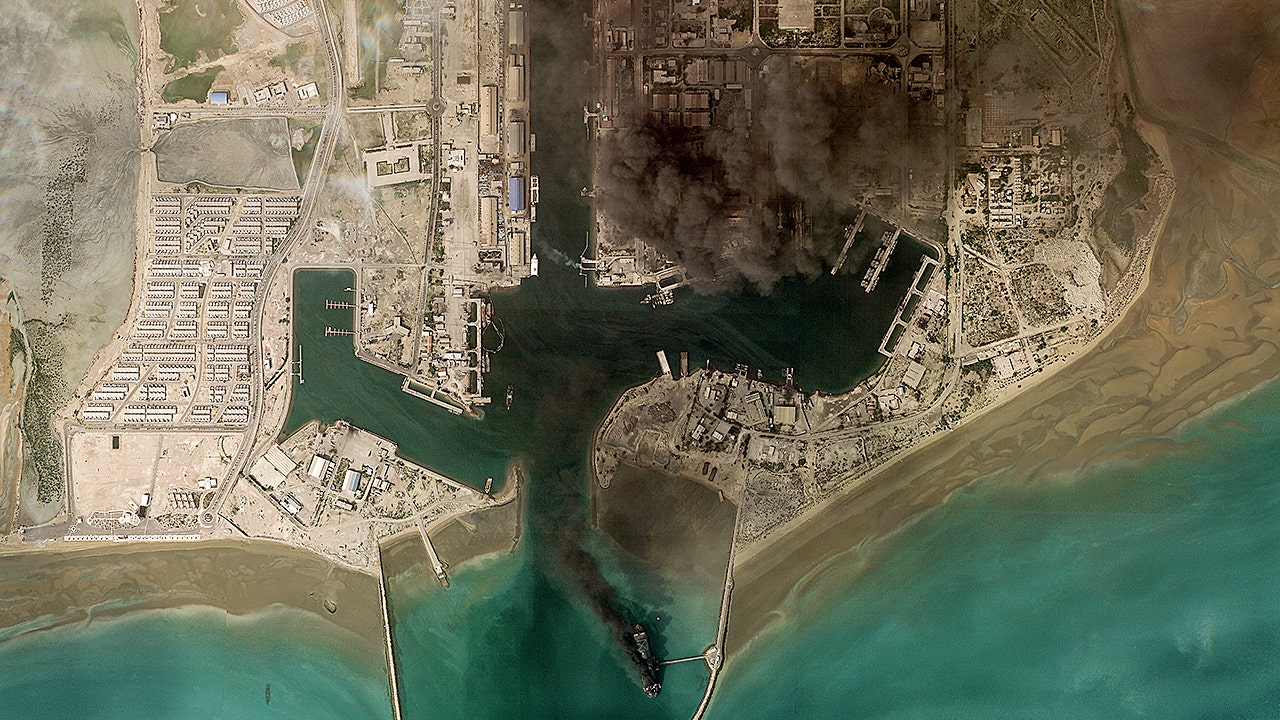

On Monday, satellite imagery unveiled intense fires and massive clouds of black smoke billowing from Bandar Abbas, the principal naval base of Iran, with at least one ship engulfed in flames following an assault.
These images, provided by Planet Labs, surfaced shortly after the United States and Israel initiated precise strikes against Iran. This development also preceded President Donald Trump’s statement, where he mentioned he wouldn’t dismiss the possibility of deploying U.S. troops to Iran if deemed “necessary” in the context of Operation Epic Fury.
This situation has led to a significant disruption in the commercial tanker traffic across the Strait of Hormuz, as reported by the maritime intelligence company Windward AI.
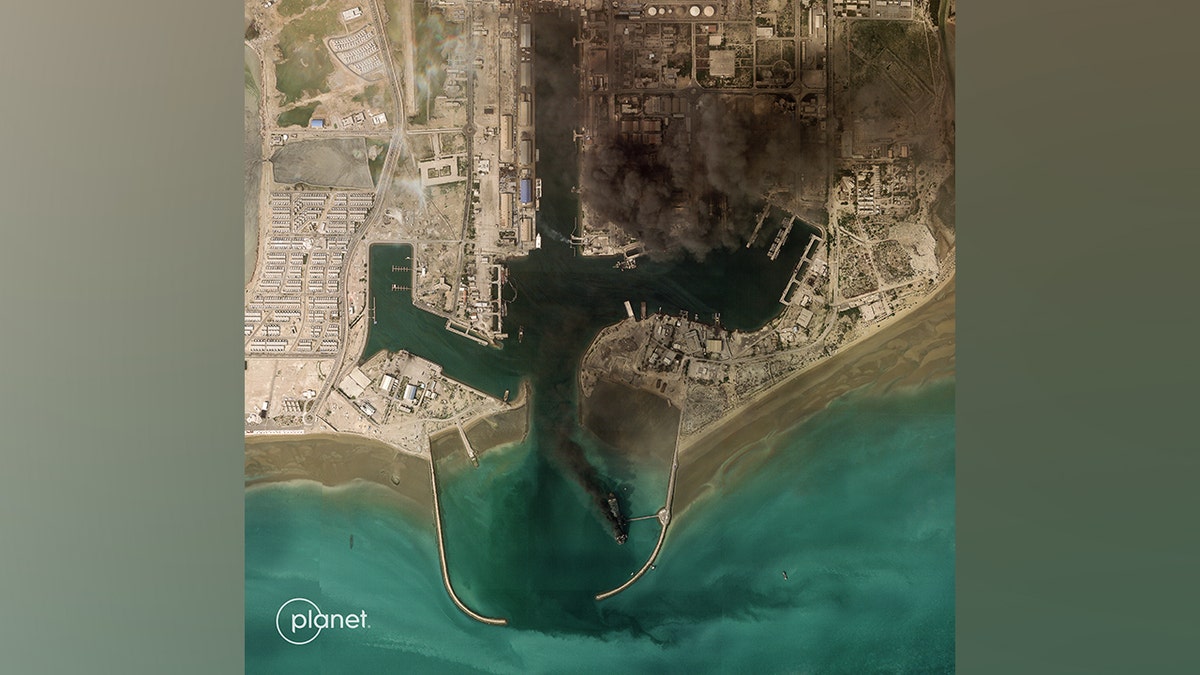
Fires engulf Iran’s primary naval base at Bandar Abbas (PLANET LABS)
As per the Times of Israel, a commander from Iran’s Revolutionary Guards (IRGC) declared that the Strait of Hormuz had been shut on Monday, with Iran threatening to ignite any vessel attempting passage.
However, Fox News National Security Correspondent Jennifer Griffin, referencing CENTCOM, confirmed that the Strait of Hormuz remains operational.
A senior U.S. military official said Iran is neither patrolling nor enforcing its claimed “closure,” and there has been no evidence of mines in the waterway. However, commercial vessels are navigating the area cautiously.
The official noted this is not the first time Iran has announced plans to close the strait, describing the move as a “pressure tactic” intended to stoke fear. The official added that Tehran is unlikely to mine the waterway, given that roughly 80% of its oil exports are shipped to China.
Bandar Abbas, the capital of Hormozgan Province, occupies a key position along the Strait of Hormuz and the port is a key base serving as the headquarters of the Iranian Navy.
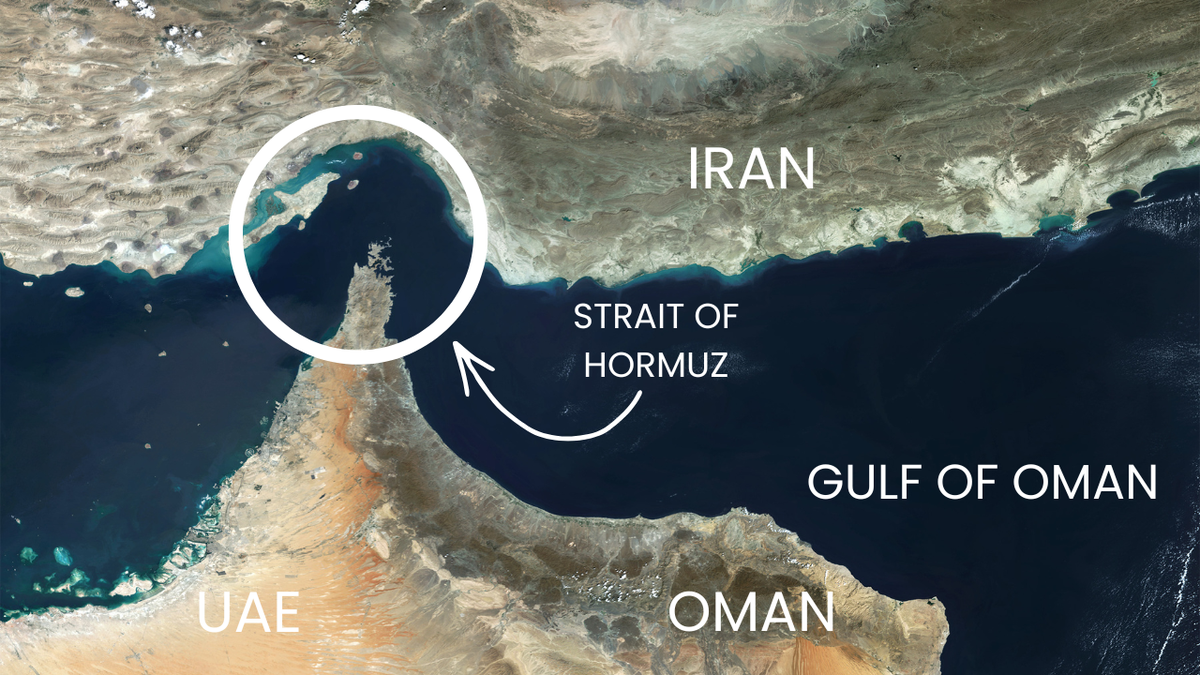
A satellite view of the Strait of Hormuz, a critical chokepoint for global energy supply, connecting the Persian Gulf to the Gulf of Oman. (Gallo Images/Orbital Horizon/Copernicus Sentinel Data 2025/Amanda Macias/Fox News Digital)
“As of 10:56 a.m. GMT on March 2, 2026, the Port of Bandar Abbas is experiencing multiple active fires, including one aboard a berthed vessel, while maintaining a significant combined military and commercial presence at port facilities,” Windward AI reported.
“Three distinct fires are currently reported in the vicinity. Two are located at port infrastructure facilities, and one involves a vessel currently at berth.”
Seventeen military vessels and five commercial ships remained docked despite the fires, the firm said, noting that the continued military concentration suggests “a heightened defensive posture rather than evacuation.”
Windward warned that active fires at Iran’s principal naval and commercial port introduce “additional operational uncertainty” and raise the risk of secondary maritime disruption across the Gulf.
Video footage also shared by Iran International appeared to show an attack targeting Iranian naval air facilities in Bandar Abbas.
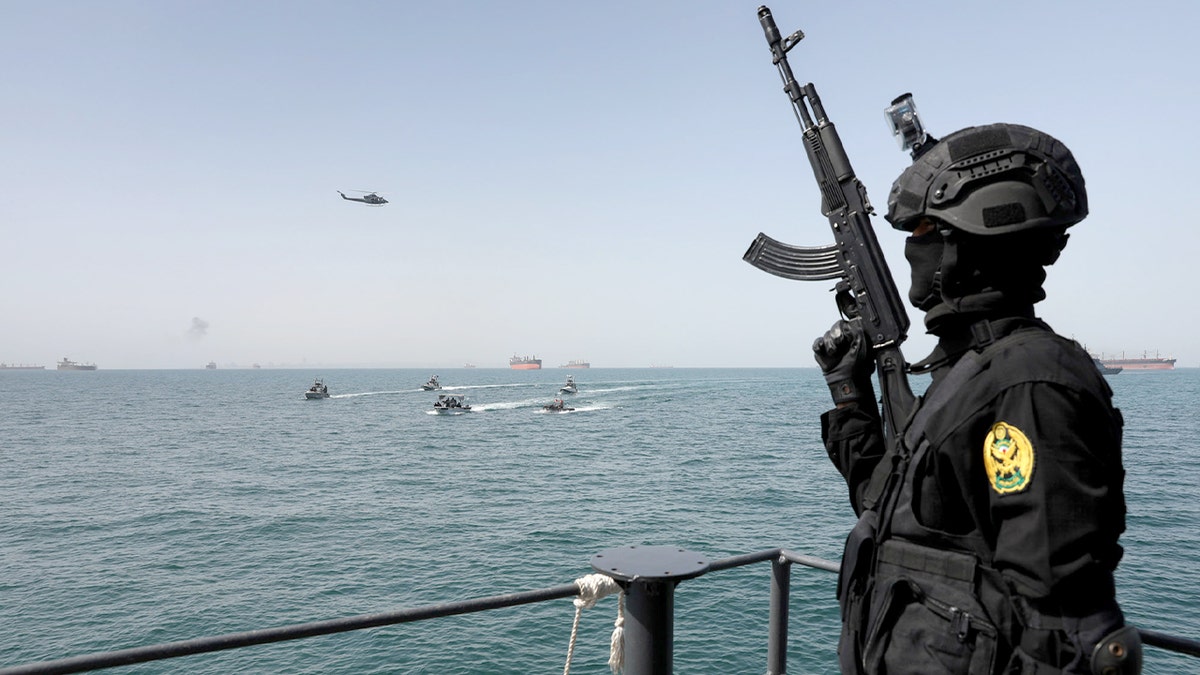
Naval units from Iran and Russia simulate the rescue of a hijacked vessel during joint drills at the Port of Bandar Abbas in Hormozgan, Iran, on Feb. 19, 2026. (Iranian Army/Handout/Anadolu via Getty Images)
Satellite imagery analyzed by BBC Verify identified a damaged vessel about 230 meters (750 feet) long — consistent, it said, with a Makran-class forward base ship operated by the Iranian Navy.
The Makran, a converted tanker measuring about 228 meters, is also a mobile maritime base and helicopter carrier capable of deploying up to five helicopters and fast-attack boats.
The strike at Iran’s naval HQ came on the third day of open conflict, with U.S. Central Command saying it had sunk 11 Iranian vessels in the Gulf of Oman.
“Two days ago, the Iranian regime had 11 ships in the Gulf of Oman, today they have ZERO,” CENTCOM said on X.
Trump has said “annihilating” Iran’s naval forces is a core objective of Operation Epic Fury, and that the U.S. has destroyed nine Iranian naval ships so far.
Related Article