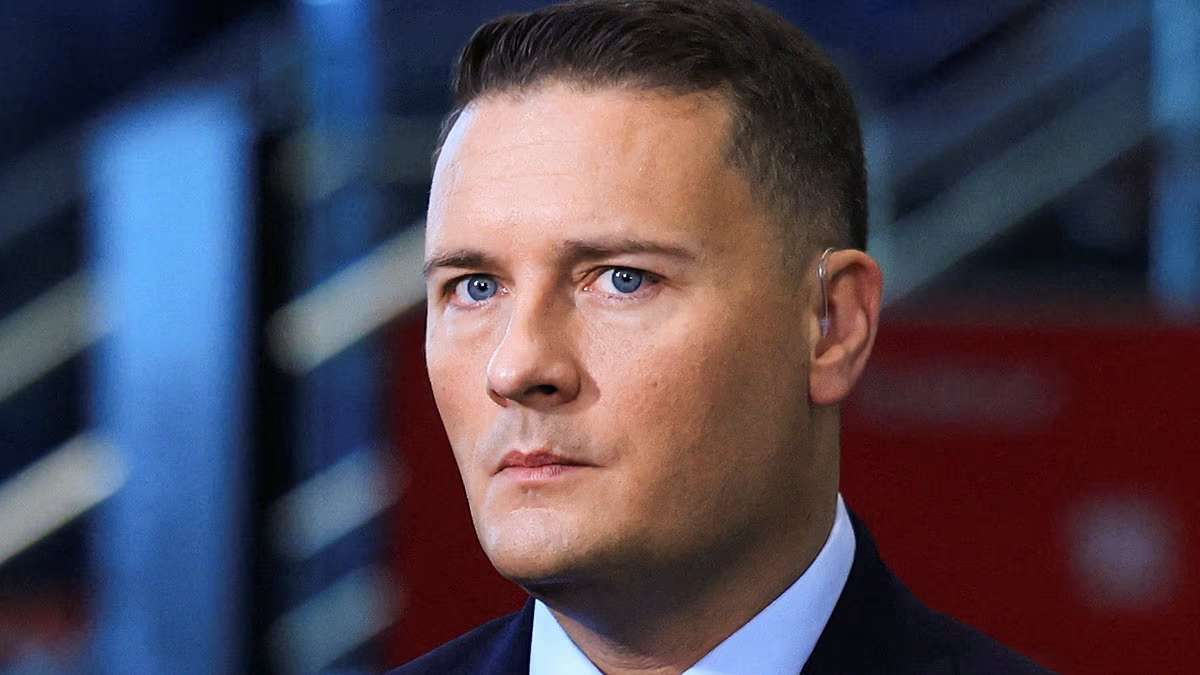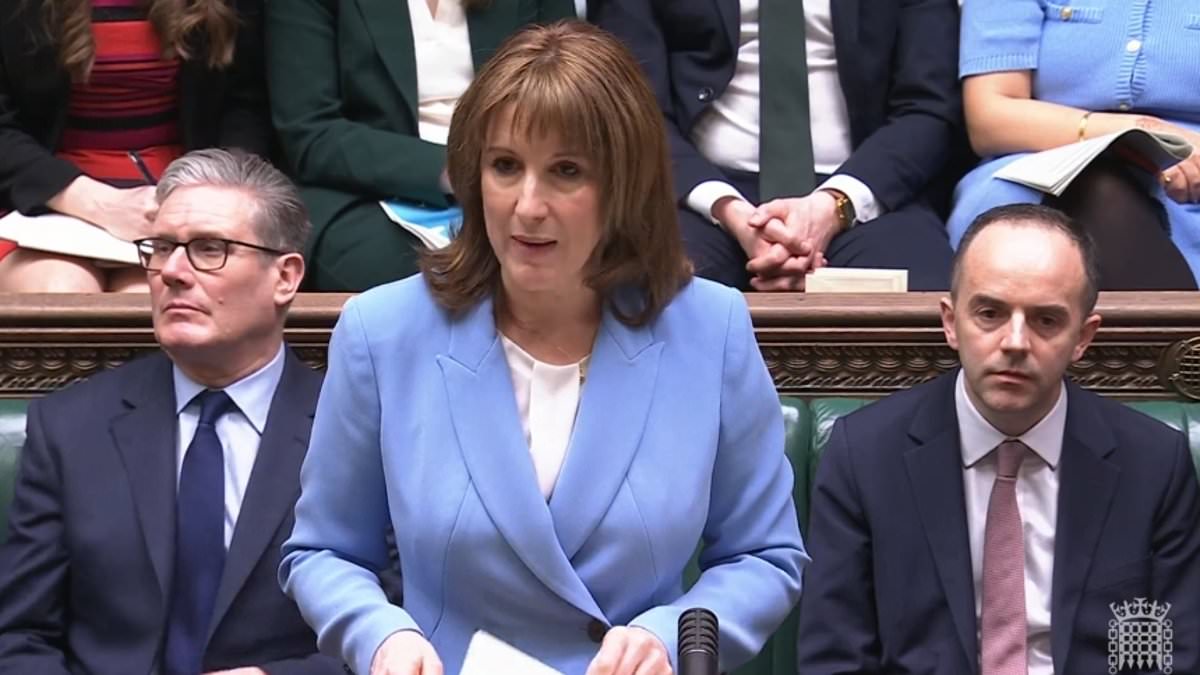

Rachel Reeves asserted today that Labour’s agenda remains steady, despite potential economic disruptions from the Middle East situation.
The Chancellor is set to present her Spring Statement in the Commons, amid growing concerns about the UK’s economic performance.
She emphasized that the government has devised the ‘right plan for the country,’ noting that decreasing inflation and interest rates are helping to increase disposable income for citizens.
However, Ms. Reeves acknowledged that the independent Office for Budget Responsibility has significantly reduced the growth forecast for this year from 1.4 percent to 1.1 percent. She added that unemployment is expected to reach its peak in the near future.
This announcement comes as fears rise over the escalating conflict in the Middle East, which is already causing oil and gas prices to surge. There are warnings today that the energy price cap might see a significant rise in July, alongside early signs of panic buying at fuel stations.
Even prior to these recent upheavals, official statistics indicated a decline in wealth for UK citizens, with GDP per capita falling for six consecutive months at the end of last year.
But Ms Reeves claimed that falling immigration meant that metric would rise by 5.6 per cent over the Parliament.
With the government making clear there will be no big moves on tax or spending this afternoon, all eyes will be on the forecasts from the OBR.

Chancellor Rachel Reeves is unveiling her Spring Statement in the Commons, with mounting questions over the performance of UK plc
The Treasury watchdog has followed the Bank of England in downgrading growth, with global instability and the impact of Labour’s massive tax raids weighing heavily on activity.
At the start of February, the Bank trimmed its estimate for expansion in 2026 to 0.9 per cent from 1.2 per cent, and to 1.5 per cent from 1.6 per cent for 2027.
Ms Reeves said that the OBR had delivered her some solace by nudging up the estimate for 2027 from 1.5 per cent to 1.6 per cent.
The watchdog has forecast 1.6 per cent for 2028 and 2029, marginally above the 1.5 per cent previously pencilled in.
The OBR could also cause Ms Reeves major headaches by lowering predictions for tax revenues, and pencilling in higher unemployment levels.
Falling immigration – regarded as good news politically for Labour – could ironically put more strain on the public finances.
The independent body will also put price tags on some of the embarrassing U-turns executed by Sir Keir, including on the farms tax and business rates increases.
Although the OBR will not make a formal assessment of whether Ms Reeves is on track to meet her fiscal targets, analysts will be able to extrapolate how the figures stand.
Ms Reeves said the ‘headroom’ for hitting her main target had been upgraded from £21.7billion to £23.6billion in 2028-29.
Hints have been coming out of the Treasury that Ms Reeves is desperately looking for ways to ease the burden come the election.
However, the Iran crisis could blow another huge hole in the government’s plans.
Former chancellor Jeremy Hunt said the Treasury’s rule of thumb was that a 20 per cent increase in global oil and gas prices would mean a 1 percentage point rise in UK inflation, and 0.5 percentage points off economic growth.
The Government has promised to restrict itself to one ‘fiscal event’ a year for tax and spending policies – the Budget in the Autumn.
The Chancellor told MPs this afternoon: ‘This Government has the right economic plan for our country… in a world that has become yet more uncertain.
‘Stability in the public finances, investment in infrastructure and reform to our economy.
‘Building growth not on the contribution of a few people or a few parts of the country, but in every part of Britain with a state that doesn’t stand back, but steps up.’
Ms Reeves added: ‘Because of the decisions we have already taken, we have a stronger and more secure economy. Inflation and interest rates falling. And in every part of Britain, working people are better off.’

Chancellor Rachel Reeves is unveiling her Spring Statement with mounting questions over the performance of the economy
Join the debate
Do YOU feel better off than a year ago?

The OBR is seen as almost certain to follow the Bank of England in downgrading growth. Pictured, the watchdog’s forecasts from November

The price per therm of natural gas touched 170p today – compared to the 78p the OBR expected it to average over the coming years

The OBR forecasts for oil and gas prices (pictured, the November outlook) could be smashed if the tumoil continues in the Middle East
Despite Ms Reeves’ positive tone, polling for the More in Common think-tank suggested voters remain gloomy about their own economic prospects.
The study found that 58 per cent of voters fear the cost of living crisis may never end, while a further 23 per cent do not think it will end this year.
The poll also found that Labour is losing the support of voters most concerned about the costs of living.
Overall, the party is holding on to 54 per cent of those who backed Labour in 2024. But the figure falls to just 38 per cent who fear the Chancellor will never get to grips with rising prices.