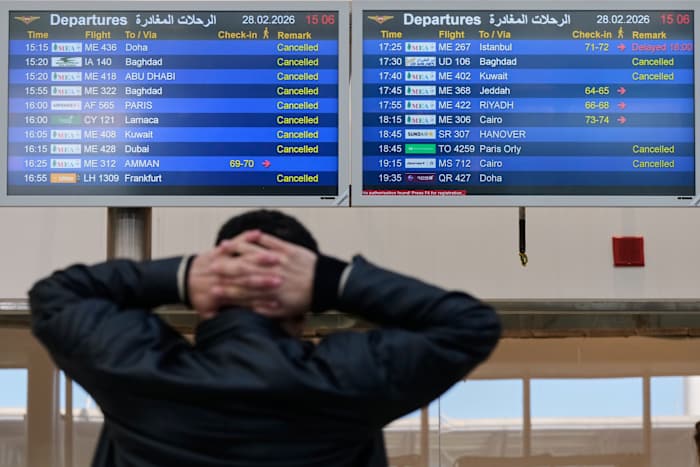


NEW YORK – The collaborative military efforts of the U.S. and Israel against Iran have already caused significant disruption in Middle Eastern travel, leaving tens of thousands of travelers in limbo. The outlook remains unpredictable.
Experts warn that the travel chaos could persist in the coming days and weeks, with potential global repercussions, as the conflict expands and retaliatory actions occur in Gulf states. Airports in this region are vital transit points for passengers traveling to Europe, Africa, and Asia, thereby affecting international travel networks.
With the closure of airspace in the affected areas, airlines are compelled to either cancel flights or reroute, leading to increased operational expenses and potentially higher ticket prices. Rising fuel costs, driven by the prolonged conflict, could exacerbate these challenges. Experts suggest deferring non-essential travel, reviewing refund or insurance options, and staying updated on safety advisories.
“This situation goes beyond typical delays; it’s about navigating airspace in a conflict zone,” explained Hassan Shahidi, president and CEO of the Flight Safety Foundation. He emphasized that flight operations, along with directives from airlines, airports, and governments, could shift rapidly. “Travelers should brace themselves for unpredictability.”
Here’s what travelers need to know for their upcoming journeys.
Stay informed with advisories and safety updates.
Since the U.S. and Israel launched attacks over the weekend, retaliatory strikes and other developments have unfolded rapidly. Iran says hundreds of people have been killed in the country. For travelers across the region, experts stress the importance of following safety guidance and updates from government officials.
A handful of governments have also issued travel advisories and emergency evacuation orders. The U.S. State Department on Monday urged all U.S. citizens to immediately leave Iran and Israel, as well as Qatar, Bahrain, Egypt, Iraq, Jordan, Kuwait, Lebanon, Oman, the Palestinian territories, Saudi Arabia, Syria, the United Arab Emirates and Yemen using any available commercial transportation — and Secretary of State Marco Rubio pleaded for the media to publicize ways to help Americans evacuate. Meanwhile, countries like China, Italy, France and Germany moved to organize evacuation efforts for their citizens.
Experts like Shahidi say travelers should monitor these travel advisories from governments and embassies to make sure they have the latest information. And because so many people are still stranded amid swaths of cancellations and airspace closures, he added that it’s wise to reconsider or rebook upcoming trips, if possible.
“If travel is optional, consider postponing it,” Shahidi said. “But if it’s necessary, then make sure that you get refundable or changeable fares.”
Travelers should also monitor updates from airports and airlines. Long-haul carriers Etihad Airways and Emirates, based in Abu Dhabi and Dubai, along with Doha-based Qatar Airways all temporarily suspended certain routes — citing airspace closures and safety requirements.
Read the fine print of refunds and insurance
Many airlines are taking refund requests or offering free rebooking — but such options are often limited to specific dates or routes, so it’s important for travelers to check carriers’ individual websites for more information. For future trips, buying refundable tickets now may provide more flexibility.
Beyond what individual airlines can offer, some may also be seeking travel insurance. But it’s important to read the fine print, particularly the exclusions listed under specific policies.
“Acts of war and civil unrest are typically excluded because they’re unpredictable,” said Suzanne Morrow, CEO of travel insurance agency InsureMyTrip. Consumers could still buy coverage for delays, she added, but travel insurance is “designed to make you whole,” and if an airline does everything to rebook you or offers a refund, you may not have an added claim.
Christina Tunnah, of World Nomads Travel Insurance, reiterates that the majority of her firm’s policies excludes coverage for losses resulting from acts of war, although someone might be able to get compensation in certain scenarios — such as if they purchase a “cancel for any reason” plan. Still, the traveler would have to cancel within a certain time frame.
Tunnah adds that once an event is known, it’s unlikely to be covered. So if a consumer has not already purchased traveler insurance, many insurers may have added restrictions to impacted destinations.
Brace for longer flights and higher ticket prices
Beyond cancellations, many carriers are now taking longer routes to avoid closed airspace. Shahidi noted that includes not only closures stemming from this current war but also previous conflicts worldwide.
Navigating these different conflict zones has become increasingly difficult for airlines, because longer routes can be more expensive. It’s industry standard for carriers to pay “overflight fees” when flying through other countries’ airspace — which there could be more of now. And, of course, longer flights need more fuel.
“Those costs will be passed on to the passengers,” explained Bryan Terry, managing director at Alton Aviation Consultancy. If the conflict continues, he said, travelers should “anticipate that some carriers will likely impose fuel surcharges” or increase existing fees.
Passengers have already reported seeing sky-high ticket prices. Experts say those immediate hikes more likely reflect supply and demand as thousands of flights were canceled in recent days. But the costs of those longer routes — paired with oil prices that have already spiked since the U.S. and Israel launched their attacks — could trickle down to consumers further ahead.
The price of crude oil is a key component for jet fuel, which accounted for about 30% of airlines’ operating costs as of 2024, according to research from the International Air Transport Association.
Many routes within the next week are completely sold out or have exorbitant prices for last remaining seats. The market currently shows those costs, while still elevated, are lower for trips booked further out, Terry notes — but, again, if the war drags on or worsens, “those conditions could change at a moment’s notice.”
Copyright 2026 The Associated Press. All rights reserved. This material may not be published, broadcast, rewritten or redistributed without permission.