

WASHINGTON – President Donald Trump views the Kennedy Center as a “tired, broken, and dilapidated” edifice desperately needing refurbishment. Meanwhile, to artists like Jane Fonda and Billy Porter, it serves as a venue for protest, symbolizing the administration’s attempts to alter the cultural landscape of the nation.
For the new management at the Kennedy Center, however, the structure represents a colossal challenge, plagued by water damage so extensive that in some areas, the steel has become alarmingly thin.
Away from the political debates surrounding this iconic performing arts hub during much of Trump’s latter term, the Kennedy Center’s newly appointed executive director and chief operating officer, Matt Floca, led journalists on a tour Wednesday. They explored the outdoor terrace with its sweeping view of the Potomac River, as well as the parking decks, loading docks, an electrical vault, and the Opera House stage.
Throughout the tour, a consistent issue surfaced: the reality of water damage was undeniable, visible in the form of discoloration and pooling. Some of the center’s equipment, including several aging 800-ton chillers crucial for cooling the building, is long overdue for replacement.
The building’s sheer scale, stretching over 1.5 million square feet, means these repairs are not only significant but also time-consuming.
In fact, completing these repairs will take a full two years.
Trump plans to shutter the building for a massive renovation slated to begin in July, supported by nearly $257 million provided by Congress to fund repairs. The institution is expected to turn to private donors to help support refurbishing some of the building’s more exclusive areas, such as lounges.
The Kennedy Center is hardly the first fixture of the Washington skyline to undergo lengthy renovations. The Smithsonian Castle, one of the most recognizable buildings along the National Mall, has been closed for renovations since 2023. The Washington Monument was shrouded in scaffolding from 1998 to 2001 and covered again at points in 2013 and 2014 to repair earthquake damage.
None of those changes, however, were guided so closely by a sitting president.
Trump, who is also trying to build a ballroom on the grounds of the former East Wing of the White House and is pushing for the construction of a triumphal arch near Arlington Cemetery, is deeply involved in the Kennedy Center plans. That’s in line with the far more hands-on approach he’s taken to the institution during his second term, ousting its previous leadership and replacing it with a handpicked board that named him chairman.
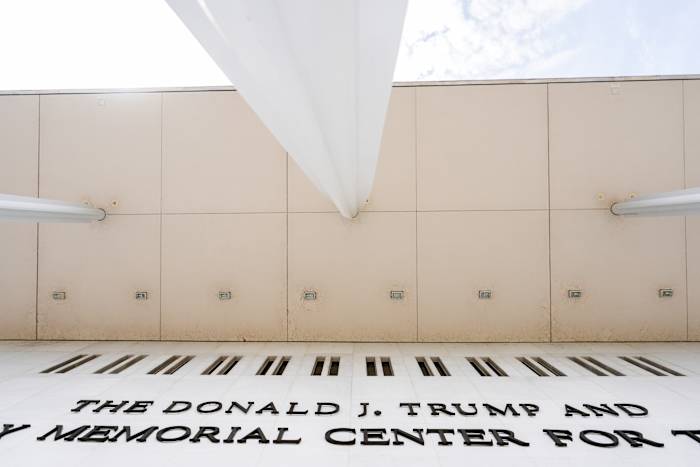
His name is now bolted to the building’s facade along with that of John F. Kennedy, the slain president that the venue memorializes.
“It’s a public building, and I completely acknowledge that, but the president is really great at this, and I think his input is invaluable,” Floca said. “He’s in the details, and it’s amazing. I really respect the input he’s given.”
As Trump tightened his grip on the building, artists abandoned the institution in droves, prompting concern that the closure is more of an effort to cover for plunging sales. The Kennedy Center hasn’t released sales figures.
Still, the tour offers the institution something of a reset opportunity after more than a year of tumult, demonstrating the need for repairs while easing some fears. A bipartisan group of lawmakers and their staff, along with representatives for Washington Mayor Muriel Bowser and some corporate and individual donors, have received a similar walk-through.
For example, there will be scaffolding around the building but the construction won’t be so dramatic that someone could see through the building. That’s notable considering Trump has suggested the steel supporting the structure could be “ fully exposed.”
It’s not entirely clear how much change will be apparent to the general public once the Kennedy Center reopens. Much of the structural repairs, which will unfold during the renovation’s first year, will happen in the building’s private core.
The venue’s more public elements, including the red-on-red decor of the Opera House, are expected to be maintained, though with some updating. There aren’t plans at the moment to change the presidential boxes.
Quotes attributed to Kennedy will stay on the building’s walls and the famous bust of the former president that sits outside the Opera House will be there again when the building reopens.
“I can’t think of any JFK changes,” Floca said.
It’s unclear, however, whether additional tributes to Trump, who will by then be in the final months of his presidency, when the public can return to the building, will join Kennedy.
Copyright 2026 The Associated Press. All rights reserved. This material may not be published, broadcast, rewritten or redistributed without permission.