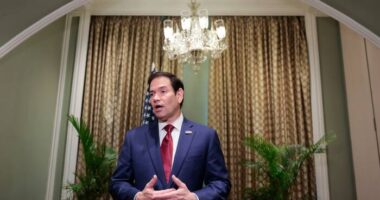


The U.S. Postal Service (USPS) is on the brink of a financial crisis, potentially running out of funds within the next year unless Congress intervenes to lift a long-standing borrowing cap. This urgent warning comes from the newly appointed Postmaster General, David Steiner, who recently shared these concerns in an interview.
Steiner painted a grim picture of the future if legislative action is not taken. By February 2027, the USPS could face severe financial difficulties, struggling to pay both its employees and vendors, which could severely disrupt mail delivery nationwide. “How long are employees going to work and vendors going to show up if we’re not paying them?” Steiner questioned during the discussion.
This warning comes ahead of Steiner’s scheduled testimony before Congress later this month, where he plans to address the Postal Service’s financial plight. A key point in his argument is the pressing need to revise outdated regulations, including the $15 billion borrowing cap that has been in place since 1990, which he believes is constraining the agency’s financial flexibility.
Operating as an independent agency, the USPS relies primarily on its revenue from postage and services. Steiner highlighted the unique challenges faced by the Postal Service, which operates under the obligations of a government entity, such as the mandate to deliver mail six days a week to every address, yet does not receive the benefits of federal budget appropriations.
“We have to have a conversation with the American public,” Steiner emphasized. “If you want us to deliver everywhere, every day, we’ll do it. That’s not a problem. But who is going to pay for it?” This poignant question underscores the critical need for a sustainable funding solution to ensure the continued operation of this vital service.
“We have to have a conversation with the American public,” Steiner said. “If you want us to deliver everywhere, every day, we’ll do it. That’s not a problem. But who is going to pay for it?”
Steiner, a former CEO of the nation’s largest waste management company and a former member of the FedEx board of directors, took over the struggling Postal Service last July. He said raising the borrowing limit is the easiest thing lawmakers can do immediately to help the agency.
“That will buy us the time to make the fixes we need to make, and we can sail on down the road,” he said.
He has called for expanding the service’s revenue base, including extending its last-mile delivery service to more entities. Last-mile delivery refers to the final step of getting a package from a local distribution center to a customer’s door, the most labor-intensive part of the delivery process.
USPS’s net losses for the 2025 fiscal year totaled $9 billion, even though total operating revenue increased by $916 million or 1.2%, due largely to its Ground Advantage shipping service. Net losses in fiscal year 2024 were $9.5 billion.
Ultimately, other changes are needed, as well, Steiner said, including giving the Postal Service authority to raise postage prices high enough to cover losses. He said increasing the price of a first-class stamp to 95 cents, from today’s 78 cents, would be enough to “fix” the Postal Service’s fiscal woes. A decade ago, a first-class stamp was 47 cents.
But he said an independent agency created by Congress to oversee the Postal Service won’t allow it, he said.
“If the Postal Regulatory Commission adopted our pricing model, problem solved,” he said, adding how the package delivery side of the business could then subsidize the mail side.
Steiner and other Postal Service officials also have called for reforms to its pension and retiree health benefit obligations, including the ability to invest the money in something other than Treasury bills.
Multiple postmaster generals over the past two decades have repeatedly asked Congress or regulators to change the various rules governing the Postal Service. In 2022, Congress did pass the Postal Service Reform Act, which ended a requirement that the agency prefund its retiree health benefits, but it left other constraints intact.
Meanwhile, the Postal Service has seen annual volume plummet from about 220 billion pieces to about 110 billion today as more people pay bills and communicate online.
“Take those 110 billion and put a 78-cent stamp on them. That’s $86 billion of revenue that evaporated in 15 years,” he said. “If either FedEx or UPS lost $86 billion of revenue, they would have no revenue.”
But instead of helping the Postal Service, Steiner said regulators and Congress have imposed costly mandates.
“I like to say we sort of got thrown overboard on a ship into the cold water, right? And instead of throwing us a life preserver, we get thrown an anchor,” he said.
Calls on Thursday to some members of Congress who oversee the Postal Service were not immediately returned.
Steiner acknowledged he didn’t realize the depth of the Postal Service’s cash crunch until he took the postmaster general job last year.
“Interestingly, I’m not sure some of the people at the Postal Service realized how dramatic it was,” he said.
Copyright 2026 The Associated Press. All rights reserved. This material may not be published, broadcast, rewritten or redistributed without permission.