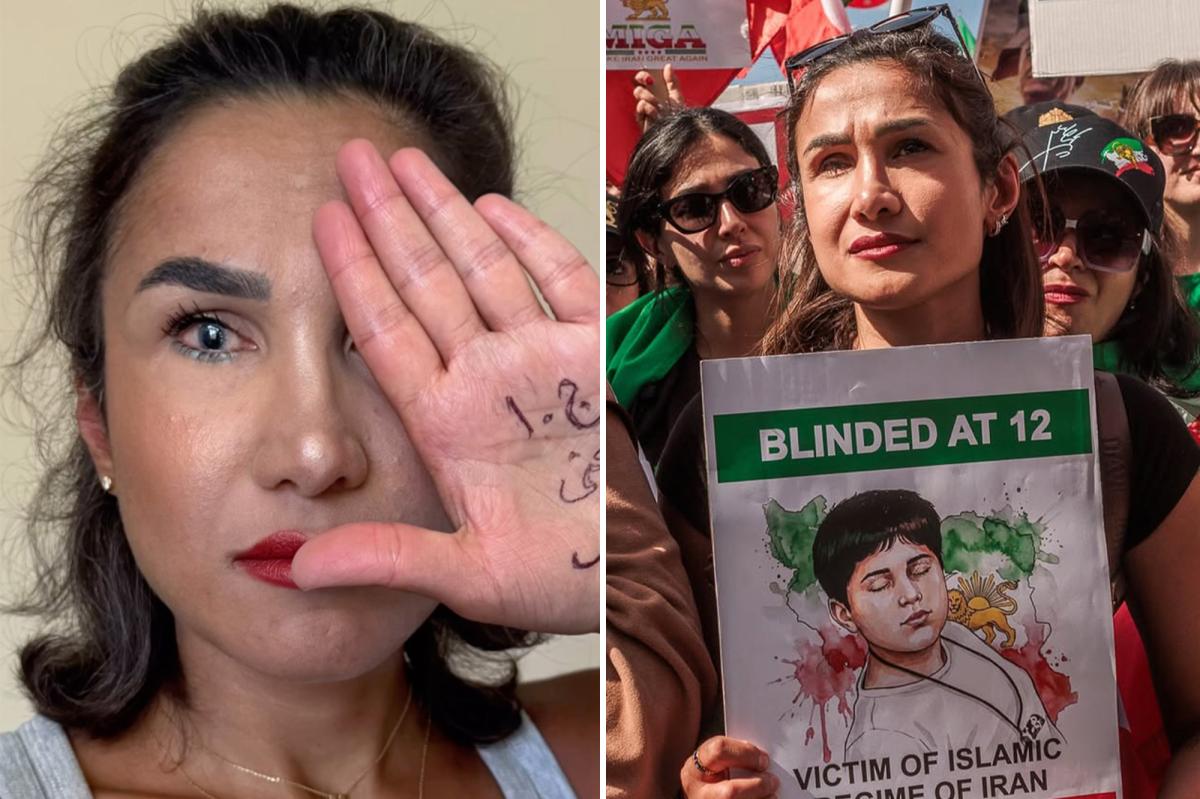


An Iranian woman, who lost an eye after being shot by Iran’s Revolutionary Guard during the 2022 “Woman, Life, Freedom” protests, has expressed strong criticism of former Vice President Kamala Harris’s reaction to recent bombings in Iran.
Mersedeh Shahinkar, a California-based mother and activist, still bears the physical and emotional scars from the harsh suppression of anti-government protests by the Islamic Republic.
In an interview with the California Post, Shahinkar shared her thoughts on fellow activist Masih Alinejad’s recent appearance on Fox News. Alinejad had criticized Harris for her comments regarding former President Donald Trump’s handling of the deadly U.S.-Israeli airstrikes on Iran.
“I am exhausted by politicians in America, particularly Democrats, who seem to use these situations for their own political gain, like Kamala Harris,” Alinejad remarked pointedly.
Harris had recently issued a statement condemning the attack as “a war the American people do not want,” following the death of Iran’s Supreme Leader Ali Khamenei and 40 senior security and regime officials in a fortified compound.
“To be clear: I oppose a regime-change war in Iran, and our troops should not be endangered by what I view as Trump’s war of choice,” Harris stated.
Shahinkar said many Iranians feel Western politicians have repeatedly failed to support the country’s pro-democracy movement.
“For many years, we tried peaceful and democratic ways to demand change, or at least reform,” Shahinkar said.
She added those were the same methods Western politicians often urge activists to pursue.
“The same methods that some members of the Democratic Party and leftists are now teaching us,” she continued.
“But I ask them: Where were you?”
Shahinkar pointed to mass protests that swept Iran earlier this year.
“Where were you when more than 30,000 people were slaughtered in early 2026, when millions of people went to peaceful protests with their children in 300 cities across Iran?” she said.
Those demonstrations, she noted, had been called by exiled Iranian opposition figure Reza Pahlavi —adding that members of the Iranian diaspora tried to draw attention to the unrest.
“Since January 8, we in the Iranian diaspora have left thousands of comments and messages on their accounts,” Shahinkar said, referring to Kamala Harris and former presidents Joe Biden and Barack Obama.
“We respectfully begged them to raise their voices for innocent children and young people whose internet access was cut off by the regime.”
Shahinkar said those appeals were largely ignored.
“They did not even say a word of sympathy to maintain their mask of humanity,” she explained.
“Every time we see a flash, a glimmer of hope of people longing for freedom, I think we have to point it out. We have to shine a spotlight on it. We have to express some solidarity about it,” added Shahinkar.
Later in the interview, she addressed Western anti-war messaging.
“Yes, ‘No War’ is a good slogan,” she said. “No one loves war in the world.”
But she argued the slogan overlooks the violence Iranians experience under the regime.
“Where were you when we were shot in our eyes and faces?” she said.
“When they lashed us, harassed us, and tortured us?”
Shahinkar said peaceful protests have repeatedly been met with harsher crackdowns.
“Every time we used democratic methods, the result was only stronger repression, severe slaughter, and more executions,” she said.
She also warned about the consequences of a heavily armed Iranian regime.
“Imagine the brutality we have endured from a regime that opens fire with live ammunition on its own unarmed youth,” Shahinkar said.
“If such a regime obtains nuclear weapons or long-range missiles, what would it do to you and to other countries in the world?”
She noted the Iranian government frequently uses hostile rhetoric toward other nations.
“These are countries to which the regime constantly sends chants of death,” she said.
For Shahinkar and many in the Iranian diaspora, the debate is not just geopolitical.
“Imagine a regime that kills tens of thousands of its own people in a matter of days,” she said.
“For many Iranians, what is happening now is not seen as war — but as rescue.”