
In a bold strategic move, President Trump reportedly contemplated deploying special operations forces into Iran to capture its stash of enriched uranium, aiming to thwart any potential nuclear weapon development.
This high-stakes military strategy has been considered by the White House amid escalating concerns that the uranium might have been removed from secure storage and could fall into dangerous hands, thereby escaping international oversight.
Details of these internal discussions were shared by three diplomatic sources, who disclosed the information to Bloomberg. These officials opted for anonymity due to the sensitive nature of the talks.
The urgency behind these considerations is fueled by a significant intelligence gap affecting both the US and Israel.
During a 12-day conflict in June, the two nations targeted Iran’s critical nuclear sites. However, nearly nine months have elapsed since international inspectors last verified the location of Iran’s most crucial uranium reserves.
This uncertainty over the uranium’s whereabouts has now escalated into an immediate operational challenge.
‘They haven’t been able to get to it and at some point, maybe we will,’ Trump said late on Saturday during a briefing aboard Air Force One.
‘We haven’t gone after it, but it’s something we can do later on. We wouldn’t do it now.’

Donald Trump acknowledged aboard Air Force One that seizing Iran’s enriched uranium is ‘something we can do later on,’ though he said it was not an immediate step

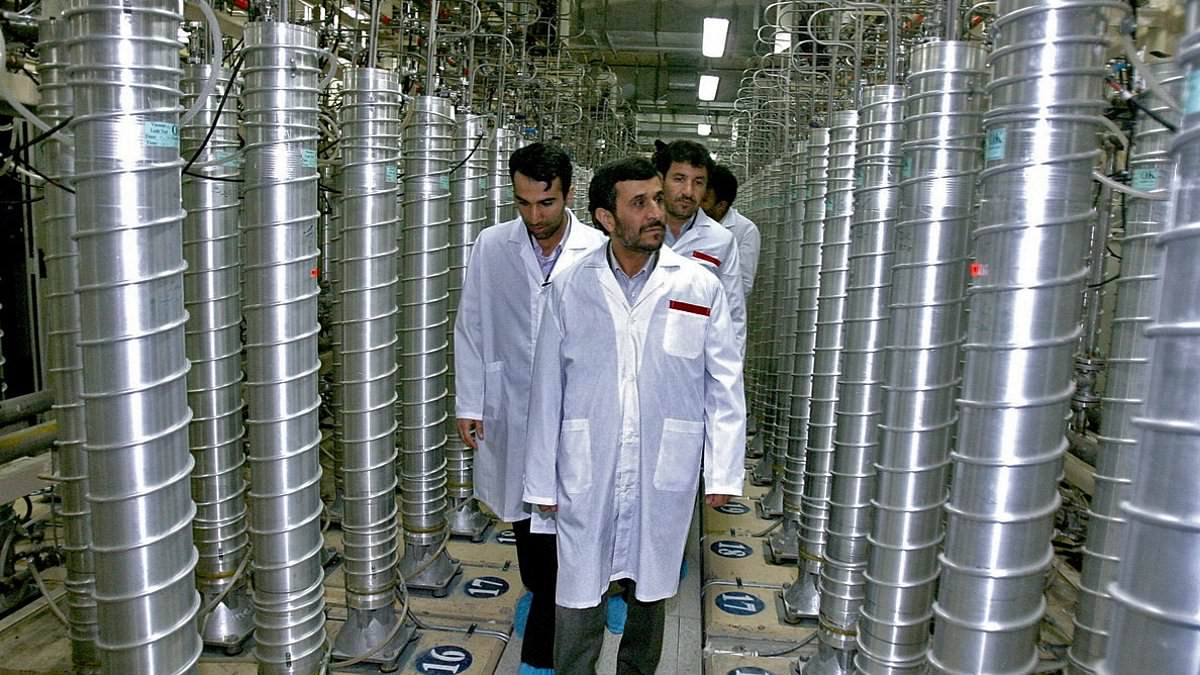
The Natanz Nuclear Facility, pictured, Iran’s main uranium enrichment site, includes underground enrichment halls and advanced centrifuges used to produce uranium enriched up to 60 percent
One of the central aims of last year’s strikes was to prevent Iran from developing a nuclear weapon.
But the attacks also complicated efforts to track highly enriched uranium – a problem now confronting military planners.
Publicly, US officials have projected confidence that they know where the material is stored. Privately, officials briefed on the matter say the certainty is lower.
Before the conflict, inspectors from the Vienna-based International Atomic Energy Agency observed sustained activity near underground tunnel systems carved into a hillside outside Isfahan, where the uranium was last documented.
That activity, diplomats familiar with the agency’s assessments said, raises the likelihood that at least part of the stockpile was relocated.
Roughly 441 kilograms (972 pounds) of highly enriched uranium were stored at the complex – material sufficient for about a dozen nuclear warheads if further refined.
US officials have put the estimate at 11 bombs. Iran also holds more than 8,000 kilograms of uranium enriched to lower levels that could be upgraded if enrichment capacity is restored.
American and Israeli officials are actively searching for the highly enriched stockpile and have prepared contingency plans that include special operations deployments if its location is confirmed, according to one official familiar with the discussions.

U.S. and Israeli forces struck key Iranian nuclear facilities – including Natanz, pictured, Fordow, and Isfahan – during last June’s 12-day war, complicating efforts to track the location of Iran’s uranium stockpile

Israeli airstrikes last June destroyed the Pilot Fuel Enrichment Plant at Natanz, a multi-story hall with 1,700 centrifuges enriching uranium close to weapons grade. Pictured, the uranium conversion facility at Isfahan
A senior Trump administration official said on March 3 that Washington had two potential pathways to neutralize the uranium.
If US forces controlled the territory, specialists could be sent to dilute the material on site and dispose of it safely. Alternatively, the uranium could be removed from Iran and handled elsewhere.
Earlier reporting by Semafor said a special operations raid to seize the stockpile was under consideration, while Axios reported that the US and Israel were evaluating potential ground missions to secure it.
Trump stopped short of confirming any troop deployment but has not ruled it out.
He said he did not want to discuss ground forces, adding they would be used only ‘for a very good reason’ and that Iran would need to be so ‘decimated that they wouldn’t be able to fight at the ground level.’
The US military has drafted detailed incursion plans before.
Decades ago, in the wake of the American embassy hostage crisis, planners developed Project Honey Badger, a concept that envisioned airlifting roughly 2,400 special operations troops aboard more than 100 aircraft into Iran.
The plan included heavy excavation equipment, including a bulldozer, in case forces needed to retrieve buried nuclear material.
First, however, the uranium must be located and it is quite possible the uranium could be dispersed and concealed indefinitely.
US estimates suggest the material could fit inside roughly 16 cylinders about 36 inches tall, comparable in size to large scuba tanks, each weighing about 25 kilograms, light enough to be transported by vehicle or potentially by hand.

A satellite image shows a historical view of the Natanz Nuclear Facility in Iran

Before the war, Iran’s nuclear program was the most heavily inspected in the world, with IAEA monitors averaging more than one visit per day to declared facilities
Before the war, Iran’s nuclear program was the most heavily inspected in the world, with IAEA monitors averaging more than one visit per day to declared facilities.
That access ended after strikes hit major enrichment sites at Fordow and Natanz, along with the uranium processing center in Isfahan.
Even before the latest fighting, Tehran had signaled it was prepared to take extraordinary steps to safeguard the material.
‘The agency should not expect safeguard measures to be implemented under such wartime conditions as if hostilities had not occurred,’ said Reza Najafi, Iran’s envoy to the IAEA.
Iran had previously indicated it was open to reducing or exporting its highly enriched uranium as part of a broader diplomatic agreement. That pathway collapsed when the latest round of fighting halted negotiations.
With diplomacy stalled, Washington and Jerusalem have intensified reviews of military contingencies, including the possibility of inserting ground forces to retrieve nuclear material, according to a European official familiar with the planning.

A satellite image taken on Saturday shows a closer view of a destroyed vehicle at the Pickaxe Mountain facility in Natanz, Iran
The extent of damage to Iran’s enrichment infrastructure remains uncertain.
Even if facilities were severely degraded, the existence of weapons-grade material outside monitored sites presents a continuing risk.
Most analysts. including within US intelligence agencies, assess that Iran has not decided to build a nuclear weapon, and the IAEA has not detected a structured weapons program.
The Institute for Science and International Security estimates the probability that Iran chooses to develop a weapon remains below 50 percent.
But the death of Supreme Leader Ayatollah Ali Khamenei in the opening hours of the war has triggered a succession process that could reshape Tehran’s nuclear position.
Khamenei had issued a religious decree opposing nuclear weapons development; a successor could revise that stance.
Iran, joined recently by China and Russia, has said that ‘a sustainable diplomatic solution’ remains possible, according to remarks delivered at the IAEA.
Recent comments from Trump, however, indicate the administration is prepared to pursue its objectives through military means if necessary.
Meanwhile, the human toll continues to rise. United States Central Command announced on Sunday that a US service member died from injuries sustained during the opening days of the conflict, bringing the American death toll to seven.